
Why community, relationships, and human networks are the most durable moats in business.
Victoria Mariscal
Head of Operations
Community is the most underestimated and overused word in business today. I wish I could say that people don't talk about it. No, that’s not the issue here. The issue is that they talk about it constantly, but the meaning and impact itself seem intangible on a good day. We see this buzzword on their pitch decks, brand guidelines, about pages, yes, what does it all boil down to in a world where people are overstimulated and tired of endless group chats, messenger apps, and email threads?
When your entire life operates through a screen, what’s left of you that actually helps you feel understood? Connected? Real?
The tech world has spent the past few years optimizing for speed. Ship faster. Scale faster. Automate faster. Don’t get me wrong, I get it, as a business owner in my own right I am constantly looking for ways to optimize for the bottom line.
What we forgot in our efforts to eliminate man hours is that we lost sight of what makes business matter. It’s who you are doing business with.
There’s no way to automate yourself.
Your personality, your charm, your unique angle to tackle certain conversations.
Automate automate automate.
But how can you automate the relationships? The rooms? The IFYKY moments life can’t quite plan a Claude Routine around.
You see, the person who picks up the phone because they actually know you doesn’t go away.
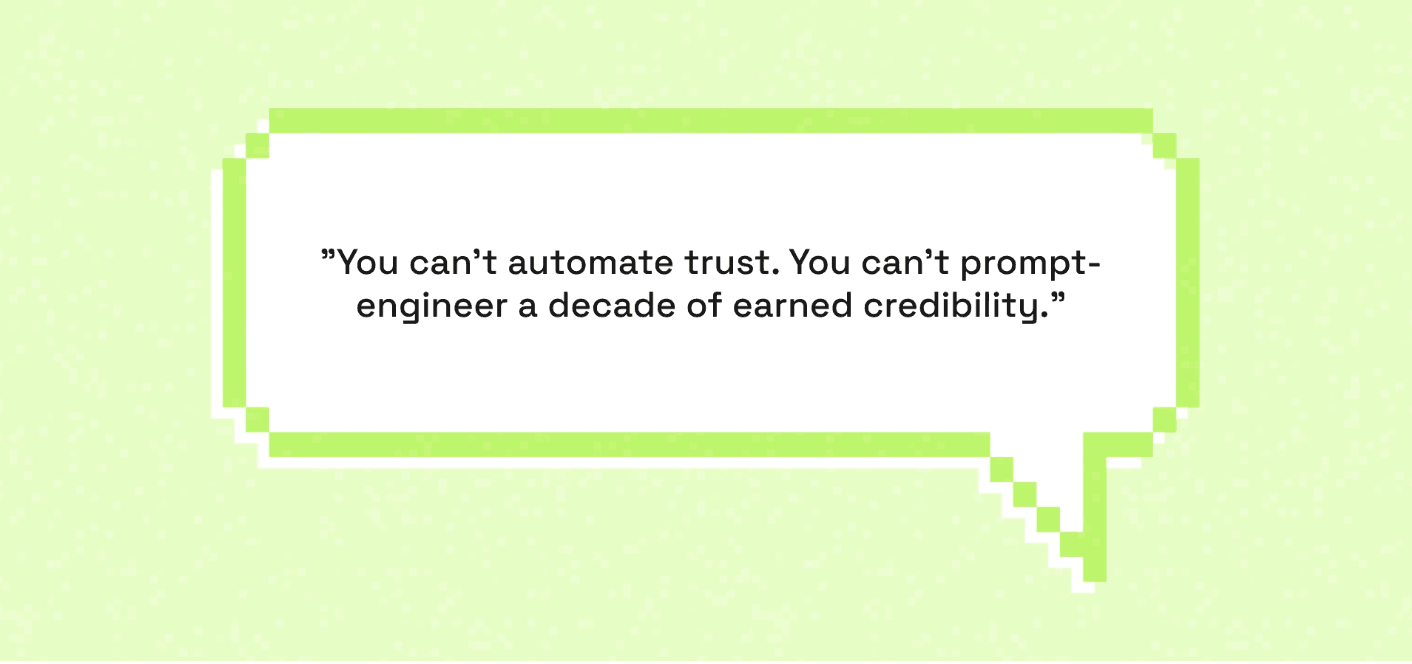
You can't automate trust. You can't prompt-engineer a decade of earned credibility. You can't deploy a model that knows, at 2am in Singapore, which person in your network is the right call for this specific problem.
That's the moat everyone forgot to build. It's the only one that has survived everything we have been through, and will outlive everything we are currently living and will live to see. Community is not engagement. It's infrastructure.
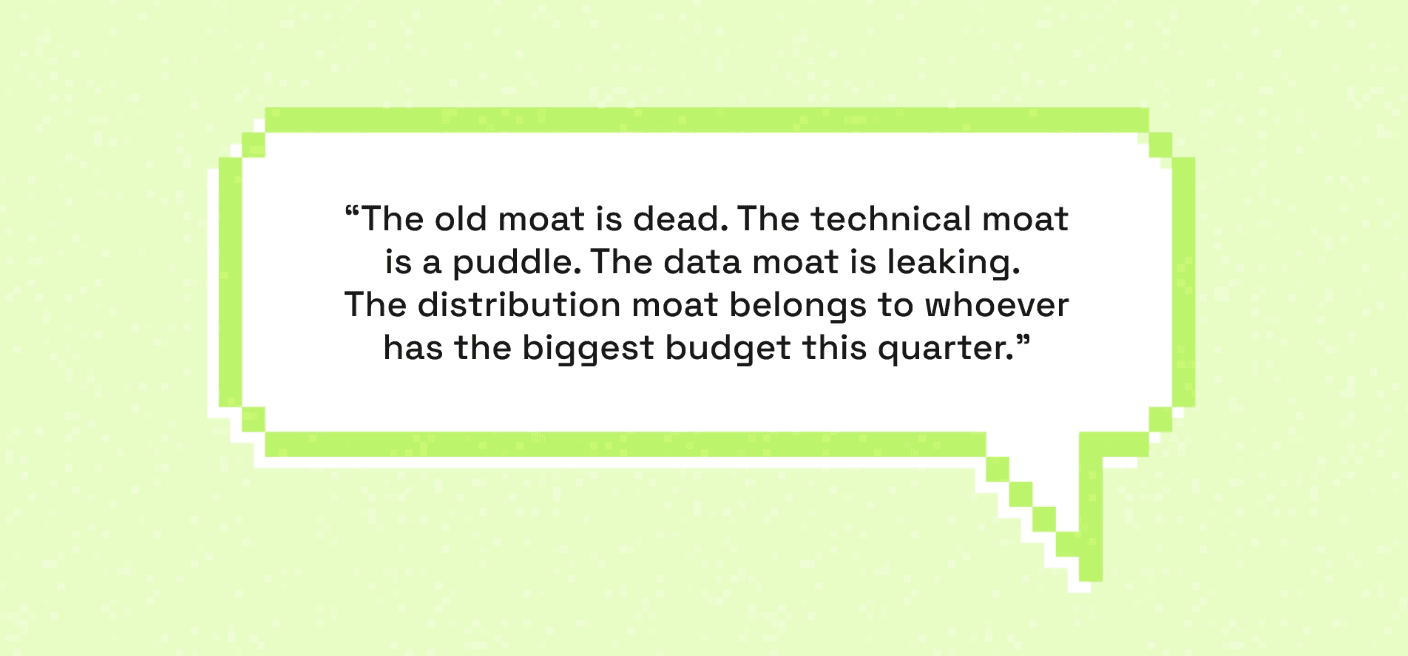
Every few years, someone declares that a new technology has changed everything. The playbook resets. Old advantages evaporate. Companies that built their identity around a feature, a platform, or a first-mover edge find out that none of it was as durable as they thought.
The crypto winter came. Then came another one. Then AI arrived and the narrative around what a competitive advantage even looks like collapsed almost overnight. One Forbes contributor put it plainly: a technical advantage only matters if it's structurally hard for competitors to replicate, and in the age of AI, the replication speed is faster than most companies can build. As technology commoditizes, what remains is the harder-to-copy stuff.
Here's what I know for sure: the hardest thing to copy is a room full of people who actually trust each other.
That's the bet Myosin made when we started. Not a bet on a platform, a tool, or a proprietary process. A bet on the network. On the humans inside it. On what becomes possible when people with real expertise, real relationships, and real stakes work together toward something they actually believe in. We're not an agency. We never have been. We're a network, and that distinction has saved us every single time the industry tried to eat itself.
There's a version of community that looks like a Discord server with 10,000 members who have never met each other. It generates likes and amplification and the appearance of belonging. It's also completely hollow, and competitors can spin up an identical one in 90 days.
What we built is different. Myosin is 110+ active members across six continents, organized by expertise, functioning as a living talent network and product studio. These are practitioners who have shipped campaigns in Seoul, raised token rounds in Dubai, built DeFi protocols with the largest institutional players in New York, and run DevRel hackathons in Singapore, all operating inside the same community infrastructure. When a client comes to us with a problem, we don't staff it from a recruiter database. We pull from a network where the people already know each other, have already worked together, and have already earned each other's trust.
That's not a product feature. That's years of relationship capital, compressed into operational speed.
When you invest in community and nurture relationships with members, it becomes a powerful moat precisely because it can't be copied on a timeline that matters. We've survived crypto winter twice. We've watched agencies collapse, networks dissolve, and platforms pivot into irrelevance. We didn't survive by being the fastest or the cheapest. We survived because we had a community that didn't go anywhere when the market turned. People stayed. They referred each other work. They built things together when clients weren't paying. That's the behavior of a real network, not a managed audience.

The analog signal in a digital world
There's something happening right now that the market is under reacting to. After years of digital saturation, people are actively pulling back. Gen Z is buying disposable cameras. Millennials are bringing back vinyl. Younger consumers are spending on experiences that create friction on purpose, because friction now reads as authenticity. That broader shift toward offline, tangible, and human-centered experience has been framed as a correction to digital trust erosion.
What's emerging from this shift isn't a rejection of technology so much as a renegotiation of its terms. People are signaling that convenience without consent is no longer a universally winning proposition, and that the next era of innovation may be judged as much by restraint and human fit as by raw capability.
That signal matters for how we operate and for why community-led organizations are going to outperform in the next cycle. The value of a trusted human relationship, one you've built over time, one that exists in real space and not just a thread, is appreciating. Not because people have gotten sentimental. Because the alternative has proven inadequate.
We've always operated with this in mind, even before we had language for it. Our events aren't just activations. They're the physical expression of the network. KBW, Token 2049, DAS London, Breakpoint: these are places where the community shows up in the same room and the trust compounds. You can't automate that. You can't prompt-engineer it. It requires proximity, repetition, and real investment in the people on the other side of the table.
The human layer is where the value lives
The product advantage in AI compresses fast. What doesn't compress as quickly is the team that can keep building the next one. The relationship is the moat.
That framing describes exactly what Myosin is at its core. We've always been a talent network first. The products, the services, the client work: all of it flows through the network. When AI compresses the cost of execution, the network becomes more valuable, not less, because the network is what decides which direction to run in, who to trust, and where to put real energy.
The founders who are winning right now aren't the ones with the best job descriptions. They're the ones who got close to the right people before they needed to hire them.
That's us. We spent years building relationships with practitioners in growth marketing, brand strategy, content, DevRel, product, and events across every major Web3 market. When clients need to move fast, we don't scramble. We call on the network. The network picks up.
What it means to be a product studio and a community at the same time
Myosin isn't just a service company anymore. We're a product studio. Hivemind is proof of that. So is the infrastructure we've built internally around talent operations, client strategy, and community health. We're building the tools that help the network work better, and we're doing it in the same spirit that built the network in the first place: by listening to the people inside it, not by reverse-engineering what the market says it wants.
The question I get asked sometimes is whether that creates tension. If you're a community, why are you also building products? My answer is: they're not in tension. They're the same thesis. The community told us what to build. The products make the community more valuable. That flywheel has been the pattern in every company that has figured this out.
Active communities surface problems that products can solve. Members share what's broken, what's missing, what would actually help. Every product we've built at Myosin started as something the network was already trying to do manually. That's not a coincidence. That's the advantage of community-first design, and it's the thing that keeps us ahead of organizations that start with the product and bolt the community on later.
What comes next
The next era of business will reward the organizations that figured out early that the real asset isn't the tech stack. It's the trust layer. It's the people who built relationships that outlast market cycles, tool cycles, and hype cycles.
We've been that organization since before it was the correct framing. We survived the winters because the community didn't dissolve when the floor dropped out. We were two steps ahead of the pivots because our network spans six continents and gives us signal before it becomes consensus. We built products because the community told us what was missing.
None of that was an accident. It was the output of a genuine, sustained investment in people over platforms.
Myosin has been building that structure since day one. The market is finally catching up.


