Learn how DATs are becoming the blueprint for how institutional capital enters Ethereum.
Simon Yi
Co-Founder Myosin
Nov 28, 2025
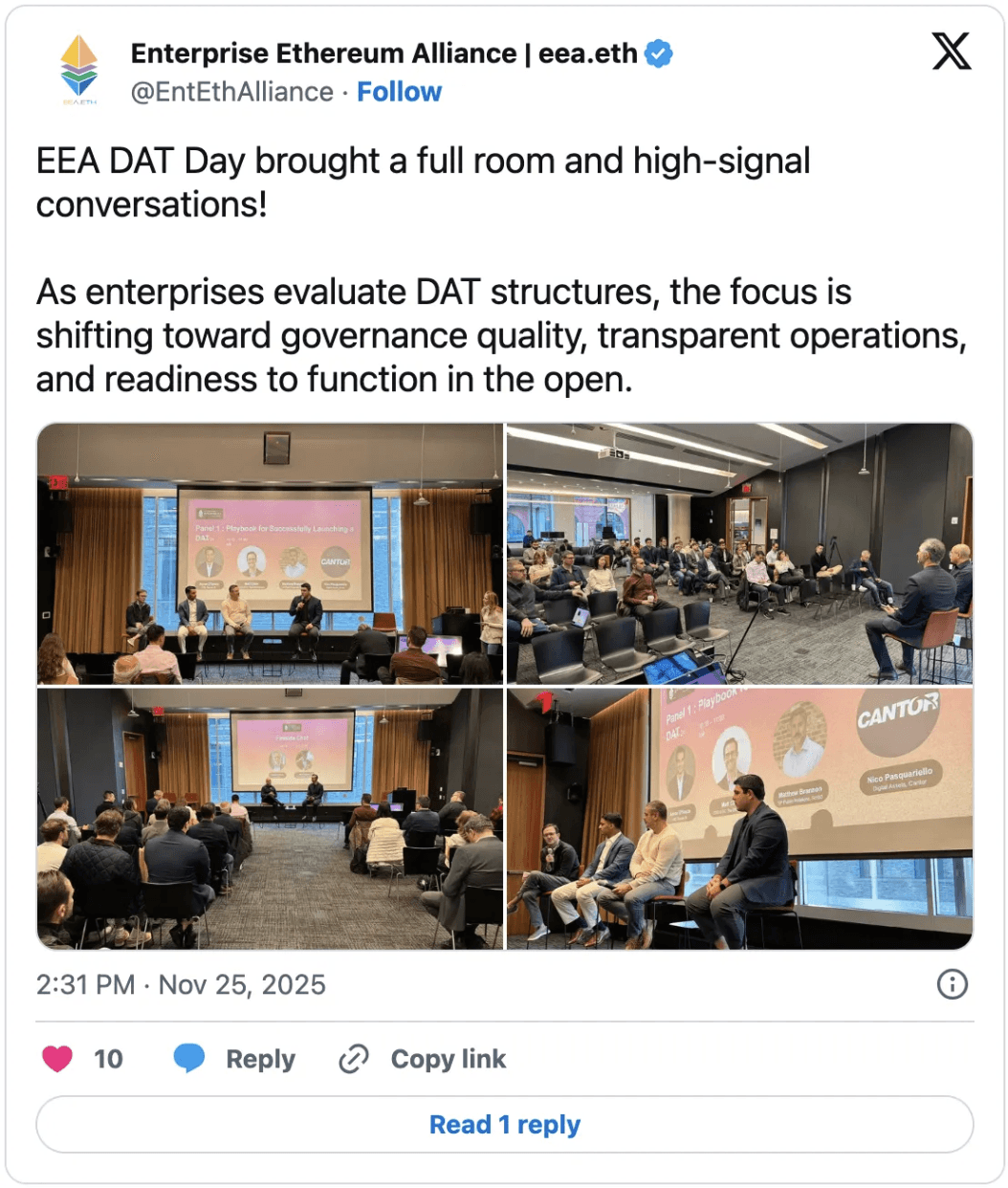
Last week at the Enterprise Ethereum Alliance's DAT Day in New York, something remarkable became clear to me: Digital Asset Treasuries (DATs) aren't just a crypto experiment anymore, they're becoming the blueprint for how institutional capital from Wall Street will enter Ethereum at scale.
The speaker roster told the story: executives from Cantor, FalconX, Validation Cloud, and publicly-traded DAT operators themselves. These aren't crypto natives evangelizing to the converted. These are traditional finance operators building the infrastructure for what comes next.
The Perfect Storm for DATs
We're standing at an inflection point that makes DATs not just attractive, but necessary. Traditional markets face a liquidity crisis as more companies choose to stay private, not enough returns to LPs from venture funds and the AI bubble showing signs of strain. Companies with astronomical price to earnings multiples and mounting short positions against names like NVIDIA signal a market searching for quality assets with real utility.
MicroStrategy proved the model works. Now, with Ethereum trading at $2,800, arguably the best entry point in years, the path forward is clear.
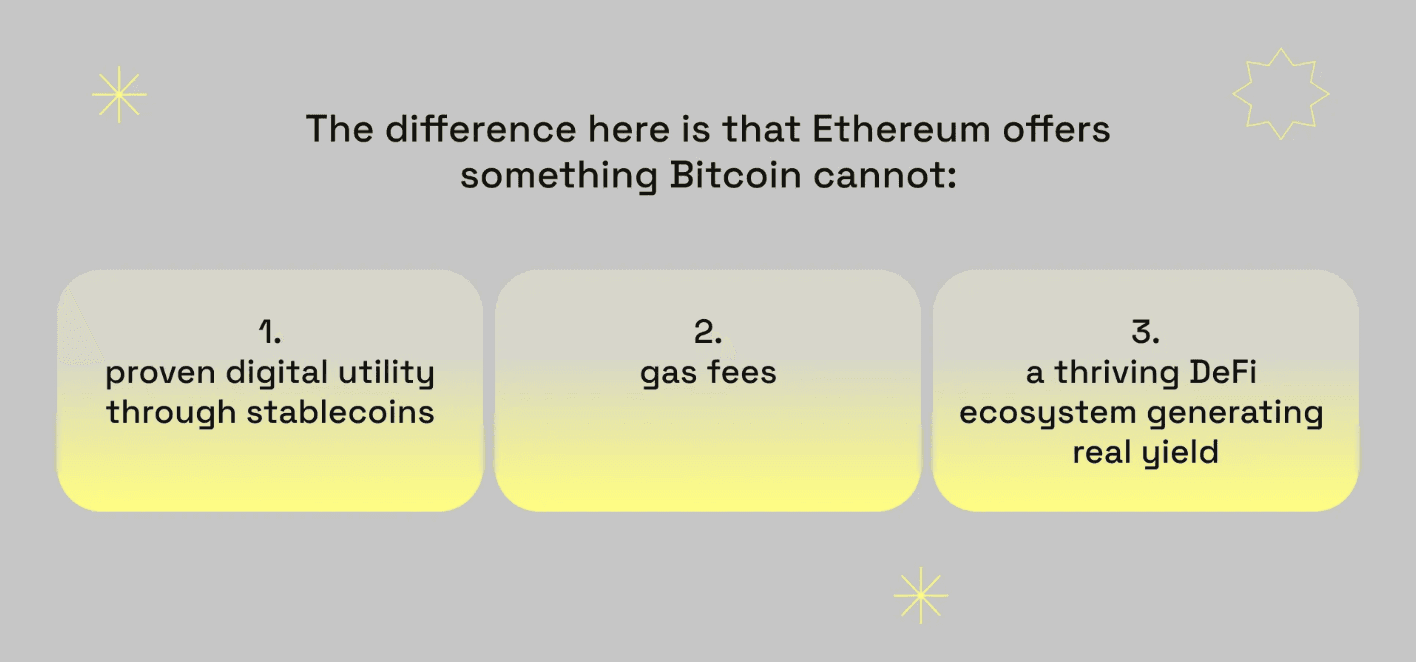
The difference here is that Ethereum offers something Bitcoin cannot:
proven digital utility through stablecoins
gas fees
and a thriving DeFi ecosystem generating real yield
Why Traditional Finance Needs Ethereum Now
Consider the economics: It costs $10 trillion to move $700 trillion around the world annually. Settlement times vary wildly… T+2 in Asia, T+1 in Europe… each discrepancy representing friction and cost. By comparison, Ethereum's 12-second finality makes this look archaic.
BlackRock's BUIDL fund success has lit a fire under every asset manager’s seat right now. Tokenization isn't experimental anymore; it's absolutely critical. When you tokenize a stock, you finally know who owns it and who interacts with it. Brokers like Robinhood, E-Trader or Fidelity don’t tell finance professionals who is holding which stock. With tokenized equities, you can trade without broker dependency. Ethereum unlocks new business models with this level of transparency.
For Asia, where retail crypto adoption in markets like South Korea drives fundamental inflows, DATs represent the most effective go-to-market strategy for bringing institutional-grade products to retail investors through traditional roadshows. As of now, there is no specific legislation or regulatory guideline in Korea that explicitly covers decentralized finance (DeFi) platforms such as EigenLayer, so Korean citizen take on material risk by participating in DeFi. With DATs, they can participate in the upside of actively managed digital asset treasuries without taking on this regulatory risk.
The DAT Value Proposition
Here's what makes DATs compelling: they generate incremental return without incremental risk. Unlike ETH ETFs that can't fully stake, DAT operators maintain direct custody and can actively manage their digital asset treasuries. This matters enormously when you're managing billions in permanent capital through corporate assets.
The mathematics are straightforward. DATs are perceived as productive when they beat the staking hurdle rate for any given token. Through active management like yield strategies using on-chain protocols, derivatives, covered calls, and protective puts… DAT operators can outperform passive holders while managing volatility through preferred equity and convertible debt offerings. So long as DAT operators are beating the hurdle rate of the staking rewards, you’re doing great.
There's currently $30-50 billion in open interest in Bitcoin options alone. The depth exists to execute sophisticated treasury strategies at scale.
Building and Marketing DATs
The playbook is emerging. PIPE deals (private investment in public equity) enable reverse acquisitions into IPOs using private capital. Due diligence with Big Four accounting firms ensures clean balance sheets. The key is transparency: institutional investors care about clarity in capital structure, as Nico Pasquariello from Cantor Fitzgerald emphasized at the event.
Marketing to institutions means focusing on mNAV (managed Net Asset Value) and growth rate in token-per-share. Forget obfuscated warrant structures. Show how you're beating the staking hurdle rate and building treasury value.
With $48 trillion of fixed income assets priced on traditional yield curves, BlackRock's tokenized treasuries in the BUIDL fund provide the foundation for an entirely new on-chain yield curve.
What's Next
DATs are the tip of the spear. Success requires deep integrations with qualified custodians (QCs) who can connect with DeFi protocols out of the box. We're seeing significant commitments, says some QCs pledging $200M over two years—to make these integrations viable.
Strategic partnerships are accelerating. SBET's alignment with Linea, chosen as the settlement layer for Swift, signals where institutional infrastructure is heading.
The S&P and MSCI may not track DATs yet, but new indices tracking crypto DAT performance are inevitable. 2026 won't be the year Ethereum goes to Wall Street—it'll be the year Wall Street comes to Ethereum, treasury-first.
The only question is whether your organization will lead this transition or watch it happen.


