How stablecoins became financial infrastructure in Africa's largest economy.
Richard Kayode
AI & Content Strategist
Nigeria is the proving ground for how digital money survives real-world economic pressure.
With inflation moderating to the low-20% range by late 2025 after peaking above 33% in early 2024, a naira that has lost more than 50% of its value since 2023, and foreign-currency accounts difficult for most citizens to access, crypto has shifted from speculation to infrastructure. Stablecoins are becoming savings accounts. Peer-to-peer rails are becoming banking networks.
This report explains how and why that transition is happening and what it means for builders, investors, and ecosystem teams entering Africa’s largest crypto economy.
Get the State of Crypto in Nigeria Report
Scale that can’t be ignored
Nigeria leads the continent in real crypto usage.
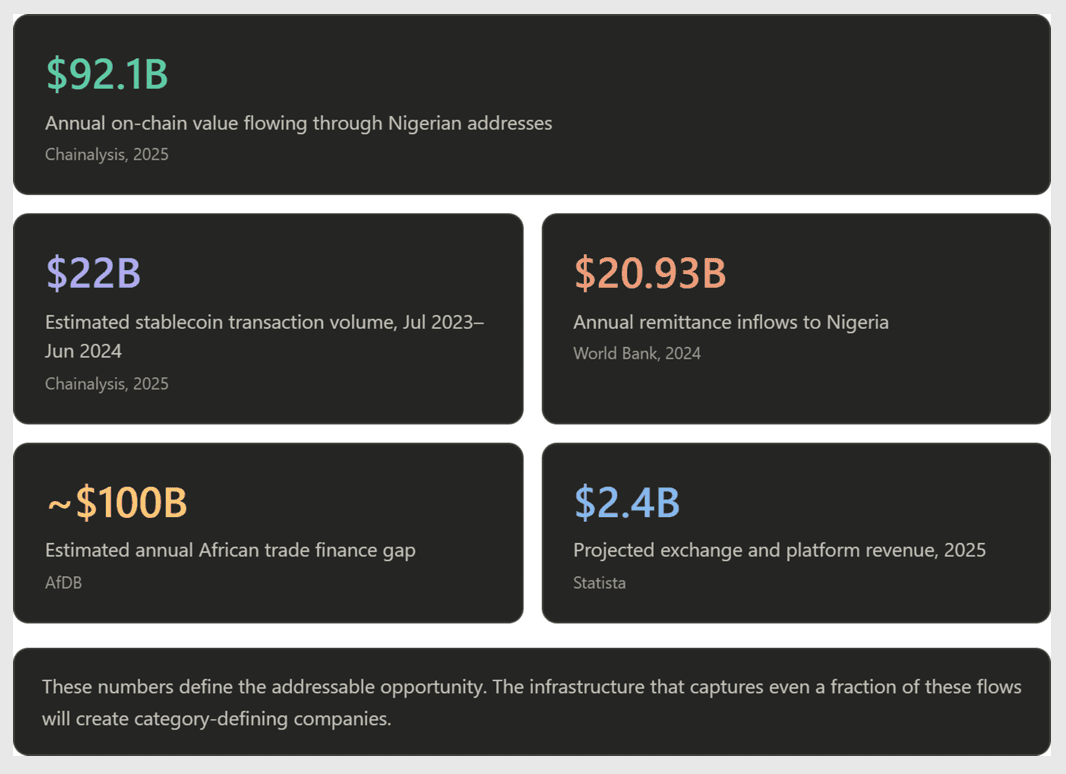
Between July 2024 and June 2025, the country received $92.1 billion in on-chain value, representing nearly 45% of Sub-Saharan Africa’s total activity.
Although Nigeria ranked #6 globally in the 2025 Chainalysis adoption index (down from #2 the year prior), this reflects rising institutional participation in high-income markets, not declining usage locally.
Nigeria remains:
Africa’s largest crypto market
one of the world’s most active grassroots adoption environments
a global signal of how necessity-driven adoption scales
Stablecoins are becoming Nigeria’s shadow savings system
Stablecoins now form the backbone of Nigeria’s crypto economy.
Across Sub-Saharan Africa, stablecoins account for 43% of total transaction volume, with Nigeria alone processing an estimated $22 billion in stablecoin activity between July 2023 and June 2024.
Usage patterns make the shift clear:
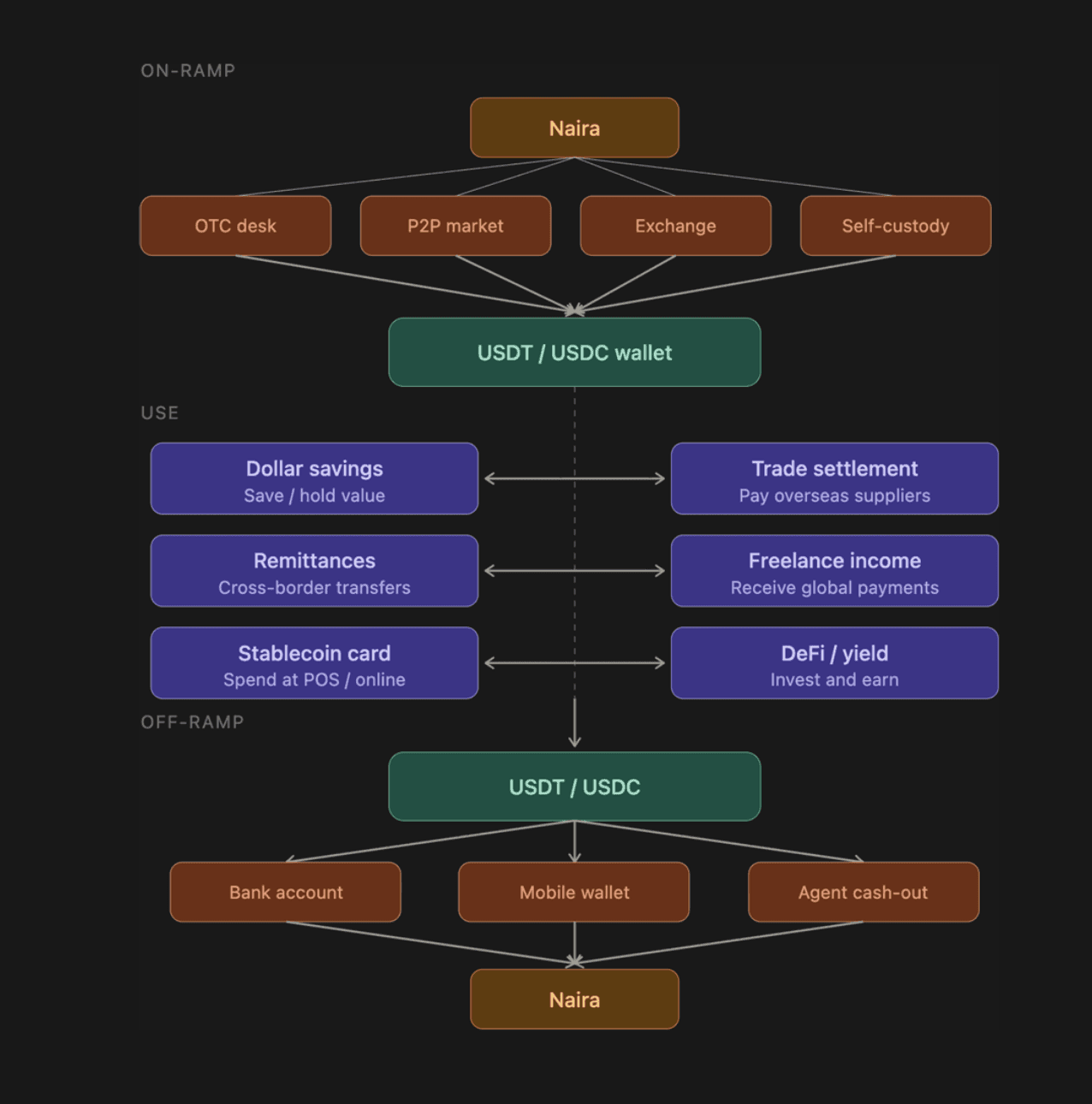
Freelancers receive payment in USDC
Importers settle suppliers through P2P rails
Families convert naira into digital dollars to preserve savings
Survey data confirms this trend:
69% of Nigerian stablecoin users converted local currency into stablecoins
57% increased usage year-over-year
72% expect usage to continue increasing
Saving in dollars is the primary use case.
A young, mobile-native population is building a parallel financial layer
More than 70% of Nigerians are under 30.
Combined with widespread smartphone access and a globally connected freelance economy, this has created the conditions for a parallel financial coordination layer to emerge.
What began as trading activity has matured into:
digital-dollar savings behavior
cross-border settlement infrastructure
informal liquidity routing networks
mobile-native participation in global markets
Crypto is not replacing banks. It is filling the gaps where banks cannot operate effectively.
Regulation is shifting from uncertainty to execution
For years, Nigeria’s regulatory posture toward crypto created uncertainty.
That phase is ending.
The Investment and Securities Act (ISA) 2025 formally recognizes digital assets as securities and establishes SEC authority over exchanges, custodians, and token issuers. The SEC’s Accelerated Regulatory Incubation Program has already issued provisional licenses to platforms including Quidax and Busha.
Meanwhile:
CBN licensing frameworks are evolving
tax obligations are being clarified
compliant infrastructure is emerging
Crypto in Nigeria is entering an execution phase, with regulatory clarity beginning to support the buildout of compliant, durable financial infrastructure.
This is a system people depend on
Nigeria received $20.93 billion in remittances in 2024, yet traditional corridors remain among the most expensive in the world.
Sub-Saharan Africa averages 7.73% remittance fees, with some intra-regional routes exceeding 19%.
Against that backdrop, crypto adoption is rational and supports:
cross-border payments
small-business settlement
freelancer income flows
household savings protection
Nigerians are already responding practically to real constraints in how money moves. The next phase is not convincing people to try crypto, but designing systems they can depend on.
The opportunity is no longer adoption. It is building infrastructure.
Nigeria’s next phase of growth is about building stronger rails for the millions of users already participating in its crypto economy.
Liquidity remains fragmented where SMEs need predictability. Compliance frameworks exist but tooling is still immature. Data visibility remains uneven across regulators, banks, and operators. Platform concentration creates fragility that local licensed infrastructure can help resolve.
These are all builder signals. The next wave of value in Nigeria will come from:
institutional-grade liquidity networks
compliance-first on- and off-ramps
shared visibility infrastructure
stablecoin-native payment layers
products designed for necessity-driven usage
The opportunity is to strengthen what Nigerians already rely on.
Download the State of Crypto in Nigeria report
The State of Crypto in Nigeria report provides a grounded, operator-focused view of one of the world’s most important digital asset economies.
Inside the report:
How stablecoins became everyday financial infrastructure
What is driving necessity-based adoption at scale
Where regulation is moving next
What infrastructure gaps still remain
Where builders, investors, and ecosystems can participate
Download the full report and understand what the future of global crypto adoption already looks like.


