
The Input Layer
Why your AI marketing tools keep producing content nobody cares about
A founder asks AI for help launching their product. They want a marketing plan. Channels, content, outreach. Something to point at and execute.
What comes back: a comprehensive plan with social media, content calendar, and influencer outreach. Thorough. Structured. Ready to execute.
They execute it. Three months later, they have distribution and no retention. They spent their budget getting people in a door that leads nowhere.
The tool answered the question. Nobody asked the right one first.
"Before we talk launch, what's your retention loop? Because 80% of projects at your stage blow their budget on distribution to people who forget them in a week. Let's figure out what makes someone stay before we figure out how to get them in the door. What happens after someone signs up? Walk me through the first 72 hours."
That question does not come from a model. It comes from a practitioner who has watched the same mistake play out across forty different launches.
That is what a different question looks like. Not a better answer. A better question. And the gap between those two things is not a model problem. It is not a prompt engineering problem. It is a judgment problem. Judgment cannot be retrieved from the internet. It has to be encoded from people who have done the work.
AI Tools Are Optimizing the Wrong End of the Pipe
The AI marketing tool industry has built at the wrong end of the pipe.
Every tool is a wrapper around a frontier model with dashboards, templates, and workflow automation layered on top. The promise is that connecting the model to your data, your brand guidelines, your past content, will produce better output. And it does. Marginally. Because the constraint was never the model's knowledge. The model already knows marketing. It knows positioning frameworks, copywriting principles, how campaigns are structured, what good GTM looks like across dozens of categories.
What it does not have is the judgment to know when the entire frame is wrong.
When a founder shares their deck and asks Claude to write landing page copy, the model processes everything and produces: "Welcome to [Product]! We're excited to offer you an innovative solution that helps you achieve your goals with our cutting-edge features..."
The founder has given the model everything. The model has produced nothing usable. Adding more context helps marginally. The output is still generic. Still interchangeable. Still something a competitor could swap their name into and it would work just as well.
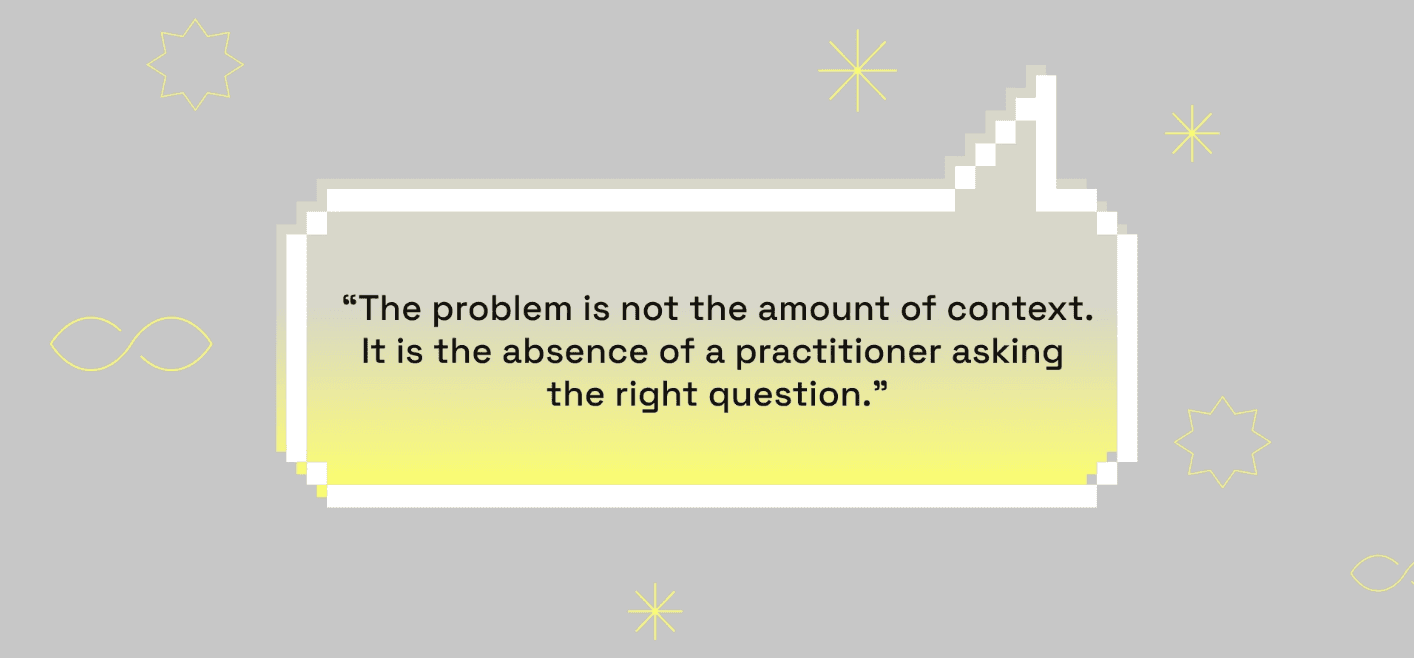
The problem is not the amount of context. It is the absence of a practitioner asking the right question before the model writes a single word.
"Your landing page is describing what you built. Nobody cares what you built. They care what changes for them. Right now you've got six feature bullets and zero tension. The rule: if your competitor could swap their name into your hero section and it still works, your positioning is broken. Who specifically is this for, and what are they failing at today without you?"
That is not more information. That is a different question entirely. The kind of question that takes years of pattern recognition across dozens of failed launches to know to ask.
Practitioners Don’t Just Answer Questions. They Reframe Them.
This is what practitioners bring that models cannot simulate: the mental models, the scar tissue, the willingness to challenge assumptions rather than confirm them.
A founder reports their community is not engaging. The model suggests AMAs, Discord channels, consistent posting, giveaways. All reasonable. All wrong. "You don't have an engagement problem. You have a belief problem. Your community doesn't know what they're building toward, so there's nothing to engage about. How many of your members could explain why your project matters in one sentence? If that number is close to zero, no amount of AMAs will fix it. Let's build the narrative anchor first."
A founder asks how to get more followers. The model optimizes for distribution. "Wrong question. You have 4,200 followers and your last twenty posts averaged three replies. That's not a reach problem, it's a resonance problem. You're optimizing distribution for content nobody cares about. What's the most controversial opinion you hold about your market that you've been too cautious to post? Start there."
A founder asks about positioning. The model produces a framework. "Tell me what happens if your project disappears tomorrow. Who notices? What breaks for them? If you can't answer that sharply, you don't have positioning yet. You have a description. Positioning lives in the gap between what your audience believes today and what you need them to believe to choose you. What do they currently believe that's wrong?"
In every case, the model answers the question. The practitioner reframes it. That reframe is not something you can prompt into existence. It comes from having seen the same failure mode across different markets, different stages, different categories. It lives in the space between what someone asks and what they actually need. A space that only experience teaches you to navigate.
The Real Leverage in AI Marketing Happens Before Generation Starts
The frontier models are largely equivalent now. At the level of raw capability, the differences are marginal for most marketing tasks. Which means the value is not in which model you use. It is in what gets encoded before the model generates a single token.
This is the input layer. And it is where all the leverage lives.
Most AI marketing tools are optimizing the output layer. Better templates. Better workflows. Better formatting. None of that addresses the constraint. The constraint is always the judgment that precedes generation. Who is asking the right question. Who knows which assumptions to challenge. Who has the pattern recognition to spot the real problem inside the stated one.
That judgment has to come from somewhere. It does not emerge from training on marketing documentation. It does not appear in a prompt template. It accumulates in practitioners over years of real work, in the form of mental models that become instinctive, frameworks that get applied before anyone opens a brief, and the confidence to tell a founder they are solving the wrong problem.
HiveMind is built at the input layer.
Not a wrapper. Not a dashboard over a frontier model with brand guidelines bolted on. A system that encodes the judgment of sixty-five senior marketing operators before anything gets generated. Real frameworks from real campaigns. The thinking that knows when to reframe the question, when to challenge the assumption, when the problem stated is not the problem that needs solving.
The model handles generation. The practitioners handle judgment. That is a different architecture than anything else in the market, because it is building at the right end of the pipe.
Generic AI gives you content. Strategy requires judgment. And judgment has to be encoded somewhere.


