
As AI enters every workflow, the real advantage shifts from output to judgment, trust, taste, and human agency.
Simon Yi
Co-Founder Myosin.xyz
Jun 16, 2026
We are all becoming cyborgs now.
Not in the sci-fi sense with metal arms and glowing eyes, but in the way we work and inside the workflows we already live in.
AI has moved from the side tab into the work itself. It is becoming part of the operating layer for how companies communicate, decide, sell, and build.
For founders and operators, this is already changing the pace of execution. The best teams are faster than they were a year ago. They can synthesize more information, produce more variations, test more angles, and move from idea to execution with less friction.
That part is real.
But the more important question is not whether AI makes us faster. It is what happens when everyone becomes faster.
When everyone can produce, judgment wins
When every team can generate more content, more analysis, and more assets, output stops being the advantage. Production costs become a race to the bottom and speed becomes table stakes. The bottleneck moves somewhere else.
It moves to judgment, taste, trust, and the human context behind the work.
That is the part of the AI conversation that still feels underdeveloped. We keep talking about how much work AI can do for us, but we spend less time asking which parts of the work still need to be led by us.
There is a tension now between the person and the machine. The machine can draft, summarize, classify, remix, and recommend. It can sit inside the workflow and make the next action feel obvious.
But obvious is not always right.
The machine does not know what kind of company you are trying to become. It does not know what your customers are afraid to say out loud, or which message will feel hollow because the market has already heard it from twenty other teams.
The machine can assist with the work, but that does not mean it should steer the ship.
The human edge is not anti-AI
The human edge in the age of AI is not about refusing the tools. That is not a serious position for anyone building in this market. The operators who learn how to use AI well will have more leverage than those who do not.
The real issue is whether we use AI to amplify human agency or slowly outsource the qualities that make the work valuable.
The best entrepreneurs are not just fast. They see what other people miss, feel what the market is telling them, and build trust with the people they need to bring along. They know when a message has energy, when a strategy is too thin, and when the team is moving quickly without actually learning.
That does not come from adding more automation. It comes from creativity, empathy, and judgment applied over time.
AI can help a founder write the first draft, but it cannot tell them what they actually believe. It can help a marketer generate ten campaign angles, but it cannot know which one carries the emotional truth of the product. It can summarize a customer call, but it cannot always feel the hesitation in someone’s voice when they say they understand the product but clearly do not.
AI can help a company communicate more often. Humans still need to build the trust that makes communication land.
Business still moves at the speed of trust
AI-generated work is about to become the default.
More emails, posts, websites, decks, scripts, replies, and reports will be generated. Some of it will be useful. A lot of it will be technically fine and strategically empty.
The market will feel that.
Buyers already feel it when a message sounds polished but disconnected from their actual problem. Communities feel it when a brand shows up with content but no presence. Founders feel it when a deck has the right words but no conviction underneath them. Teams feel it when AI creates more work to review instead of better decisions to act on.
This is why the human layer becomes more important, not less.
The output is easier, but the taste is harder. The message can be generated, but the trust still has to be earned.
That is the shift every AI-enabled team has to understand. The value is not in producing more generic work with better tools. The value is in building systems where AI improves the quality of learning, deciding, and executing without erasing the human context that makes those decisions good.
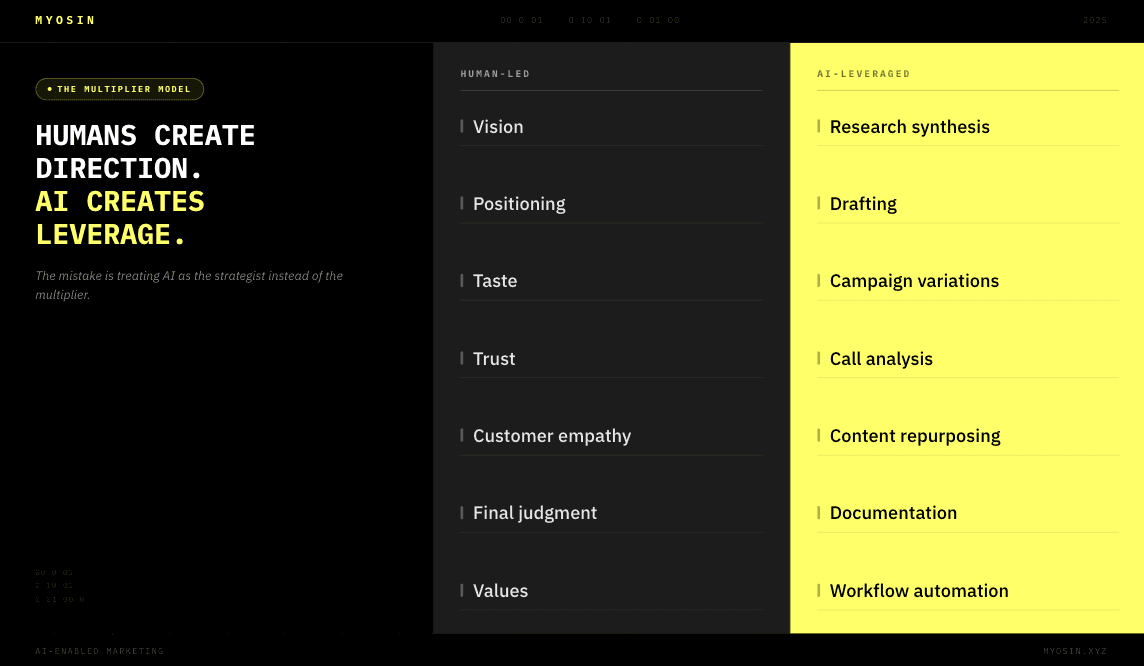
Humans create direction. AI creates leverage.
The useful mental model for founders is simple: AI creates leverage, but humans create direction.
The mistake is treating AI as the strategist instead of the multiplier. AI can help you move faster, but it cannot decide what kind of company you are trying to build, what customers should trust you for, or which tradeoffs are worth making.
The work that defines the company still has to be human-led: vision, positioning, taste, trust, values, customer empathy, and final judgment. Around that layer, AI can create enormous leverage. It can synthesize research, analyze calls, repurpose content, and help teams execute with more consistency.
But when those layers get flipped, the company gets faster without getting sharper. It produces more without becoming more trusted.
The question for founders is not just, “Where can we use AI?”
It is, “What must remain human-led, and where can AI give that human judgment more leverage?”
That question cuts through the noise. If AI helps clarify the founder’s actual thinking, capture customer insight, improve decision quality, and turn scattered context into execution, it is amplifying human agency. If it creates generic content, synthetic presence, shallow personalization, and faster output with less conviction, it is flattening the company.
The wrong AI future strips dignity
There is a darker version of this future, and we are already seeing glimpses of it.
Workers are being paid extra to wear sensors while they do manual labor, training humanoid robots on the movements that make their work possible. On the surface, it looks like another transaction. A company needs data. A worker gets compensated for their time. The machine gets trained.
But there is something uncomfortable underneath it.
There is a price being placed on knowledge that may eventually be used to replace the person providing it. There is a short-term incentive attached to a long-term loss of leverage. At some point, the question stops being only economic and becomes a question of dignity.
This is part of a much larger dialogue beginning to take shape around AI, ethics, and the future of human work. The question is not simply whether AI can make systems more efficient. It is whether those systems preserve the dignity, agency, and creative role of the human beings inside them.
When people become inputs for systems they do not control, something important gets stripped out of the work. Their skill becomes training data. Their movement becomes a model. Their experience becomes an asset captured somewhere else.
That is not the future of abundance most of us want.
The better AI future amplifies agency
The better version requires people to become much better at using AI, but in a way that strengthens human agency instead of weakening it.
AI should help people build more, learn faster, coordinate better, and make sharper decisions. It should give small teams leverage that used to require entire departments. It should help founders turn messy context into strategy, operators turn signals into systems, and communities turn shared goals into coordinated action.
But that only works if humans stay responsible for the direction.
This is where the trust question becomes unavoidable. If AI is going to produce more of the world’s content, decisions, agents, and economic activity, we need better ways to verify what is real, who said what, where something came from, and who benefits when value is created.
Digital abundance without trust becomes noise. Without provenance, it becomes confusion. Without aligned incentives, it becomes extraction.
This is why blockchains matter in the AI conversation, but not as a forced narrative or another trend to staple onto the deck. They matter because the more AI expands what people and machines can do, the more we need trust rails underneath the systems coordinating that work.
If we want to trust AI, we need ways to verify outputs, identity, provenance, and value flows. If we want to trust people, we still need what we have always needed: shared context, repeated interaction, real relationships, and communities organized around something that matters.
The future will need both: digital systems that make trust easier to verify and human environments where trust can actually form.
The machine should not drive
That is the world we are building toward at Myosin.
Not a world where AI replaces the operator, the marketer, the founder, or the community. A world where people who understand the work can use AI to compound intelligence, coordinate execution, and create more abundance with better guardrails.
In the age of AI, the teams that win will not simply be the ones that produce the most. They will be the ones that know what is worth producing. They will know what should be automated, what should be reviewed, what should be protected, and what should remain deeply human.
They will move faster, but they will not confuse speed with strategy. They will use machines, but they will not let machines flatten their taste. They will generate more, but they will still build trust the only way trust has ever been built: through consistency, clarity, judgment, and presence over time.
We are becoming cyborgs. That part is already happening.
The question is whether the machine becomes the driver, or whether we become more capable humans because we learned how to use the machine well.
That choice is still ours.


