How AI Expanded My Skillset Instead of Replacing Me
Victoria Mariscal
Head of Operations
Mar 3, 2026
I was doomscrolling on LinkedIn a year ago, and noticed a common theme — AI is taking our jobs. There were two camps around this, and I personally felt like I stood somewhere in between. The bear market was hot, and the winter was longer than expected. I was working a very mundane Web2 job, and like many of us in the space, took on something stable while I waited on the market to somewhat stabilize. In the meantime, I was dabbling in Web3 more as a side hustle to keep my pulse on how things were moving.
Everywhere I looked, Web3 experts were rebranding themselves as AI experts. It was not subtle and it was not niche. It was taking the media and the job market by storm. Job titles were changing overnight, headlines were shifting weekly, and suddenly AI fluency was being treated as table stakes.
Naturally, I was skeptical. Not because I didn’t believe in the technology, but because the pace of the shift felt almost too fast to be real. Crypto already moved at breakneck speed. We had barely finished explaining NFTs to our parents, and now we were supposed to become fluent in machine learning, autonomous systems, and APIs.
But the more I watched the market, the more obvious it became. This wasn’t a passing trend. This was a structural shift in how work, creativity, and leverage would function going forward.
I had a quiet realization that felt uncomfortable but necessary. If I didn’t get on board and stay ahead of things, I’d be stuck pushing papers around for years to come. I needed to embrace AI skills, not because I thought I’d not be replaced by machines, but because I’d be outpaced by those who stayed curious and moved faster.
What I discovered surprised me. I became obsessed. AI wasn’t going to take my job, it was going to fundamentally change how I worked forever.
It’s expanded my range. It’s compressed time. It allowed me to do more work with more depth and more precision. Strategy that used to take hours now takes minutes. Research that once required dozens of tabs has become contextual and immediate. Creative execution that once stalled behind my lack of skillset or turnaround times happened at the tips of my fingers- finally, what lived in my brain could be seen by the world.
Let me tell you what I am seeing as a marketer this year, and why I think we’re headed this way- and yes, AI helped me write this, to what extent, that’s for me to know and you to guess.
Five AI Predictions for 2026
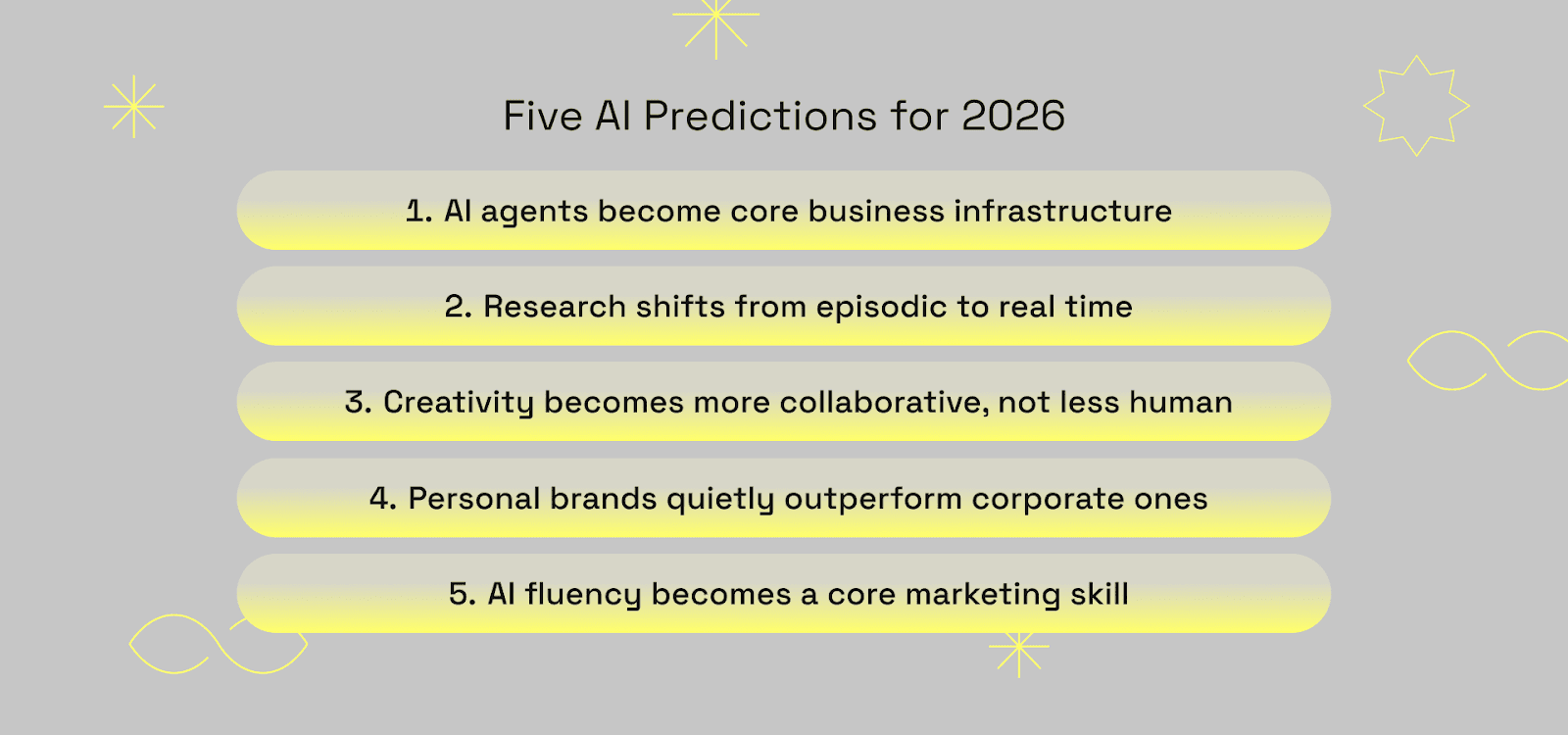
1. AI agents become core business infrastructure
In 2026, AI agents are no longer experimental tools living on the edges of workflows. They are becoming foundational infrastructure. According to IBM’s 2026 AI trend outlook, agentic systems are moving into central business operations, handling multi step tasks across tools and environments without constant human direction. These agents are capable of routing information, executing workflows, and adapting based on outcomes rather than static instructions.
As AI systems act, learn, and collaborate autonomously, governance becomes the architecture aligning machine decisions with human intent.
For marketers, this removes operational friction. Campaigns no longer stall because of handoffs or missed follow-ups. Agents manage the connective tissue of work, which allows humans to focus on decision-making and creative direction.
2. Research shifts from episodic to real time
Research used to be something you scheduled. In 2026, research is continuous. Tools like Perplexity allow marketers to synthesize live information, pull cited summaries, and stay aligned with current narratives without spending hours digging.
In a 2025 a HBR survey of more than 3,000 C-suite leaders we conducted, nearly 9 in 10 (87%) agreed that agentic AI is ushering in a new era of process transformation. Already, two in ten (20%) of those leaders report that their organization is redesigning processes with AI at the core.
This shift matters deeply in crypto, where sentiment, regulation, and community narratives evolve quickly. Real-time research enables a proactive strategy rather than reactive messaging.
Take Perplexity’s model of generative search, for example- it reflects a broader move toward always-on intelligence rather than static reports that age the moment they are published.
3. Creativity becomes more collaborative, not less human
There was early concern that AI would flatten creativity and produce homogeneous output. Research published in early 2026 suggests the opposite. When humans remain in the loop, AI enhances creative range by expanding ideation, iteration, and exploration rather than replacing judgment or taste.
Thus coining a new term: Human-AI co-creativity. Now what does this mean? Essentially, this involves humans and AI operating as partners to produce shared creative work, significantly improving user engagement and perceived reliability when the AI provides active, communicative feedback
The differentiator is no longer the ability to produce content, but the ability to direct systems toward meaningful output. Taste, context, and cultural awareness become more valuable as execution becomes easier.
In practice, creativity in 2026 is less about doing everything manually and more about orchestrating tools with intention.
4. Personal brands quietly outperform corporate ones
As AI lowers the barrier to content production, audiences increasingly gravitate toward people rather than logos. Individuals with clear perspectives and consistent voices are building trust faster than corporate accounts that rely on broadcast messaging.
AI enables this shift by reducing burnout. Individuals can maintain consistency without sacrificing quality. For crypto marketing, where trust is fragile and narratives matter, personal credibility compounds faster than institutional polish. According to Forbes, 72% of businesses have adopted AI for at least one function.
This is not about influencer culture. It is about informed operators showing their thinking in public.
5. AI fluency becomes a core marketing skill
By 2026, AI fluency is no longer a bonus skill. It is foundational. This does not mean understanding model architecture. It means knowing how to collaborate with AI systems, build feedback loops, evaluate outputs, and integrate tools into real workflows.
Marketers who treat AI as a partner rather than a shortcut are creating disproportionate leverage. The gap between AI-fluent teams and traditional teams is no longer marginal. It is structural.
If AI fluency is becoming foundational, the question isn’t whether to learn it, it’s how.
That’s exactly why we built The AI-Enabled Marketer Skool, a hands-on community where marketers learn to build AI workflows, deploy real automation systems, and turn experimentation into infrastructure.
If you’re ready to move from dabbling to building → Join here
The Tools Powering My Day-to-Day
The Sixty Second Design Team
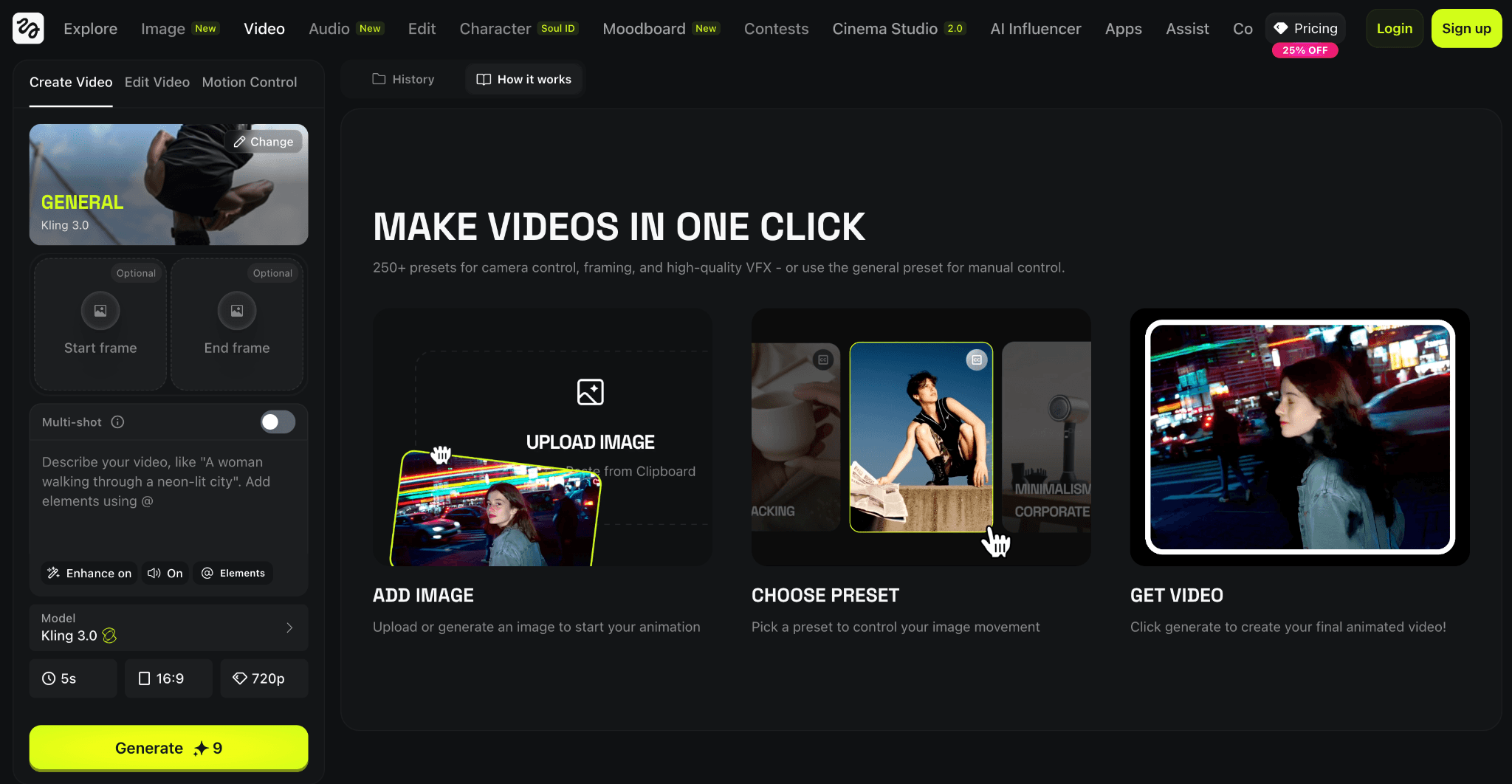
When I need to animate a static post, I don’t wait days for a design handoff. Higgsfield lets me turn still images into motion content in about sixty seconds. That speed fundamentally changes how I think about creative risk. I test more formats, try more angles, and iterate faster because the cost of experimentation is low.
Higgsfield is known for fast AI image and video generation with minimal setup. Pricing ranges from free access to paid tiers that go up to roughly forty-nine dollars per month, depending on usage volume and credits. The value is not just speed. It is momentum.
The Roommate Who Never Runs Out of Ideas
All right, now everyone uses ChatGPT, or as my friend group likes to call it, Chat Daddy, but here’s how I like to jam with it. I don’t take its first output. I’m specific and clear in how I write my strategies. I actually chat with it. We brainstorm campaign concepts, pressure test narratives, explore cultural references, and map out go to market angles. It feels less like delegation and more like mental sparring.
A year ago, I did not know what an API was. Now I casually reference them in campaign planning because this tool lowered the intimidation barrier. I’ll gladly pay $20 bucks a month for a tool that saves me hours.
The Research Assistant That Never Sleeps
Perplexity changed how I research. Instead of opening dozens of tabs, I get cited summaries and context in minutes. That directly improved my newsletters and long-form thinking. They are sharper, more current, and more confident.
Perplexity is known for AI-powered search with source attribution and real-time synthesis. It offers a free tier and a Pro plan, typically around twenty dollars per month, which includes deeper search, file uploads, and enhanced capabilities. It compresses research time without sacrificing depth.
The Content Engine Behind the Curtain
I started with ten thousand followers on LinkedIn. Then I built a content engine powered by Claude, and the game changed. IT sounds like me, talks like me, and tries its best to think like me- all with the best creator’s hacks and tricks. I’ve reduced my weekly workload from ten hours to roughly twenty minutes. I now have twenty thousand followers and a warm inbound pipeline.
Claude’s knowledge base writes in my voice using my past content as context. It is known for long context windows and strong writing coherence, which makes it ideal for thought leadership and repeatable content systems. Claude Pro subscriptions are typically around twenty dollars per month. The real value is consistency without burnout.
The Designer Who Never Misses Brand
Gemini is my go-to for graphics. I can hand it a Canva brand identity or spin up a quick prompt and get polished visuals back immediately. Infographics, social assets, and campaign graphics that once took hours now take minutes.
It’s known for high-resolution image generation and better text rendering than many earlier models. It removes design friction without lowering quality.
Typing Is Optional Now
Typing fast used to mean typos. Wispr lets me speak ideas and turn them into clean text instantly. It keeps me in flow and reduces the friction between what I am thinking and how fast I can get it on paper (or screen).
From Vibes to Shipping
Vibe coding changed how I build. Heck, it taught me that I can build. With tools like Lovable, I can spin up simple sites, prototypes, and internal tools without involving a developer. Ideas no longer live in documents. They live in the real world.
Lovable is known for no-code and low-code product creation with fast iteration. Most plans are freemium with paid tiers under fifty dollars per month. The real benefit is creative independence and speed.
The Invisible COO
AI agents now run much of my backend. They send emails, nudge me with reminders, and keep projects moving. As an agency owner and fractional executive, this is a game-changer. Things do not slip through the cracks anymore.
Relay.ai is known for agent-based automation that connects tools and workflows. Pricing varies based on usage and team size, but the real return is reclaimed attention. If you still rely on memory and manual follow-ups, you are working harder than you need to.
A moment for the AI notetakers
They show up on time, catch what you missed when you’re staring off into space, wondering what you’re going to have for lunch today, and send automatic recaps to clients. There are so many to choose from, and I’m curious to know yours. My current obsession is with Circleback.ai. Myosin runs a big operation, and having a team space for note-taking is great and fairly priced.
The TLDR if You Got This Far
Don’t sleep on AI. Make moves. Stay curious. Make time in your day to play. It's not going to make your work easier by doing something you don’t know how to do. Please do not be that gimmicky marketer who is now a master at everything. Use the tools to shape how you think, how you absorb information, and how you ship in your personal zone of genius. Do that first. Then go off and dabble at the things that you’ve always wanted to learn, but if it were the manual way, it would take years.
Ai improves human processing speeds.
Crypto still rewards conviction, taste, and timing. Apply that with your AI chops, and you can become unstoppable. AI will give you leverage.
If you are willing to learn in public, experiment without ego, and build systems instead of shortcuts, you’ll even end up with a cool personal brand that people aspire to.
AI makes you smarter if you let it, and that, my friend, more than any trend, is what will last for years to come.


