Blockchain infrastructure for real world impact.
Greg Patenaude
Content Guild Co-Lead
Jan 28, 2026
The social-impact sector urgently needs an infrastructure upgrade. Financial and reporting systems designed for a slower, pre-digital world are struggling to keep pace with today’s real-time crises and global coordination.
This report examines how a growing set of NGOs, humanitarian organizations, and public-goods ecosystems are already using blockchain to move capital faster, reduce overhead, strengthen accountability, and coordinate public goods at global scale.
Get the full Blockchains for Good report (PDF)
Practical, evidence-based, and ready to use.
The problems are systemic, not strategic
Across NGOs, philanthropies, and humanitarian institutions, the same bottlenecks appear again and again:
Cross-border capital moves too slowly.
Reporting is costly and inconsistent.
Donor trust suffers when visibility is low.
Aid struggles to reach the last mile.
Intermediaries absorb 20-40% of humanitarian capital.
Fraud and leakage remain persistent risks.
These are system failures and infrastructure problems.
Legacy financial rails were never designed for real-time crises, global coordination, or radical transparency. As crises accelerate and donor expectations rise, the gap is becoming impossible to ignore.
How blockchain reduces the structural cost of doing good
Blockchain does not “disrupt” impact work. It removes friction that should never have been there in the first place.
Today, many organizations face:
Annual audits costing $5,000–$50,000+
20–40% of staff time spent on compliance and reporting
5–7% lost on cross-border transfers
Significant losses from misallocation, delays, and opacity
Blockchain compresses these costs at the system level:
Immutable ledgers simplify audits and reconciliation
Stablecoins move money globally in minutes, at near-zero cost
Programmable controls reduce misuse and leakage
Onchain transparency strengthens donor trust through verifiable data
Redirecting even a fraction of these savings returns more resources directly to mission-critical work.
Where blockchain is already working
This report focuses on environments where failure is not an option: crises, conflict zones, fragile economies, and underfunded public goods.
Disaster relief
Blockchain has enabled rapid global fundraising and disbursement when traditional rails were too slow, most visibly during India’s COVID-19 crisis and the war in Ukraine.
Stablecoins in fragile economies
In regions where banking is unreliable or weaponized, stablecoins already function as parallel financial rails, supporting payroll, procurement, and cash assistance.
Public goods funding at scale
Web3 ecosystems have distributed tens of millions to open-source software, climate initiatives, and scientific research, areas historically underfunded due to coordination failures.
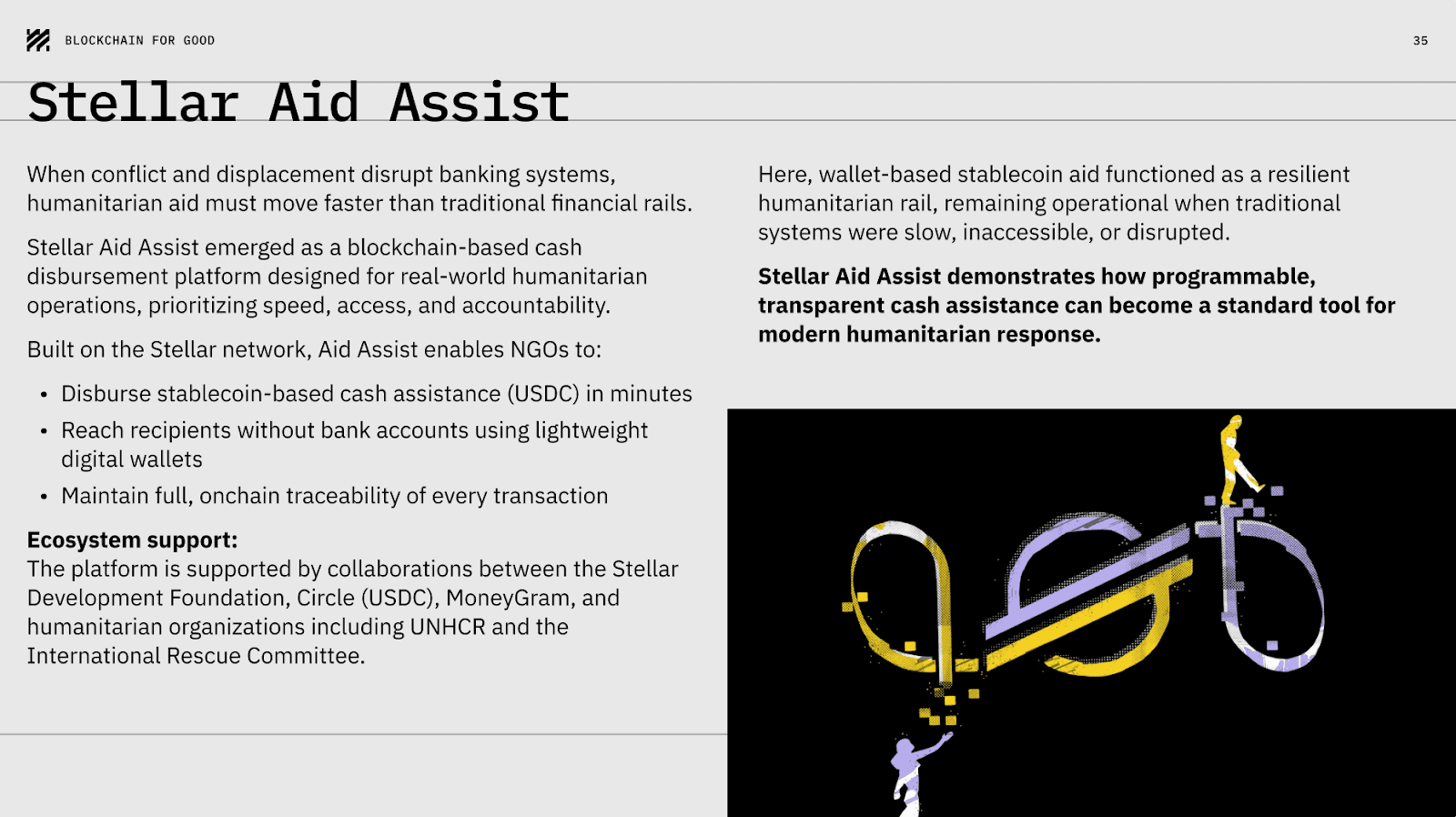
Humanitarian cash assistance
Wallet-based aid has enabled NGOs to reach unbanked populations directly, with full traceability from donor to recipient.
The pattern is consistent: When legacy systems slow down or fail, blockchain rails remain operational.
Blockchain is not just about payments, it’s about coordination
One of the hardest problems in social impact is deciding how to allocate money fairly, transparently, and effectively.
Blockchain introduces new coordination mechanisms that help communities:
Signal collective priorities
Allocate capital based on participation, not influence
Govern shared resources with accountability
Fund work retroactively, based on proven impact
Models like quadratic funding, conviction voting, retroactive public-goods funding, and impact staking are not abstract experiments. They are already shaping how public goods are funded and governed in Web3, and they translate directly to real-world impact contexts.
Faster money matters. Better decision-making is the real multiplier.
Inside the Blockchains for Good report
This is a practical guide for using blockchains for good. Inside, you’ll find:
Why legacy impact infrastructure is breaking and what replaces it
Real case studies across disaster relief, public goods, science, and civil society
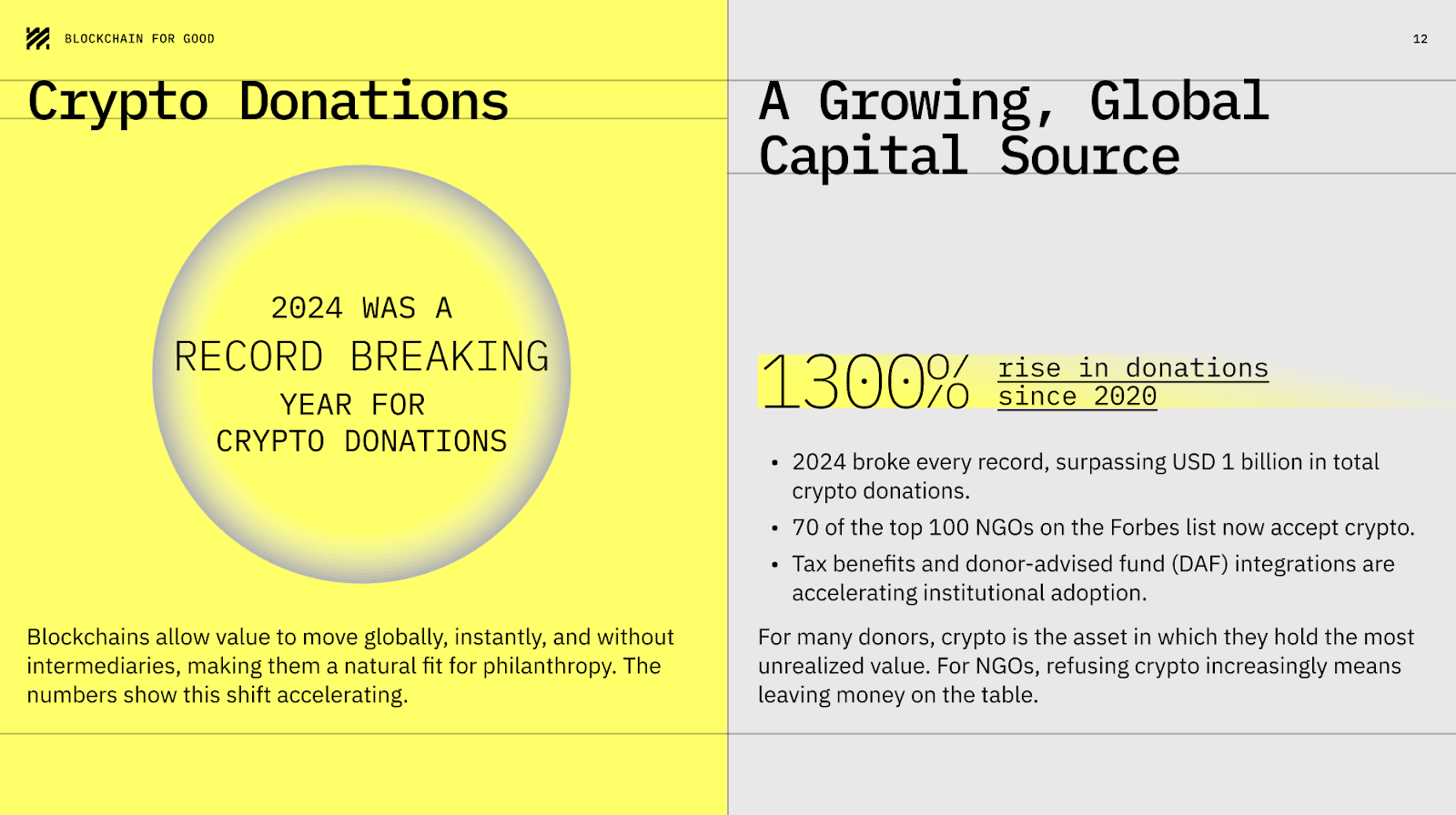
How crypto donations and stablecoins are being used today
New funding models that reduce reliance on donor fatigue
Coordination mechanisms that improve allocation, not just fundraising
A clear, low-risk roadmap for organizations getting started
Each section connects problem → mechanism → impact → how to begin.
Built for operators, not spectators
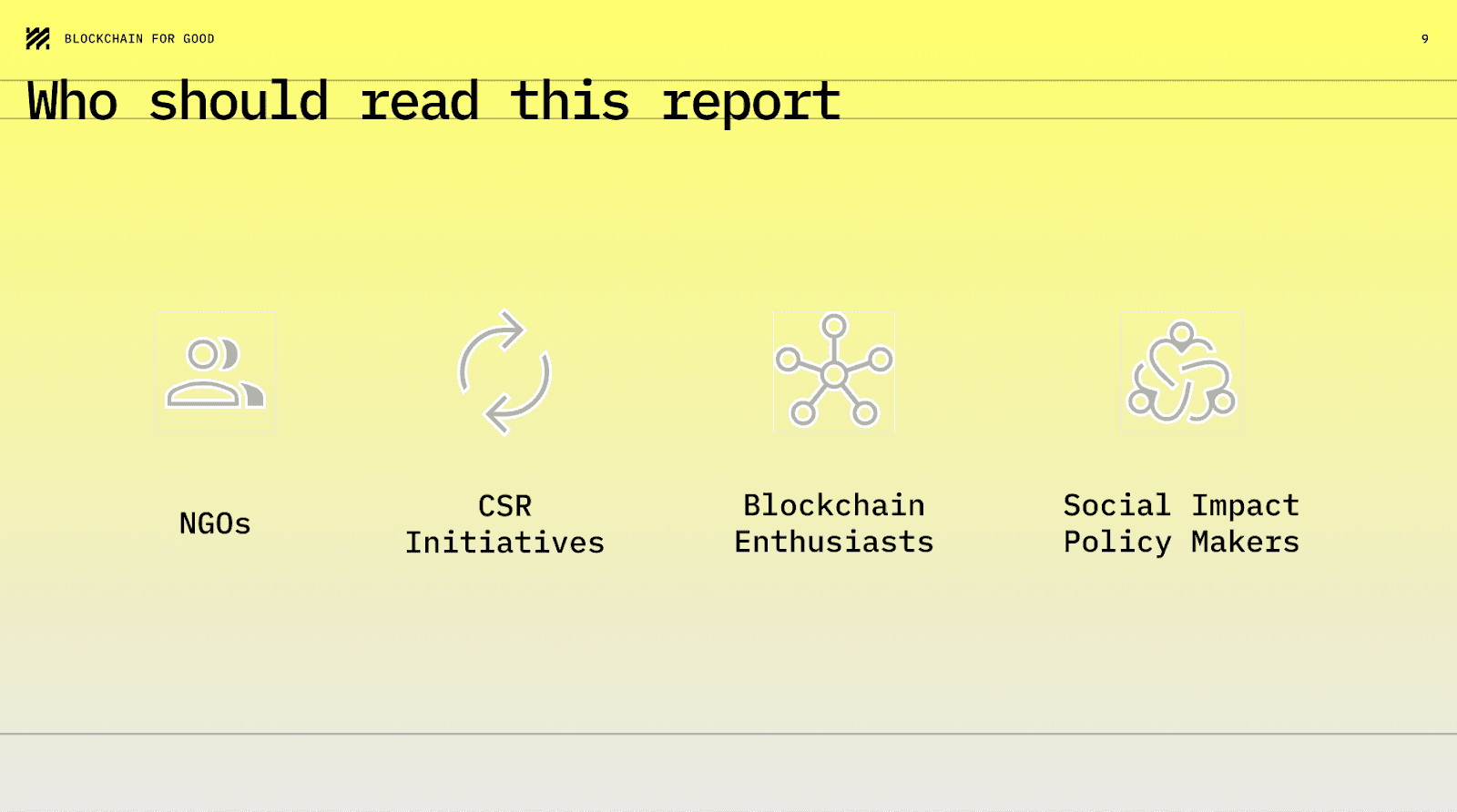
This report is written for:
NGO and foundation leaders overseeing operations, finance, or reporting
Program teams managing cross-border disbursement or cash assistance
Innovation and digital transformation teams evaluating new infrastructure
Development teams exploring crypto donations and new funding sources
Policymakers and ecosystem builders focused on transparency and resilience
No crypto background required. Respect for compliance, risk management, and institutional realities is assumed.
How organizations begin, without betting the mission
You do not need a full Web3 strategy to start. The report outlines a step-by-step path:
Accept crypto donations and open stablecoin rails
Run a transparency pilot on one program
Pilot stablecoin-based payouts in a single region
Partner with an existing public-goods ecosystem
Experiment with alternative funding models at small scale
Introduce governance tooling for participation and feedback
Scale what works
Each step is modular, reversible, and designed to minimize risk.
The new operating reality for social impact
Donors expect real-time transparency. Crises are more frequent and more global. Operational resilience now depends on infrastructure that can move at the speed of need.
Organizations that adopt these tools will:
Move capital faster
Prove impact more credibly
Reduce administrative overhead
Build deeper trust with donors and communities
Those that don’t will remain constrained by rising costs and legacy rails.
“Poverty is not created by poor people. It is created by the systems we have built.”
Muhammad Yunus, Nobel Peace Prize Economist
Blockchain offers an opportunity, and a responsibility, to build better systems.
This report is an invitation to approach that work seriously, pragmatically, and collaboratively.
Start building the better world we know is possible with what already works.


