Learn how startups can use AI-native GTM systems, managed growth loops, and strategic learning infrastructure to accelerate PMF.
Greg Patenaude
Narrative & GTM Strategist
Most startups think they have a growth problem.
In reality, most of them have a learning problem.
They rush into GTM before they truly understand who their product is for, what emotional tension drives adoption, which users stick around, or why the market should care in the first place. Then they layer AI tools on top of that uncertainty and mistake increased productivity for real progress. More content. More campaigns. More dashboards. More noise.
The truth is, before PMF, the core challenge for startups is not scaling. It is discovering where real market pull exists.
The companies that survive the earliest stages are usually the ones that learn the fastest. They identify signal inside market noise, refine their understanding continuously, and converge toward product-market fit before they run out of time or capital.
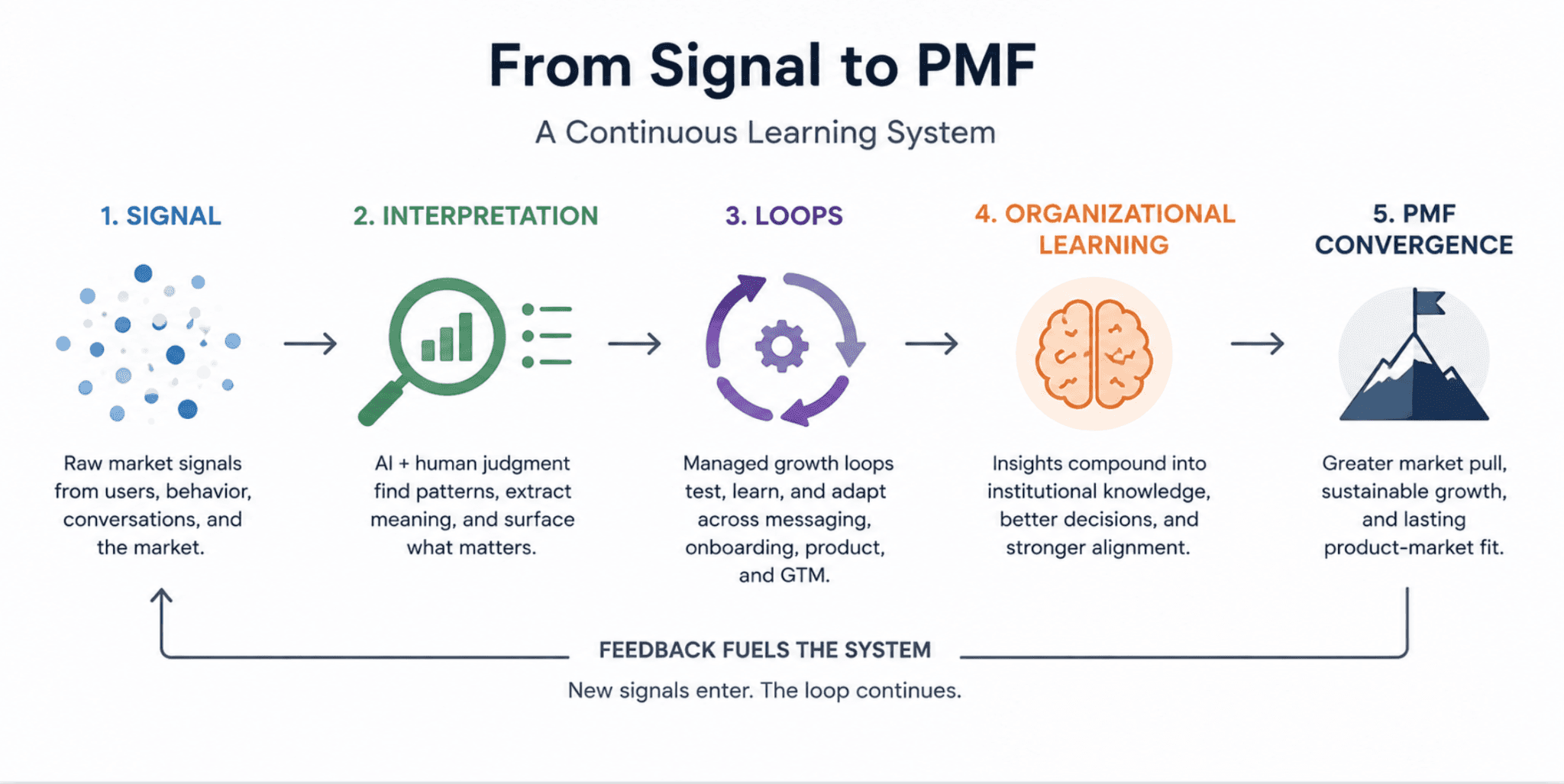
This is why the next generation of GTM will not be built around outsourced execution or isolated AI tools. It will be built around managed growth loops that accelerate learning, product-market fit, and growth at every stage of a startup.
The future of agentic marketing is not autonomous content production. It is organizational learning systems. The startups that can transform market signals into strategic clarity faster than their competitors will win.
Product-Market Fit Is Really a Transition in Market Certainty
Most founders talk about product-market fit as if it were a milestone. A feeling that suddenly appears when growth starts accelerating organically.
In reality, PMF is usually a gradual reduction in uncertainty.
At the earliest stages, startups are operating inside ambiguity. They do not fully know who their strongest users are, what category they belong to, what positioning creates pull, or which behaviors predict retention. The entire company is still searching for clarity.
This is why startup stages are really different stages of risk reduction.
At pre-seed, the core question is whether the problem is real at all. At seed, the question becomes whether there is repeatable pull from a specific segment of users. By Series A, investors are looking for evidence that the system can scale predictably.
The companies that move through these stages successfully are rarely the ones moving the fastest. They are the ones learning the fastest. They identify where real demand exists, which signals matter, and what behaviors predict long-term pull.
PMF is not simply growth. It is increasing certainty that the market consistently wants what the company is building.
Most GTM Systems Are Built for Post-PMF Companies
One of the biggest problems in startup marketing is that most GTM frameworks assume the company already has product-market fit.
Traditional marketing systems assume:
the ICP is already defined
positioning is stable
acquisition channels are tested
onboarding is frictionless
retention patterns are understood
the value proposition is validated
But pre-PMF startups rarely operate with that level of clarity.
Their ICP changes every few months. Their positioning evolves through customer conversations. Their onboarding flow contains hidden friction. Their strongest use case may not even be obvious yet. In many cases, the founders themselves are still discovering what business they are actually in.
A startup may think it is building a wallet for freelancers, only to discover through onboarding and retention analysis that its strongest pull comes from cross-border businesses managing treasury flows. That single insight changes the entire GTM motion: the messaging, onboarding, partnerships, retention strategy, and even product roadmap.
Yet many startups begin scaling acquisition before they discover these underlying truths. They hire agencies, launch campaigns, optimize funnels, and push distribution before the system has found its ground.
AI often accelerates this problem. Teams start generating more content, more campaigns, and more experimentation without improving the quality of the underlying understanding. The result is almost always faster confusion.
This is why many early-stage teams feel busy while making very little strategic progress. They are scaling activity before establishing clarity.
The Real Job of Pre-PMF GTM
Before PMF, GTM is primarily a function of market intelligence. That means understanding:
which users stick around
what emotional tensions drive adoption
which onboarding moments create activation
which narratives generate trust
which behaviors predict long-term engagement
A startup that learns quickly can survive imperfect execution. A startup that scales aggressively without learning often burns through capital accelerating in the wrong direction.
Historically, startups solved this by hiring agencies to increase output, but AI is rapidly commoditizing execution itself. Content generation, workflow automation, reporting, and campaign production are becoming abundant. The bottleneck is no longer production.
The bottleneck is organizational learning.
This is where a new category begins to emerge: PMF acceleration infrastructure.
The next generation of GTM systems will not simply produce marketing outputs. They will continuously transform market signals into strategic clarity, execution, feedback, and organizational learning.
The value is not the individual AI agent. The value is accelerated convergence toward truth.
Managed Growth Loops Become the Core Operating System
This is why AI-native GTM will increasingly operate through managed growth loops.
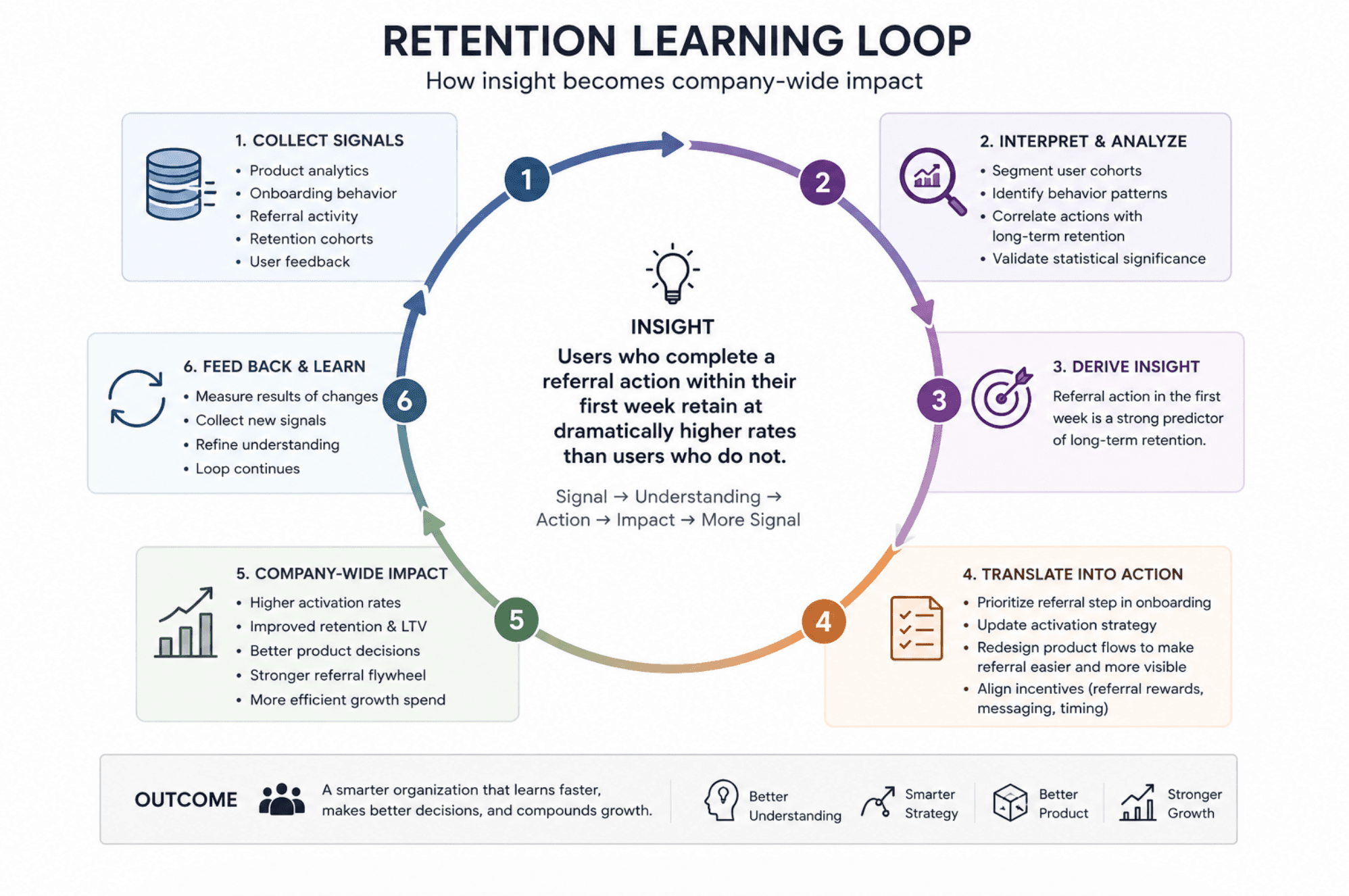
A strong loop absorbs signals, interprets them, translates them into action, measures outcomes, and feeds those learnings back into the system.
Over time, the organization becomes smarter.
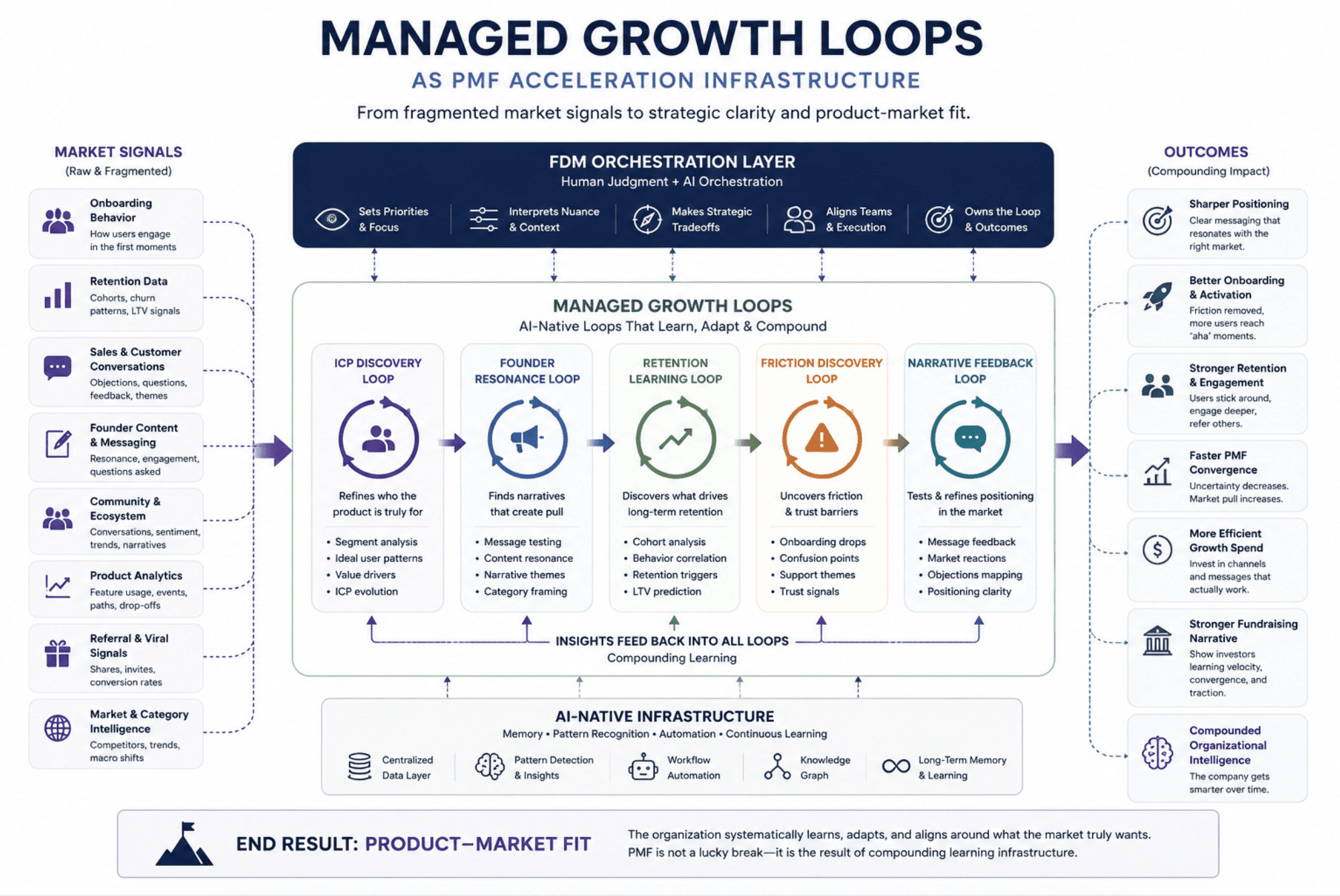
An ICP discovery loop refines who the product is truly for. A founder resonance loop identifies which beliefs and narratives create pull. A retention learning loop reveals which user behaviors correlate with long-term engagement. A friction discovery loop exposes onboarding breakdowns and trust barriers before they become scaling problems.
For example, a retention learning loop may reveal that users who complete a referral action within their first week retain at dramatically higher rates than users who do not. That insight does not simply improve a dashboard metric. It changes onboarding priorities, activation strategy, product design, and referral incentives across the entire company.
The loop matters more than the agent.
Most AI systems today operate like disconnected freelancers producing endless output without accumulating understanding. They generate isolated outputs but do not create institutional learning.
The strongest GTM systems are different. Every interaction sharpens the organization’s understanding of the market. They preserve organizational memory, improve future decision-making, and continuously refine the company’s understanding of what actually drives adoption.
Eventually, the company’s advantage becomes its ability to learn faster than competitors, not simply execute faster.
The Role of the Forward Deployed Marketer
This is the context in which Myosin began developing the idea of the Forward Deployed Marketer, or FDM.
The FDM is not a traditional consultant delivering strategy decks from the outside or simply a marketer using AI tools.
The role emerged from recognizing that most startups increasingly need someone who can bridge strategy, systems, execution, workflows, AI infrastructure, and organizational learning simultaneously.
In many ways, the FDM becomes the human owner of the growth loop.
Their responsibility is to install the systems that allow the organization to learn faster over time. That includes:
building research workflows
structuring feedback loops
refining positioning continuously
connecting sales feedback into messaging
orchestrating AI-enabled execution systems
improving operational consistency
translating fragmented signals into strategic clarity
The most important part of the role is judgment.
AI can generate infinite iterations, but it still struggles to determine what actually matters. It cannot reliably understand ecosystem timing, founder credibility, category dynamics, narrative tension, emotional trust signals, or the strategic tradeoffs shaping adoption.
Those decisions still require human intuition and contextual awareness.
The Forward Deployed Marketer exists to bridge the gap between automation and strategic understanding.
Why This Changes Fundraising
This shift has major implications for venture funding.
At the earliest stages, investors are not simply funding products. They are funding the company’s ability to discover product-market fit before capital runs out.
That means investors are increasingly underwriting learning velocity, founder judgment, operational coherence, retention signals, and strategic adaptability. In other words, they are underwriting the strength of the company’s learning systems.
The strongest seed-stage companies are often not the ones with the biggest audience or the most polished marketing. They are the ones demonstrating that they are rapidly reducing uncertainty.
They can clearly explain:
which users are retained
which narratives resonate
which onboarding flows work
which segments show strongest pull
what behaviors predict long-term adoption
This creates a very different fundraising narrative.
Instead of telling investors, “We are growing fast,” the company can demonstrate, “We are learning rapidly and converging toward repeatable market pull.”
That is a much stronger signal at the pre-seed and seed stages.
Because ultimately, the startup with the best learning system often outcompetes the startup with the best initial idea.
The Teams That Win Will Learn Faster
The future of GTM will not belong to the companies producing the most content or running the most campaigns. It will belong to the organizations building the strongest systems for turning market feedback into organizational intelligence.
As AI compresses the value of execution, the real advantage shifts toward managed growth loops that continuously transform market signals into strategic clarity, better decisions, and faster convergence toward product-market fit.
The loop matters more than the agent.
That is the shift from marketing as outsourced labor to GTM as PMF acceleration infrastructure. And the startups that build the strongest learning systems will define the next generation of winners.


