Myosin is rewriting the GTM operating system through Forward-Deployed Marketers, managed growth loops, HiveMind, and AI-native marketing infrastructure.
Blake Kim
Co-Founder Myosin.xyz
May 12, 2026
Eric Siu recently wrote that the future agency will not sell labor. It will sell managed growth loops.
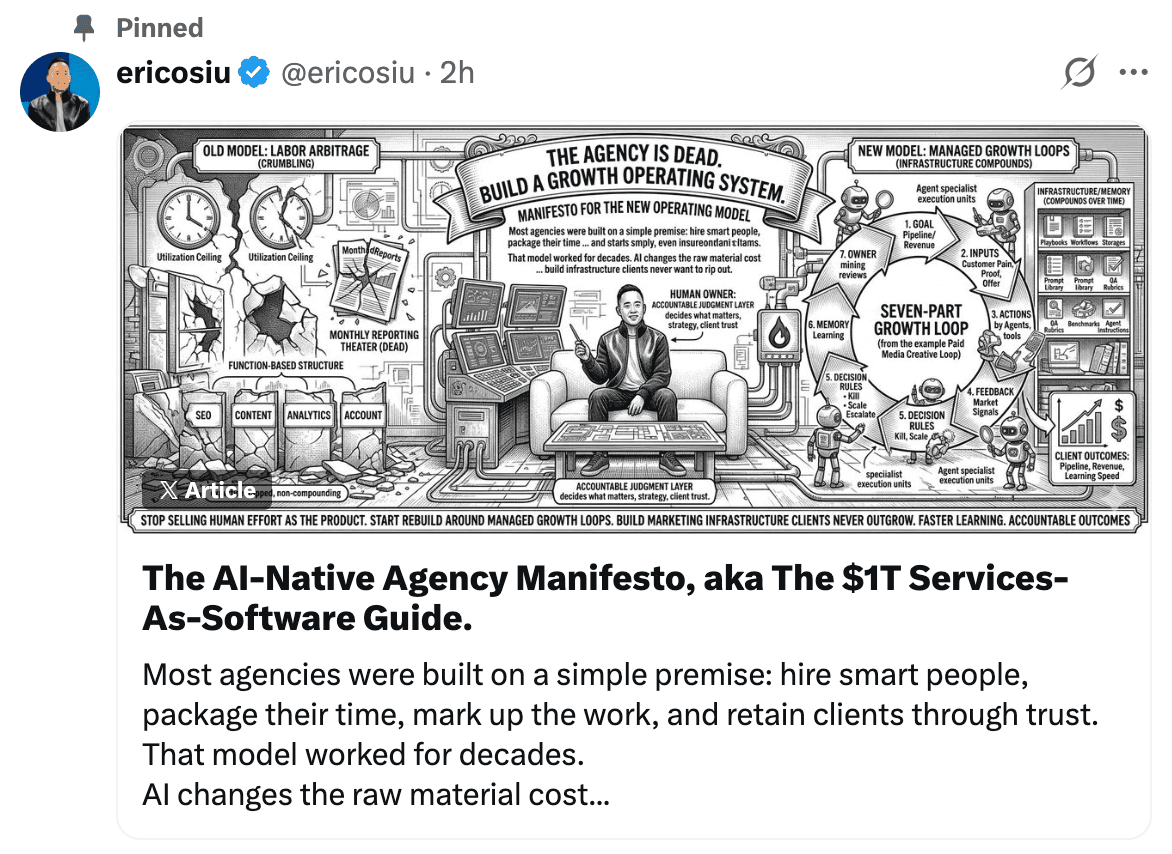
He’s right. But this shift is already happening.
At Myosin, we’ve been building toward this operating model since last year through:
Forward Deployed Marketers (FDMs)
HiveMind, our AI-enabled crypto strategist
The real change happening right now is not that AI makes marketing faster. It is that AI is forcing a complete rewrite of the GTM operating system.
For years, agencies operated on the same underlying model: more people, more retainers, more deliverables, more coordination layers. AI accelerated parts of that machine, but in most cases it did not fundamentally change the system itself. It simply made the factory run faster.
Now every agency can create more content, more reports, more ad variants, and more automation than ever before. But volume was never the true bottleneck. Operational coherence was.
Most marketing teams are still built around fragmented execution and with the implementation of AI what emerges is not an intelligence system but just operational noise.
The teams winning right now are not the ones with the most AI tools. They are the ones building systems that continuously turn market signals into strategy, execution, feedback, learning, and compounding performance.
That is the shift Myosin recognized early.
And it is the reason we started building toward a different model entirely: embedded operators, managed growth infrastructure, AI-native workflows, and GTM systems designed to compound over time.
The future of marketing is not AI replacing marketers. It is marketing becoming an operating system.
Most AI Marketing Teams Are Automating the Wrong Thing
Right now, most AI-enabled marketing teams are solving for production speed. They are trying to make the existing machine move faster, but faster production is not the same thing as better marketing.
If the positioning is weak, the AI scales weak positioning. If the ICP is unclear, AI accelerates unclear messaging. We’re already seeing AI generate more noise for projects with a fragmented story. What many teams are discovering is that AI does not automatically create strategic clarity. In fact, it often exposes the absence of it.
We wrote previously that AI is not failing most teams, it is revealing the quality of their GTM strategy, positioning, and operational alignment. This is why so many organizations feel underwhelmed after implementing AI tooling. The problem is usually not the model they’re using. The problem is that the underlying GTM system was never coherent to begin with.
Most marketing organizations still operate as disconnected functions pretending to be a unified strategy. Content lives in one corner. Performance marketing lives in another. Sales feedback rarely loops back into messaging. Community conversations never meaningfully shape positioning. Reporting becomes a historical dashboard instead of a forward-looking decision making system. AI agents get layered on top of this environment and everyone wonders why the outputs feel generic or disconnected from actual business growth.
The problem is that most teams are optimizing for iteration speed without building the systems needed to interpret signals, refine understanding, and develop strategic maps they can actually operate from.
That realization became increasingly clear to us at Myosin as we worked across leading fintech ecosystems, infrastructure projects, startups, and growth teams. The companies struggling most with AI were not lacking tools. They were lacking operational alignment. They had strategy documents, dashboards, content calendars, automation tools, and prompt libraries, but no coherent system connecting those things together into a continuous learning process.
That is the missing layer most organizations are now running into.
The Missing Layer Between Strategy and Execution
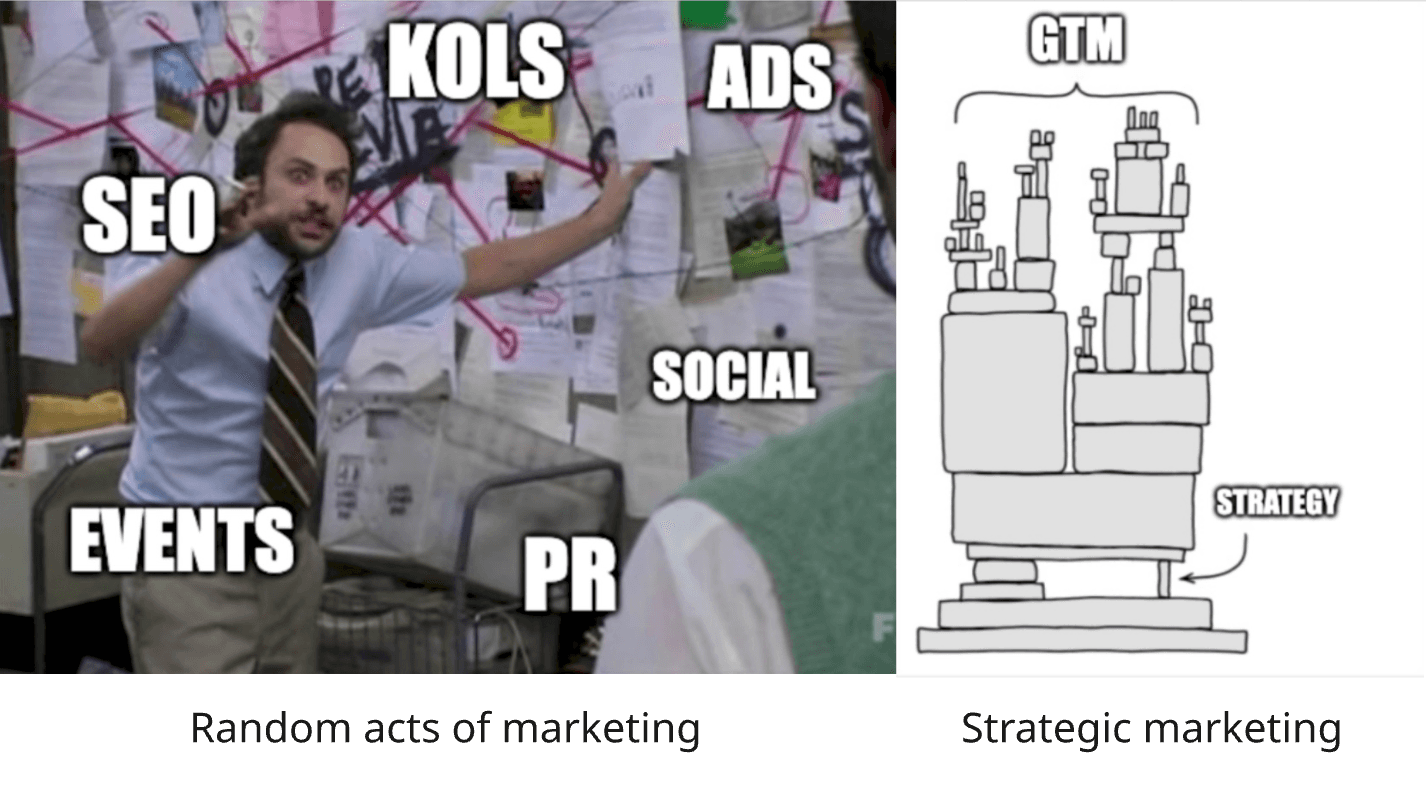
One of the patterns we kept observing was that strategy and execution had drifted apart. Founders still held valuable intuition about their market, their users, and their category, but that insight rarely translated cleanly into operational systems. Marketing teams were generating more activity, but the activity itself was often disconnected from a deeper understanding of what actually drove adoption.
This is where a lot of AI conversations become shallow. People talk about replacing tasks, automating workflows, or generating assets faster, but they skip over the harder question: who owns the system that connects all of this together?
Who ensures that customer feedback influences positioning? Who translates sales objections into narrative refinement? Who determines which signals matter and which are distractions?
In most companies, the answer is effectively nobody. Or more accurately, everyone has an opinion in the moment, but no one is building a coherent operating system over time.
That gap is what we mean when we talk about the missing layer between AI tools and marketing strategy. Most organizations do not need another isolated AI application.
What they are missing is the operational layer that translates strategy into systems, workflows, and execution.
They need systems that can continuously transform raw market information into execution, feedback, learning, and better decision-making.
That is a very different problem than simply generating content faster. It also changes how we think about marketing infrastructure itself.
Managed Growth Loops Are the New GTM Infrastructure
Eric’s framing around managed growth loops is important because it shifts the conversation away from individual tools and toward building systems that compound.
A lot of companies right now are building collections of AI agents. Research agents. Content agents. Analytics agents. Social media agents. n8n powered workflow automations. But in most cases, those systems operate like disconnected freelancers inside an organization. They produce output, but they do not necessarily produce organizational learning.
The value is not the agent itself. The value is the loop.
A managed growth loop continuously absorbs market signals, translates them into action, measures outcomes, and feeds those learnings back into the system. Over time, the organization becomes smarter, faster, and more strategically aligned because every cycle improves future execution.
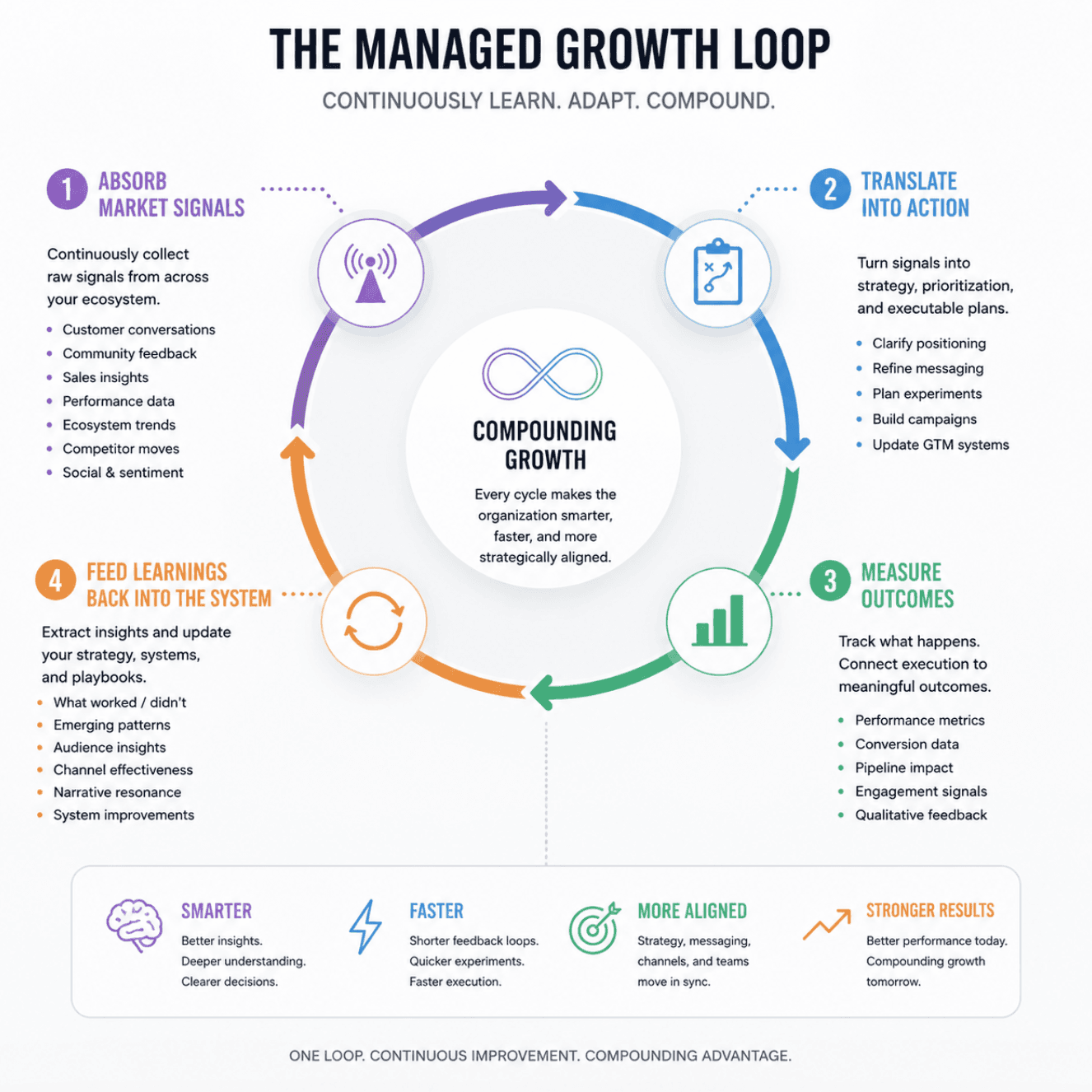
This is increasingly how we think about GTM at Myosin.
The first layer is what we call the input layer. Most bad marketing begins with weak inputs. Teams often operate with surprisingly thin understanding of their own audience. They know broad demographics but not emotional drivers. They know product features but not the language customers actually use. They know what they want to say, but not which narratives are resonating in the market or where competitors are winning mindshare.
When those inputs remain stale, growth goes stale too.
The organizations that improve fastest are usually the ones continuously collecting and refining strategic inputs through sales calls, community conversations, ecosystem behavior, performance data, founder intuition, competitor positioning, and real customer objections. Those signals become the foundation for everything else.
From there, execution itself becomes a connected system rather than a collection of deliverables. Market research informs positioning. Positioning shapes the narrative. Narrative influences content and campaigns. Campaigns generate performance data and sales feedback. That feedback then sharpens the next cycle of execution.
Eventually, the real advantage becomes the organization’s ability to learn faster than competitors, not just execute faster.
That learning becomes infrastructure and infrastructure compounds..
The Role of the Forward Deployed Marketer
This is the context in which we started developing the idea of the Forward Deployed Marketer, or FDM.
FDM is not simply a marketer using AI tools and they’re not a traditional consultant delivering strategy decks from the outside. The role emerged from recognizing that modern GTM organizations increasingly need someone who can bridge strategy, systems, execution, and operational infrastructure simultaneously.
In many ways, the FDM is the human owner of the growth loop.
Their job is not just to launch campaigns or manage channels. Their job is to install the systems that allow marketing to compound over time. That includes building research workflows, narrative systems, automation infrastructure, content engines, reporting architecture, community feedback loops, and operational processes that connect all of those layers together.
But the most important part of the role is judgment.
AI can create endless iterations. What it still cannot do reliably is determine what actually matters. It cannot fully understand the tradeoffs between positioning decisions, ecosystem dynamics, founder credibility, timing, risk, narrative tension, or long-term brand direction. Those decisions still require human intuition, strategic taste, and contextual awareness.
That is why we believe the future GTM team does not become less human. The human role simply moves higher up the stack.
The operational work becomes increasingly systemized. The strategic work becomes increasingly valuable.
HiveMind and the Strategic Input Layer
This is also why we built HiveMind the way we did.
A lot of AI products position themselves around outputs. Better copy. Faster content. More assets. But we became increasingly convinced that the real leverage sits earlier in the process, at the level of strategic reasoning itself. This comes back to the input layer: the structured thinking, judgment, and strategic framing that determines the quality of everything downstream.
HiveMind is designed as a strategic input layer for crypto GTM. Its purpose is not simply to produce marketing materials. Its purpose is to help teams think more clearly about the systems driving growth in the first place.
That means helping organizations identify bottlenecks, clarify positioning, structure narratives, connect execution back to strategic objectives, and improve operational consistency across the entire GTM process.
The strongest operators in marketing have always been strong sense-makers. They know how to identify the clear signal within all the noise. They understand how to organize fragmented information into coherent action. They recognize patterns before they are obvious.
In that sense, HiveMind is less about replacing strategic thinking and more about strengthening it. The goal is to help teams build better judgment systems around GTM itself.
Because ultimately, better outputs are usually the result of better thinking upstream.
On Demand: AI-Enabled Marketers
This shift also changes what valuable marketing talent looks like.
For a long time, marketing organizations primarily rewarded production capacity. The people who could manage more campaigns, produce more assets, coordinate more vendors, or execute faster often became the most valuable operators inside the system.
But AI increasingly compresses the value of pure execution work.
As that happens, a different set of capabilities becomes more important. The marketers who become most valuable are the ones who can build systems, improve workflows, interpret weak signals, orchestrate execution, and continuously refine the organization’s learning process.
At the same time, one of the biggest misconceptions around AI is that it reduces the need for human operators. What we are actually seeing is almost the opposite.
As organizations adopt AI, the demand for people who can design, direct, improve, and manage these systems is increasing rapidly. Most companies do not need fewer marketers. They need marketers who can operate at a higher level of abstraction.
They need people who understand how workflows connect together, how feedback loops improve systems, how positioning translates into execution, and how to coordinate agents, automation, and human judgment into a coherent GTM process.
That realization became one of the foundations behind launching the AI-Enabled Marketer Skool.
The goal was never simply to teach people how to use AI tools. The tools change constantly. What matters is developing operators who understand how AI, systems thinking, strategy, workflow design, and operational infrastructure fit together into a coherent GTM model.
The real opportunity is helping marketers evolve into AI-native operators who can build and manage systems that compound over time.
Because that is the actual skill set the next generation of organizations will need.
The Agency Model Is Being Rewritten
The traditional agency model was built around labor scaling and the search for more work. AI changes that equation, but only if organizations rethink the operating model itself rather than simply accelerating existing workflows.
The next generation of GTM firms will likely look less like agencies and more like adaptive operating systems. They will combine embedded operators, codified workflows, AI infrastructure, strategic judgment, and continuous learning into integrated growth systems that improve over time.
Clients will not simply pay for deliverables anymore. They will increasingly pay for better decision-making infrastructure, faster organizational learning, stronger strategic clarity, and systems that compound execution quality over time.
This is what “services-as-software” actually means. The service itself becomes infrastructure.
That is a fundamentally different relationship than the traditional agency-client model. And it is the direction we believe the market is already moving.
The Teams That Win Will Learn Faster
A lot of discussion around AI still revolves around replacement. Replacing marketers. Replacing agencies.
I think that framing misses the deeper shift entirely.
The real advantage in the AI era will come from organizations that can continuously compound learning faster than everyone else. Teams that can turn raw market signals into strategic clarity, strategic clarity into execution, execution into feedback, and feedback into building better systems.
The companies that win will not necessarily be the ones with the most AI tools. They will be the ones with the clearest operating systems for turning information into action and action into organizational intelligence.
That is the direction we believe modern GTM is moving toward.
And at Myosin, it is the operating model we are actively building.