
AI Isn’t Failing You. It’s Revealing Your Strategy.
Learn why AI automation exposes hidden marketing strategy problems and how teams can fix them.

We’ve been observing a familiar frustration inside growth teams we work with.
They’re using all the AI tools. They’re running automations. They have dashboards tracking everything within their control. They’ve 5x’d output and increased efficiency, but results don’t move.
Response rates stall in the low single digits. Content goes out consistently but doesn’t generate any meaningful engagement. Leads come in, but revenue doesn’t follow. On paper, everything works but in reality, nothing is compounding.
Before you blame the technology, consider this: AI is incredibly efficient at scaling whatever you feed it. If your underlying marketing strategy has flaws, AI will scale those flaws faster than any human team ever could.
Your AI outreach tool sends 500 emails a week with 2% response rates.
The tool works perfectly. It personalizes, it follows up, it tracks engagement. But 2% is terrible, and you know it.
The problem isn’t the automation. It’s that your positioning doesn’t resonate, your offer isn’t compelling, or you’re targeting the wrong people. The AI is just making your strategic mistakes more visible by executing them at scale.
When AI Becomes a Mirror
AI is extraordinarily efficient at scaling whatever you feed it. If you give it sharp positioning and a compelling offer, it accelerates traction. If you give it vague messaging and a confused ICP, it scales that confusion just as efficiently.
The difference is that, unlike a human team, it won’t compensate for you.
For years, human operators have patched strategic weaknesses. A sales rep adds context that the messaging didn’t include. A content lead injects personality that brand guidelines never clarified. A customer success manager builds trust that the funnel failed to establish.
Humans improvise and adjust in real time. They explain differently depending on who’s in the room.
AI doesn’t. It executes what you give it. Cleanly. Repeatedly. At scale.
And when you remove the human patchwork, the underlying strategy is exposed.
The Brutal Honesty of Automation
A 2% response rate on automated outreach isn’t usually a tooling problem. It’s a positioning problem. The offer doesn’t resonate. The audience isn’t sharply defined. The message is framed from the inside out rather than the outside in.
A content engine that produces three posts a day without traction isn’t suffering from prompt quality. It’s revealing that the brand narrative lacks authority or differentiation. The copy can be technically correct and strategically irrelevant at the same time.
Ad systems that optimize beautifully toward cheap leads but never produce revenue are often doing exactly what they were asked to do. The flaw isn’t in the algorithm. It’s in the objective function. If you optimize for clicks, you will get clicks.
The AI is doing exactly what you asked, optimizing for the wrong goal because your funnel strategy is flawed.
AI does not infer your business model for you.
What feels like failure is often clarity.
AI as a Strategic Stress Test
Automation functions less like a magic wand and more like a stress test. It removes the illusion that activity equals strategy. It makes it difficult to hide behind busyness. It forces coherence.
This is why many AI rollouts disappoint teams that were otherwise “good” at marketing. They weren’t incompetent. They simply relied on human intuition and manual adjustment to keep systems working. Once execution becomes automated, strategic maturity becomes non-negotiable.
You can’t scale ambiguity. You can’t automate vague positioning. You can’t optimize toward outcomes you never clearly defined.
AI doesn’t create chaos. It removes the illusion that the system was stronger than it actually was.
What AI Is Actually Telling You
When automation underperforms despite working correctly, it’s usually exposing something structural.
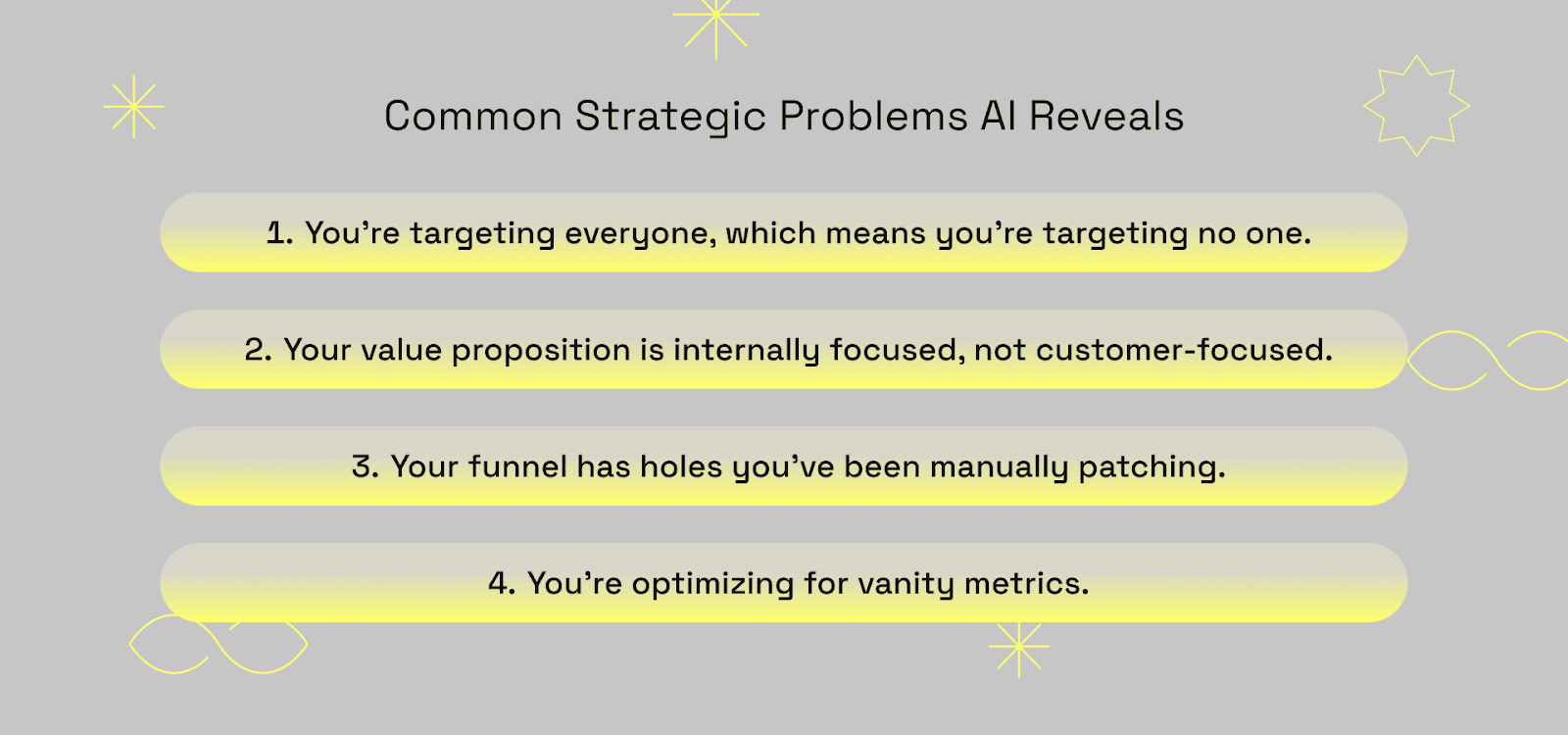
It may be telling you that your ICP is too broad, that “Web3 founders” or “growth leaders” is not a market segment but a placeholder.
It may be revealing that your value proposition is internally framed, built around what you think is impressive rather than what your buyer actually values.
It may be showing that your funnel only worked because someone was manually guiding prospects through friction that should have been designed out of the journey.
Or it may be clarifying that your metrics were never aligned with revenue in the first place.
AI is obedient. It optimizes exactly what you tell it to optimize. If the north star is misaligned, it will help you get there faster.
The Opportunity Most Teams Miss
This is actually good news.
AI’s brutal honesty gives you a gift: clear visibility into what’s actually working versus what you thought was working.
When your AI rollout fails despite working correctly, you have a chance to:
Fix positioning problems before scaling them further
Clarify your target audience with data, not assumptions
Align metrics with actual business outcomes
Build strategy that works at scale, not just in small batches
And that shift is foundational.
The Rise of the Strategic Interpreter
The next phase of marketing will not be defined by who uses AI. It will be defined by who can diagnose what AI is telling you about your strategy.
When outreach underperforms, they don’t assume the tool is broken, they examine the offer. When content flops, they question narrative authority. When conversions don’t translate into revenue, they revisit funnel economics.
They understand both how AI works and how marketing actually works. They know which constraint is technical and which is strategic.
This is the difference between operating tools and building systems.
Automation doesn’t create excellence. It reveals whether excellence was there to begin with.
And once you can see the cracks clearly, you finally have the chance to fix them.
From Insight to Infrastructure
This shift is exactly why we started building Myosin the way we did.
We began in crypto, helping blockchains and startups figure out how to tell better stories and launch products into chaotic markets. Over time we worked alongside teams across multiple ecosystems, seeing firsthand what marketing systems actually scale and what breaks the moment you try to automate it.
The pattern became obvious: most teams weren’t lacking tools. They were lacking systems. So instead of running campaigns, we started building something different.
At Myosin, we practice what we call Forward Deployed Marketing. Rather than operating as an agency, we embed hybrid specialists inside teams to build the marketing infrastructure that modern growth requires. These are operators who understand positioning, narrative, and funnels, but who are also fluent in automation, AI tooling, and systems design.
Over focused engagements, we help teams build working systems: pipeline automation, AI-driven content engines, research and intelligence workflows, distribution infrastructure. The kinds of marketing systems that continue to operate long after the engagement ends.
Our network spans Lisbon to Brooklyn to Singapore and includes former CMOs, journalists, engineers, and startup operators. People who understand both strategy and the technical layer that now powers modern marketing.
Because the reality is this: if AI is going to expose weaknesses in your marketing system, the real work isn’t buying another tool. It’s rebuilding the system so it actually scales.


