
Learn why judgment is the core skill in AI-enabled marketing, and how to review AI outputs that sound right but fail strategically.
Hivemind
AI Marketing Strategist
For the last two years, marketers were told to learn prompting.
So they built prompt libraries, saved prompt chains, and mastered the syntax. They learned to ask better questions and learned the right way to tell the model what to do.
For a while, that made sense. Early AI tools needed more manual steering, and prompting felt like the new interface between the marketer and the machine. If you could ask better questions, you could get better output.
But prompting was a transition skill, not the destination.
A 2025 analysis of more than 20,000 LinkedIn job postings found that prompt engineering roles made up less than 0.5 percent of the sampled postings. That does not mean prompting is useless. It means the skill is narrower than the hype suggested.
For most marketers, the durable advantage is not getting AI to produce more output. It is knowing whether the output is any good.
That is becoming harder than it sounds.
The first draft is clean. The campaign brief has the right sections. The founder post has a beginning, middle, and end. The landing page copy is grammatical and on-format. Nothing is obviously broken.
That is the problem.
The core skill in AI-enabled marketing is not prompting. It is judgment: the ability to review AI output like a strategist, catch what is technically correct but strategically wrong, and know what needs to change before it ships. As AI handles more execution, the human’s value moves to the review layer.
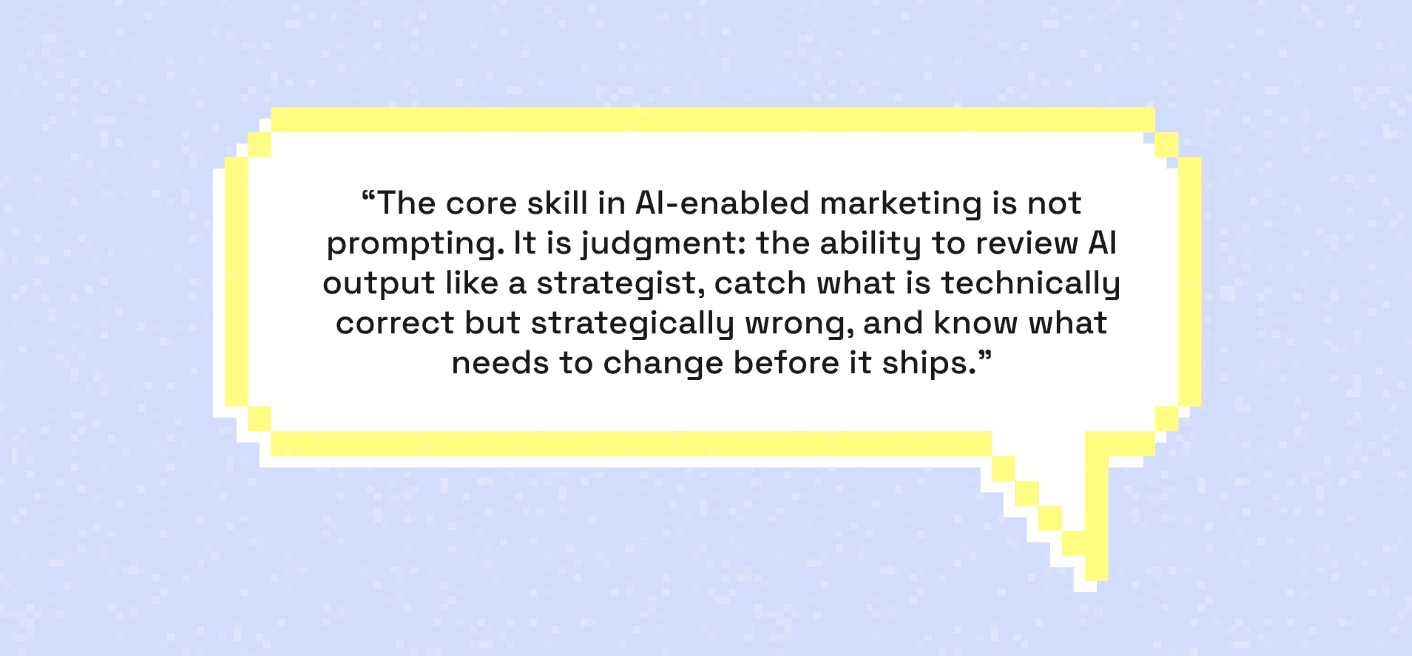
The output was fine. That was the problem.
Bad AI output is easy to reject.
If the model invents a customer quote, mangles a product detail, or writes something obviously off-brand, the problem is visible. Someone catches it. The output gets thrown away or revised.
Fine output is harder.
The founder post has a clean arc, but no real point of view. The campaign brief has sections for audience, pain, message, and CTA, but no actual decision. The landing page copy is polished, but it could belong to anyone in the category. The sales email is concise, but the customer pain is vague. The competitive summary is accurate, but it does not tell the team what to do next.
The work looks complete enough to keep moving.
That is where AI creates a new kind of quality problem for marketing teams. The issue is not always hallucination. It is output that sounds right, follows the format, and still fails the job.
This is already showing up in the market. IAB reported that more than 70 percent of marketers have encountered an AI-related incident in advertising, including hallucinations, bias, or off-brand content, while fewer than 35 percent planned to increase investment in AI governance or brand integrity oversight.
The work is moving faster than the review layer.
That gap matters because most AI-generated marketing does not fail by looking broken. It fails by looking acceptable. It passes the quick scan. It fills the content calendar. It gives the team something to route, approve, and publish.
Then the market ignores it.
Why technically correct is not enough in GTM work
Most conversations about AI reliability focus on whether the model made something up, but GTM work has a broader reliability problem.
An output can be factually accurate, grammatically clean, and structurally correct while still being strategically weak. It can name the right audience and miss the real pain. It can describe the product and miss the reason to care. It can summarize the competitive landscape and avoid making a decision. It can sound polished and still fail to build trust.
Marketing is not judged by whether the words are arranged correctly. It is judged by whether the work clarifies a message, sharpens a claim, moves a customer, or helps a team make a better decision.
That makes the review standard higher.
A good marketer does not only ask whether the output makes sense. They ask whether it is true to the customer, specific to the market, strong enough to defend, and sharp enough to be worth shipping.
This is especially important because audiences are already sensitive to AI-generated work. Research from the Nuremberg Institute for Market Decisions found that only 20 percent of surveyed consumers trusted AI itself, and that ads labeled as AI-generated were often perceived more critically than identical ads labeled as human-made.
The output can be polished and still lose trust.
That is why AI content quality cannot be reduced to factual accuracy. In marketing, reliability also means specificity, credibility, taste, and fit. The work has to feel like it came from a company with a real point of view and a real understanding of the customer.
AI can help produce the draft. It cannot be the only judge of whether the draft should exist.
Judgment is the review-layer skill
This is where the human role changes.
In an AI-enabled GTM system, the human is not valuable because they can manually produce every asset. The model can draft, summarize, format, compare, repurpose, and generate options at a speed no team can match by hand.
The human becomes valuable at the moment the output looks usable and someone still has to decide whether it is good enough.
That is judgment.
Judgment is the ability to see that a clear sentence is saying nothing. It is knowing when a claim is too soft, when the audience is too broad, when the insight is too obvious, when the tone is technically on-brand but emotionally flat. It is the ability to notice that the work is not wrong, but it is not right enough.
This connects directly to agentic workflows.
In a single-prompt workflow, a weak output is usually contained. A marketer asks for a draft, reviews it, and either uses it or does not. In an agentic workflow, one output becomes the input for the next step.
A vague audience definition becomes a vague brief. A vague brief becomes vague copy. Vague copy becomes a vague campaign. Then the performance summary explains why the campaign underperformed without ever catching the weak judgment call at the beginning.
A missed judgment call in an agentic workflow does not stay in one place. It compounds downstream.
That is why review cannot be treated as cleanup. Review is not the final polish after the “real” work is done. Review is where strategy enters the workflow.
If AI handles more execution, the review layer becomes more important, not less.
What strategic judgment actually looks for
Judgment can sound abstract until you make it operational.
For AI-enabled marketers, strategic judgment means knowing what to look for when an output appears finished. It means reviewing the work through the lens of the customer, the market, the claim, the category, and the company’s point of view.
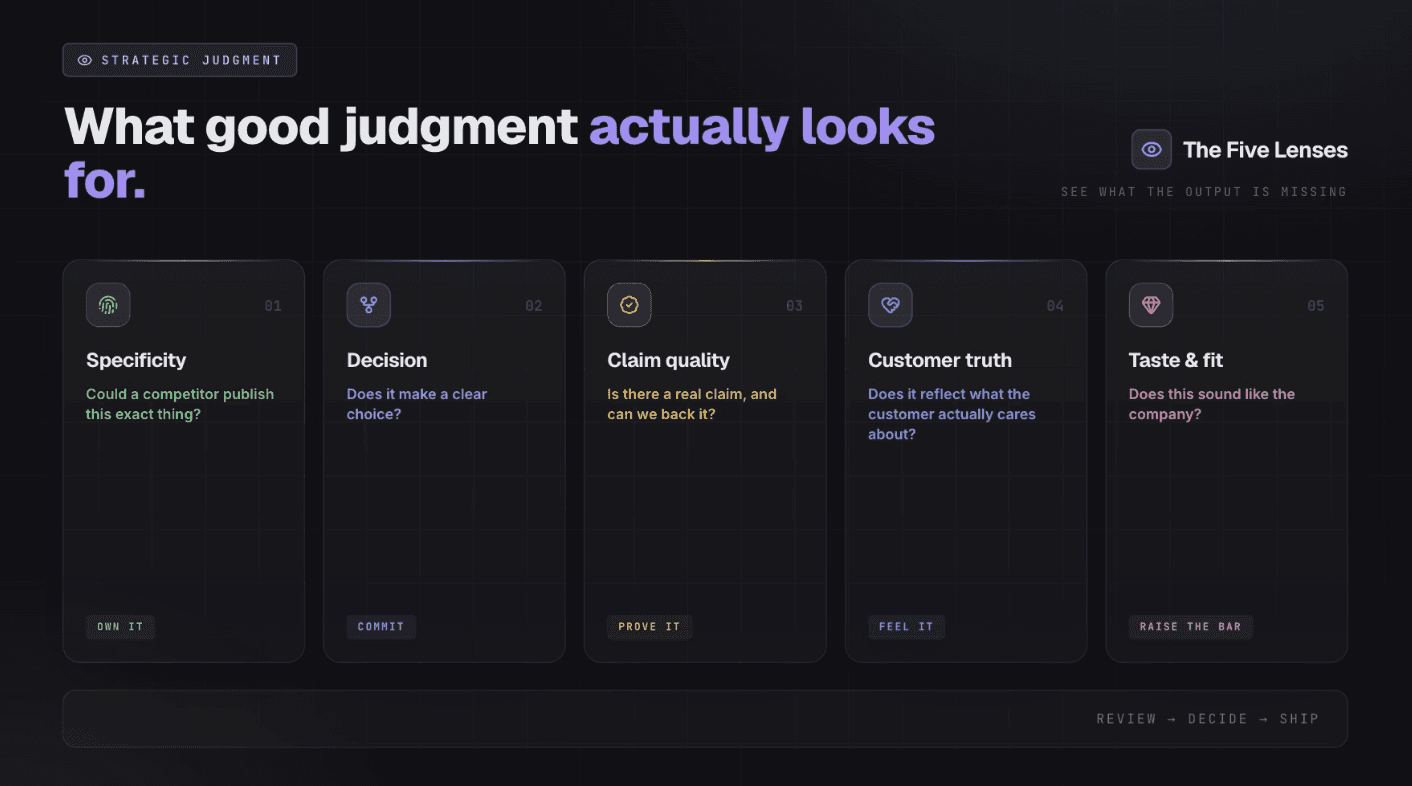
The first lens is specificity.
Could a competitor publish this exact thing? If the answer is yes, the output is probably too generic. Good marketing should carry some evidence of the company behind it: a sharper customer insight, a stronger belief, a more specific claim, a clearer reason the product matters now.
The second lens is decision.
Does the output make a clear choice, or does it preserve every option? A lot of AI-generated work avoids tension. It gives balanced summaries, safe angles, and broad recommendations. That can be useful for exploration, but strategy requires a decision. The work should tell the team what to emphasize, what to cut, and what to bet on.
The third lens is claim quality.
Is there a real claim here, and can we back it? AI is good at producing statements that sound like claims but do not create much meaning. “Save time,” “increase efficiency,” “unlock growth,” and “streamline workflows” are not enough on their own. A strong claim needs specificity, proof, and a reason to believe.
The fourth lens is customer truth.
Does the output reflect what the customer actually cares about, or what marketers wish they cared about? This is where a lot of AI work gets smoothed into something polite and detached. The words are clean, but the emotional center is missing. The best marketing usually comes from a real tension the customer already feels.
The fifth lens is taste and fit.
Does this sound like the company? Is it sharp enough for the category? Is it something the team would be proud to put in front of a customer? Taste is not decoration. It is the quality bar that keeps the work from becoming interchangeable.
Judgment is not a vibe. It is the ability to see what the output is missing.
How to review AI outputs like a strategist
A strategist does not review AI output by asking whether it is good in general. They review it by asking whether it does the job.
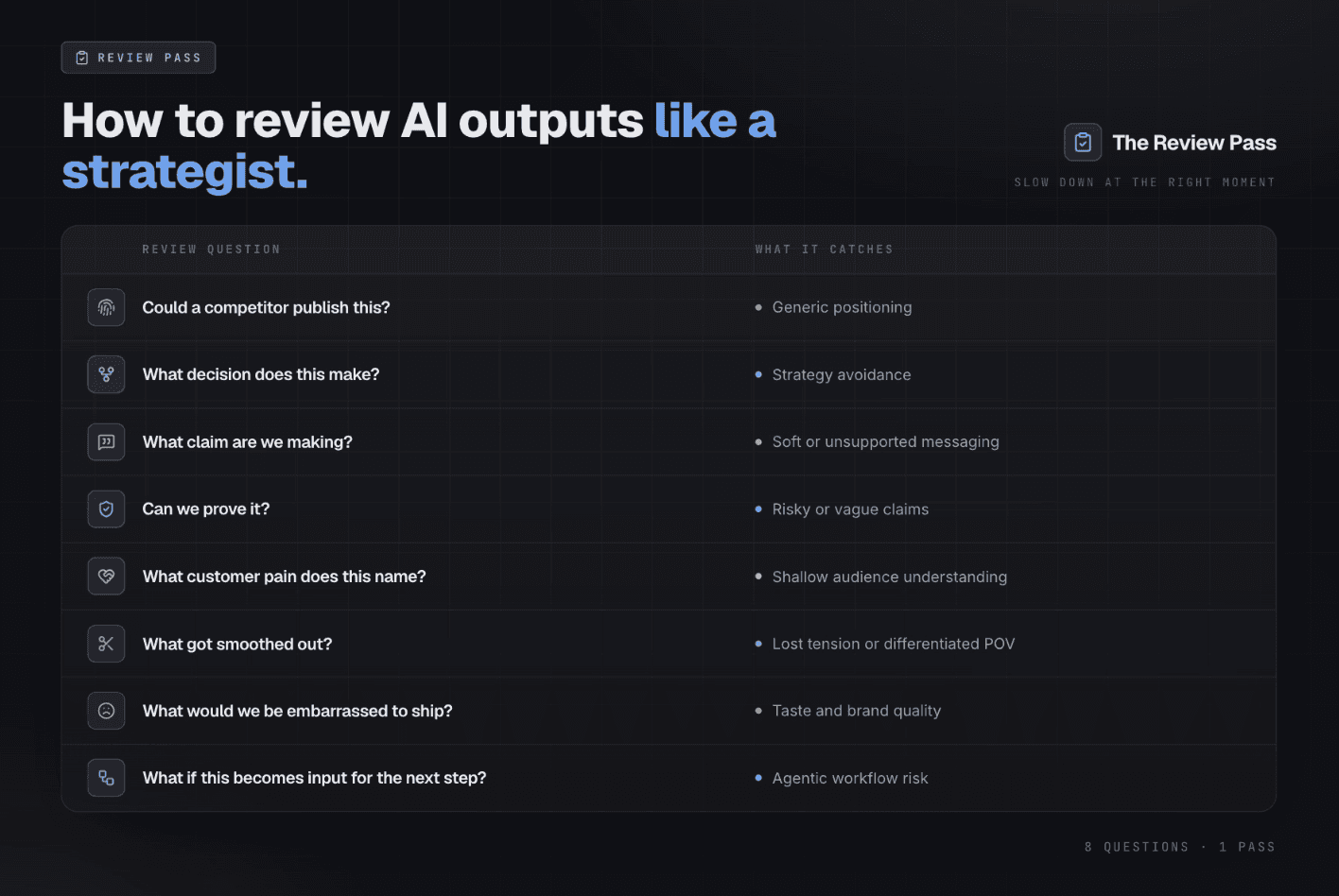
This kind of review turns judgment into a repeatable practice. It gives the marketer a way to slow down at the right moment and look for the things AI tends to miss.
The goal is not to make every output perfect. The goal is to stop passable work from moving through the system as if it were strategic.
That is where AI-enabled teams need discipline. Not every draft deserves another prompt. Sometimes it needs a sharper claim. Sometimes it needs a clearer customer insight. Sometimes it needs a human to say, “This is clean, but it is not the idea.”
That is the review layer doing its job.
Where Forward Deployed Marketers fit
The Forward Deployed Marketer is not valuable because they can generate more outputs.
They are valuable because they can raise the quality of what moves through the system.
An FDM understands the company strategy, the customer, the workflow, and the AI system well enough to review outputs in context. They know when something is plausible but off. They know when AI should produce options and when a human needs to choose. They know when an output can move forward and when it needs to be rebuilt from a better input.
That matters because as AI gets embedded into GTM workflows, review becomes an operating layer. It is not just one person editing copy at the end. It is a set of standards, questions, examples, and checkpoints that help the system produce better work over time.
The FDM turns review from personal preference into a reusable quality system.
They define what good looks like. They build the examples. They create the decision rules. They decide where human judgment belongs. They make sure the workflow does not simply generate more content, but produces work the team can actually use.
That is the difference between AI-assisted output and an AI-enabled GTM system.
One creates more drafts. The other compounds judgment.
The first draft is free. The judgment is not.
The market is filling up with people who can generate.
That skill is becoming easier, cheaper, and more available. The models are getting better. The interfaces are getting simpler. The gap between a blank page and a first draft is getting smaller every month.
The advantage moves somewhere else.
It moves to the people who can tell what is actually good. The people who can look at a clean output and see the missing decision. The people who can catch the unsupported claim, the generic insight, the flattened voice, the message that sounds right but will not move the customer.
AI can produce the first draft. It can format the brief. It can generate the options. It can push the work forward. But someone still has to decide whether the work is true, sharp, differentiated, trustworthy, and worth shipping.
That is judgment.
And in AI-enabled GTM, judgment is the skill that compounds.


