How to Write Copy That Actually Converts in Crypto
Matthew Baggetta
Head of Content, io.net
Feb 9, 2026
You can't build a growth flywheel if you don't know who you're building your product for or why users cannot live without it.
So much crypto marketing today comes off as dry and anodyne (at best), or pure robo-slop (at worst) when teams skip this step.
If you publish a website, then jump straight to tactical campaign execution without understanding what your target audience actually needs to hear and why it matters to them, you’re going to get roasted or worse – be effectively invisible
A crisp, confident (read: this does not mean ‘perfect’, or even ‘accurate’) target audience and product tailored messaging matrix helps prevent this. It forces you to put yourself in your user’s place, define exactly who you're serving and map your top 3 features to the specific problems those people experience, in terms that are visceral, vivid, and immediate. And if it doesn’t work after a first crack, it’s way easier to iterate and try something completely different.
Done right, a product messaging matrix is the foundation for content, partnerships, and community building that actually compounds. So let's dive in so you can start to build yours now.
Step 1: Define Your Primary Audience
Your audience isn't "crypto users." That's too broad to be useful. You need to get specific across as many dimensions as make sense for your product or service. Here are some good ways to think about defining your audience:
What values brought them to crypto? Financial freedom, privacy, decentralization, curiosity about new technology. Someone chasing sovereignty over their assets needs different messaging than someone experimenting with new tech. This shapes your entire tone.
What does their success look like (in the context of your project)? A crypto native grinding toward financial independence sees your product differently than a builder creating infrastructure for the next generation of the internet. Know which one you're talking to.
Where do they actually spend time? These are your watering holes, and they determine your distribution strategy. Crypto natives live on CT, Discord, and Telegram. Builders congregate on GitHub, Stack Overflow, and protocol-specific forums. Your content and partnerships should meet them there.
What do they care about beyond your product category? The ecosystems they follow, the cultural trends they track, the other projects they support. This context helps you speak their language and find partnership opportunities that feel natural rather than forced.
Step 2: Build Your Messaging Matrix
Once you know your audience, map each feature to a complete story. Generally speaking, I wouldn’t focus on more than the three most impactful, differentiated features you can identify. More than that and trying to get actionable feedback from messaging performance bercomes more of a crapshoot.
Building these matrices is really all about connecting what your product does to what your users struggle with and experience, in the context of how they could use your product or service, right now, day after day. Sometimes these are experiences users are oblivious to, because they’re mundane, or so common, they’ve become numb or apathetic towards them.
Your messaging matrix’s job is to bring these experiences to life – in vivid, direct, and explicit terms, the good, the bad, and the ugly – so readers have an aha moment, realize their situation sucks, and then become open to exploring solutions. Without that opening, there is no decision being made to use your product or not.
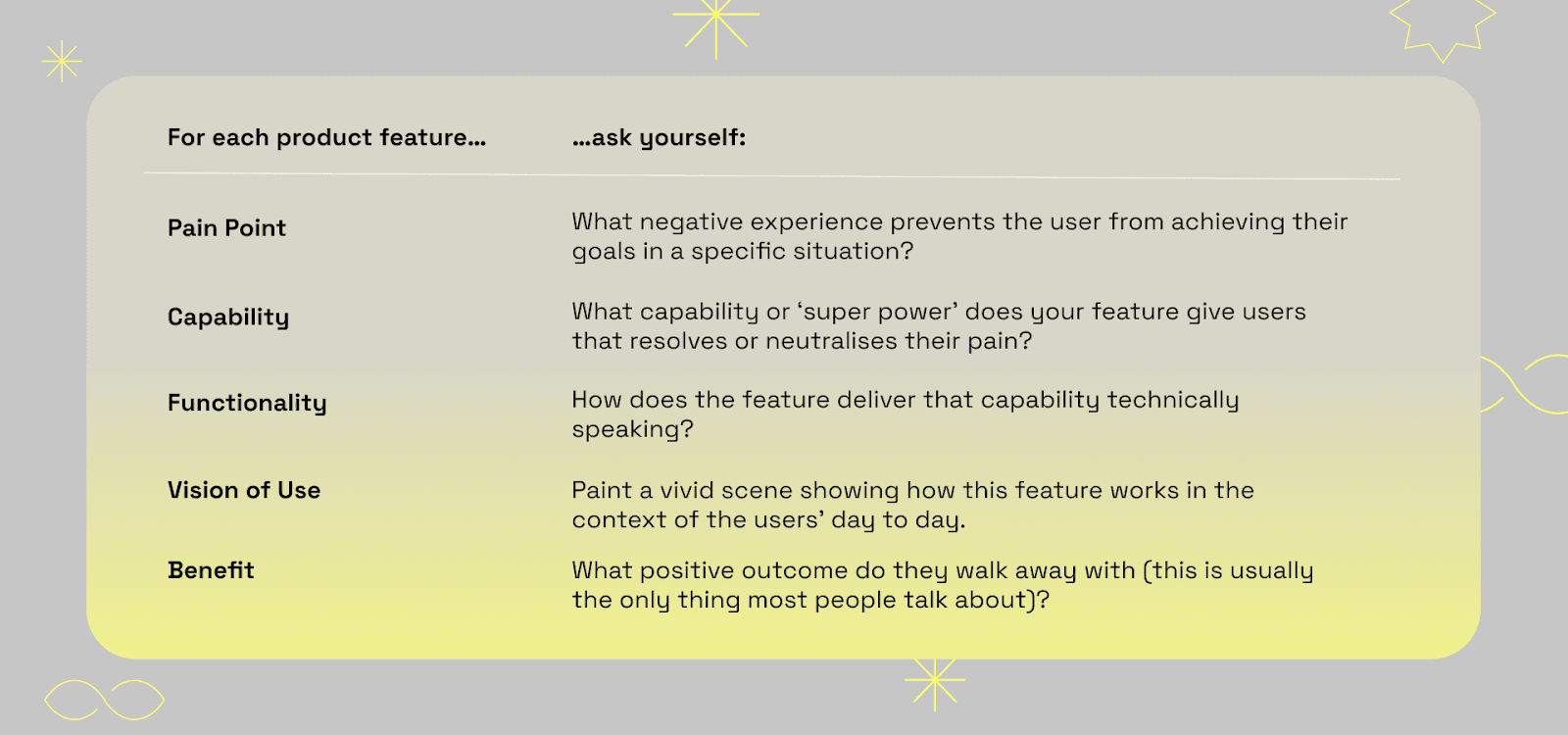
The order matters. Start with pain, not features. Your audience doesn't care about your technical architecture until they see themselves in the problem you're solving.
Example: Matrix in Action
Let's say you're targeting crypto natives: moderate to aggressive speculators chasing financial freedom, hanging out on CT and Discord, constantly bridging and swapping across chains in search of the next round trip.
Here's how a unified gas tank feature could map to the matrix:
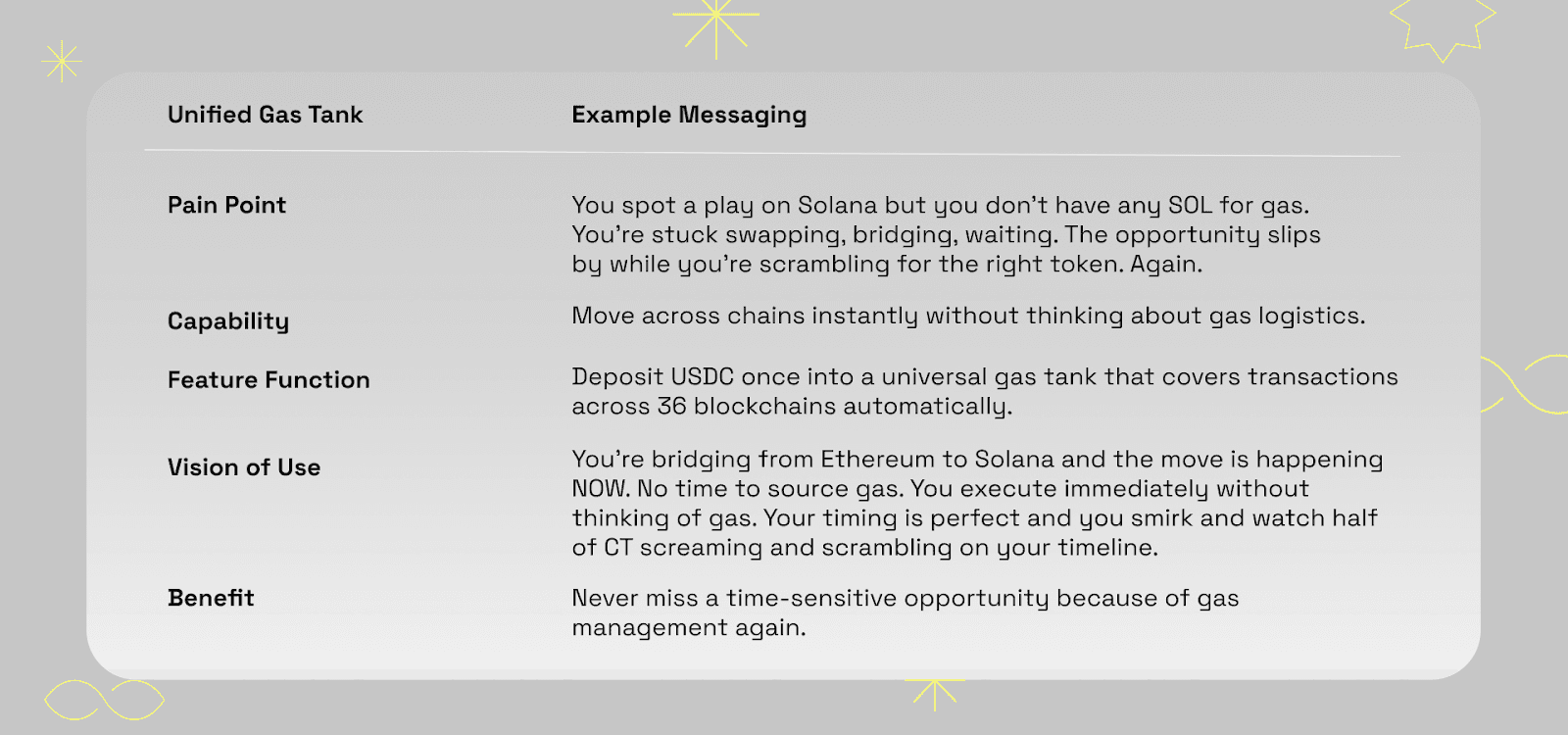
When you write each message, put yourself in your audience's shoes. Be the user. Use "you" language. Describe the frustration as it is felt and experienced, do not explain like some impartial third-party observer. The Vision of Use especially should be specific and urgent. Your audience should feel that scenario in their gut.
Context Matters
This type of marketing tool isn't a static document that you build, file away in a folder and then forget about. Its value is not (only) in building it, it’s in applying it to campaigns and activations. Your matrix is now a resource that you (or your favourite agent) can use to guide strategy and messaging across the marketing functions.
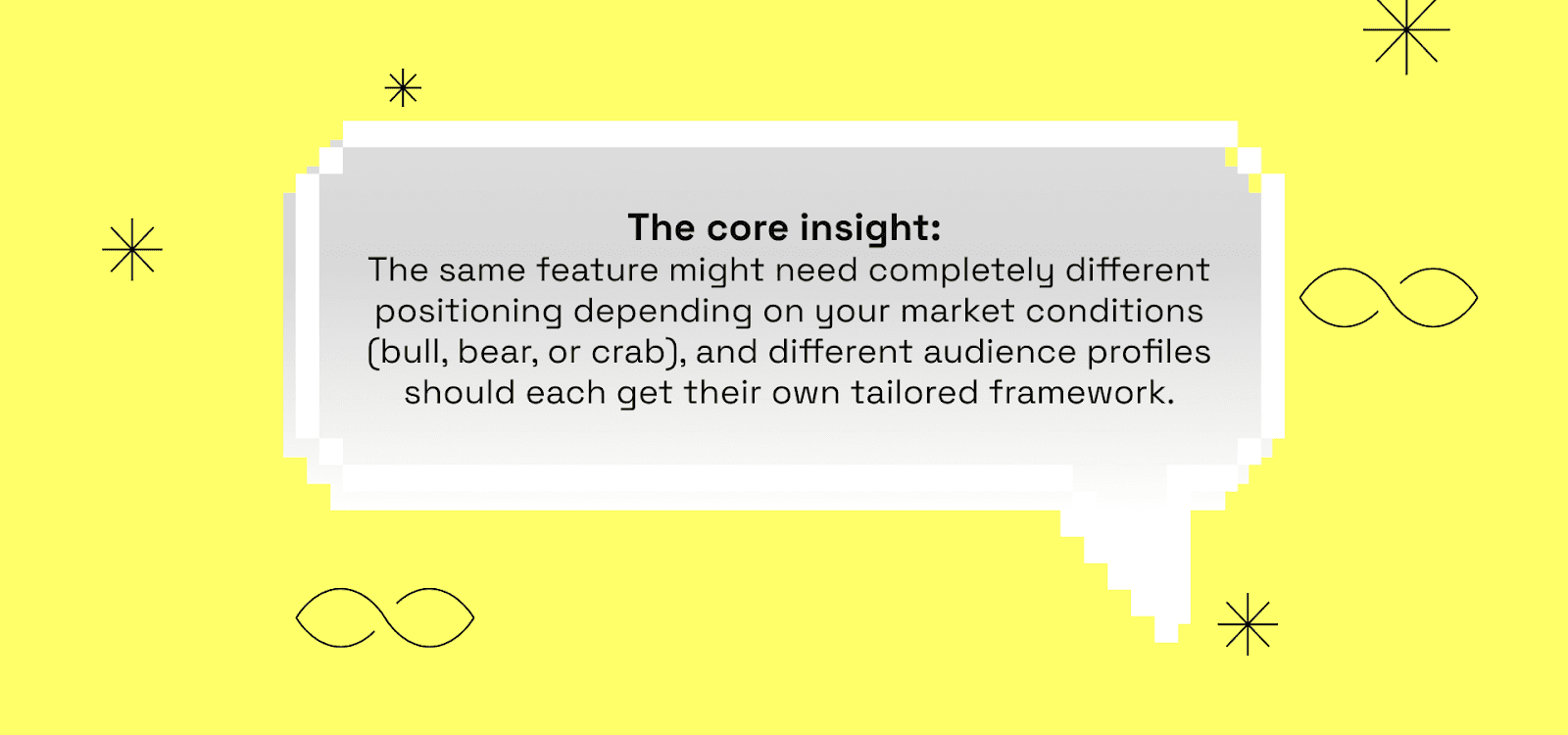
In speculative markets, your audience is optimizing for speed and opportunity capture. Pain points center on friction that costs them alpha. In necessity-driven markets like Argentina or Nigeria, the pain points are about access, stability, and protecting purchasing power. Same product, different story.
Once you've built your matrix, here's how to actually use it:
Threads and socials: Try mapping each post in a thread to a row. Open with the pain point as your hook, walk through capability and functionality in the body, close with the vision of use. Track which pain points drive the most engagement and double down.
Partnership pitches: Lead with the shared pain point your potential partner's audience also experiences. The vision of use becomes your co-branded content angle, showing both products in a single user workflow.
Community conversations: Train your team to recognize when someone describes a pain point from your matrix, even in different words. Respond with language pulled directly from your framework.
Landing pages: Structure each product section in matrix order: pain point as the headline, capability as the value prop, functionality as the explanation, vision of use as the closer.
Your matrix forces clarity on who you're talking to and what they actually need to hear. It gives you a repeatable system for content, partnerships, and community that speaks directly to your audience's lived experience.
Build it, deploy it across channels, track which pain points and visions of use land hardest, then iterate. That's how messaging compounds.


