
A Marketing Engagement Should Leave You More Capable Than It Found You
Olly Jones
BD & Growth
A company can receive every promised deliverable and still finish a marketing engagement more dependent than when it started.
The campaign launched. The content shipped. The dashboard exists. The workflow was built. The files were delivered.
Then the agency leaves.
The workflow only runs inside the agency’s account. Nobody internally understands the logic behind it. The prompts live in a private workspace. The team cannot tell whether the AI output is strategically strong or merely polished. When something breaks, the original builder is the only person who knows what to do.
The work was delivered. The operational capability was not.
This does not mean every ongoing agency relationship is a problem. Many companies deliberately choose external production, specialist expertise, or flexible execution capacity. The problem begins when the engagement is supposed to build internal capability but instead creates structural dependency.
A successful marketing implementation should be measured not only by what the partner produced, but by what the client can access, operate, evaluate, maintain, and improve after the engagement ends.
The client should own not only the output, but the systems that produced it.
What should a marketing parnter leave behind?
A marketing implementation partner should leave behind more than completed assets.
The client should retain control of the systems, accounts, context, workflows, documentation, quality standards, and operating knowledge required to continue the work.
That does not mean avoiding every third-party tool or eliminating the need for outside expertise. Most modern marketing systems rely on external software, AI models, data providers, and technical specialists.
The goal is choice.
The client should be able to continue with the partner because the relationship keeps creating new value, not because the partner remains the only person capable of operating what has already been built.
The four levels of marketing value
Outputs, assets, systems, and capabilities are often treated as if they mean the same thing.
They do not.
Each represents a different level of lasting value.
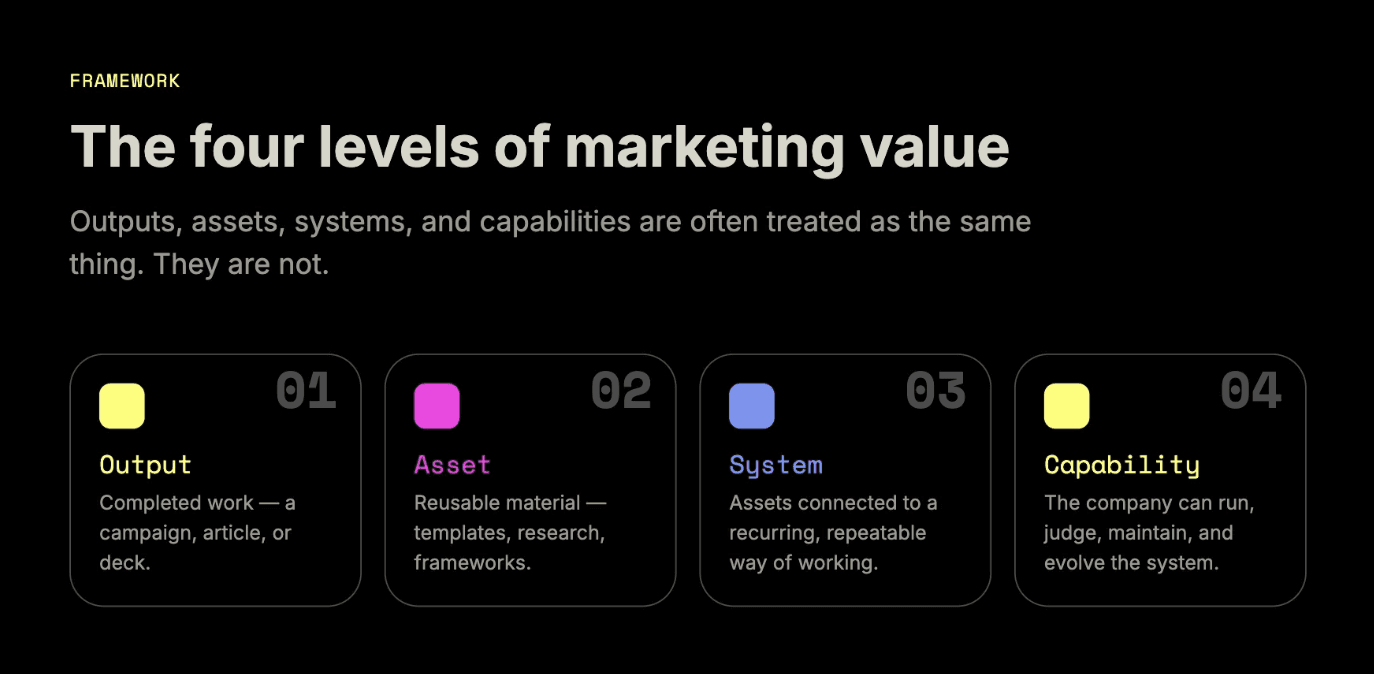
Output
An output is the completed work.
It may be a campaign, article, report, sales deck, research project, or content calendar. Outputs can create immediate value, but they do not necessarily change what the company is capable of doing next.
A company can receive a strong campaign and still need the same partner to recreate the process from zero the following month.
Asset
An asset is something the company can reuse.
Templates, prompt libraries, research repositories, design files, source code, customer interviews, and strategic frameworks all fall into this category.
Assets are more durable than outputs, but possession does not guarantee usability. A folder of files may technically belong to the client while remaining difficult for anyone internally to understand or apply.
A folder of files is not capability transfer.
System
A system connects assets to a recurring way of working.
It includes triggers, inputs, tools, owners, reviews, handoffs, and measurement. Instead of producing one deliverable, the system helps the company produce the work repeatedly.
This is a meaningful step forward. But a system can still create dependency if the client cannot access it, judge its output, or maintain the knowledge it depends on.
Capability
Capability means the company can operate the system, evaluate its performance, maintain its inputs, adapt it as the business changes, and decide when it should be improved or replaced.
Receiving the output tells you what was completed.
Receiving the capability changes what the company can complete next.
That is the level an implementation engagement should be designed to reach.
Chosen partnership versus structural dependency
Dependency is not automatically a problem.
A company may choose to rely on an external partner for media buying, creative production, campaign execution, specialist expertise, or additional capacity. In those cases, continued delivery is part of the product being purchased.
The client is not necessarily trying to internalize the work.
Structural dependency is different.
It appears when the company cannot reasonably continue, change providers, or bring the work in-house because the essential knowledge and control remain outside the organization.
The system may live in the provider’s account. The workflow may depend on undocumented manual fixes. The client may have the final files but not the editable sources. Nobody internally may know how quality is evaluated or how the system should be updated.
Outsourcing is a choice. Lock-in is the absence of one.
The healthiest long-term partnership is one the client is free to continue because the partner remains valuable, not one the client is unable to leave.
Why AI makes dependency harder to see
Traditional agency dependency is usually visible.
The agency produces the campaigns, manages the media, or supplies a specialist team. Everyone understands what remains external.
AI-enabled systems can create a less obvious form of dependency because the real value often sits behind the visible output.
A client may see the article, report, lead list, or campaign brief without seeing the system instructions, decision logic, source hierarchy, quality constraints, or fallback behavior that produced it.
The workflow may rely on context stored in a private workspace, code housed in an inaccessible repository, integrations controlled through the provider’s credentials, or manual interventions that were never documented.
The most important dependency may not be technical at all. It may be judgment.
The provider may know which outputs to reject, which claims need evidence, when the positioning is weak, which exceptions matter, and what “good” looks like for the company. If that judgment stays with the provider, handing over the prompts and accounts does not complete the transfer.
No lock-in is an architectural requirement
Ownership cannot be added during the final week of an engagement.
It has to shape how the system is designed from the beginning.
If the client is expected to own the result, the core accounts should be client-controlled where practical. Code, configurations, prompts, and workflow logic should be accessible. Dependencies should be visible. Documentation should be created while the system is built rather than reconstructed at the end.
Internal owners should participate early enough to understand the decisions behind the workflow. Quality standards should be made explicit. Maintenance requirements should be known before handoff.
No lock-in is not a clause in the contract. It is an architectural requirement.
This does not mean every prototype has to begin inside the client’s production environment. There may be good reasons to use a provider-controlled sandbox during testing, including speed, security, or access to specialized infrastructure.
The important question is whether the final dependency is deliberate, visible, and transferable.
If the provider’s environment remains necessary, both parties should understand what depends on it, what alternatives exist, and what would be required to move the system later.
The client should never discover those constraints only after the relationship ends.
What capability transfer actually means
A successful handoff should leave the client able to do five things:
access, operate, evaluate, maintain, and improve.
These five abilities are a more useful test than the number of files delivered.

Access
The client can reach the system and the materials it depends on.
That includes the relevant accounts, repositories, prompts, configurations, documentation, dashboards, and data sources. The client knows which subscriptions are required, who controls permissions, and what would stop working if the provider’s account disappeared.
A system that only functions inside the provider’s environment has not been fully transferred.
Operate
The internal team knows how the workflow functions in practice.
They understand what triggers it, which inputs it requires, where human review belongs, what gets handed off, and what happens when something fails.
This requires more than a written SOP. Internal owners need to run the workflow through real work while the partner is still present.
Documentation records the system.
Transfer proves the team can operate it.
Evaluate
The client can determine whether the system is producing good work.
This matters in every function, but especially in marketing. AI output can be technically correct and still be generic, poorly positioned, unsupported, off-brand, or disconnected from the customer.
A successful handoff includes the quality standards, examples, review criteria, claim rules, and escalation paths required to judge the work.
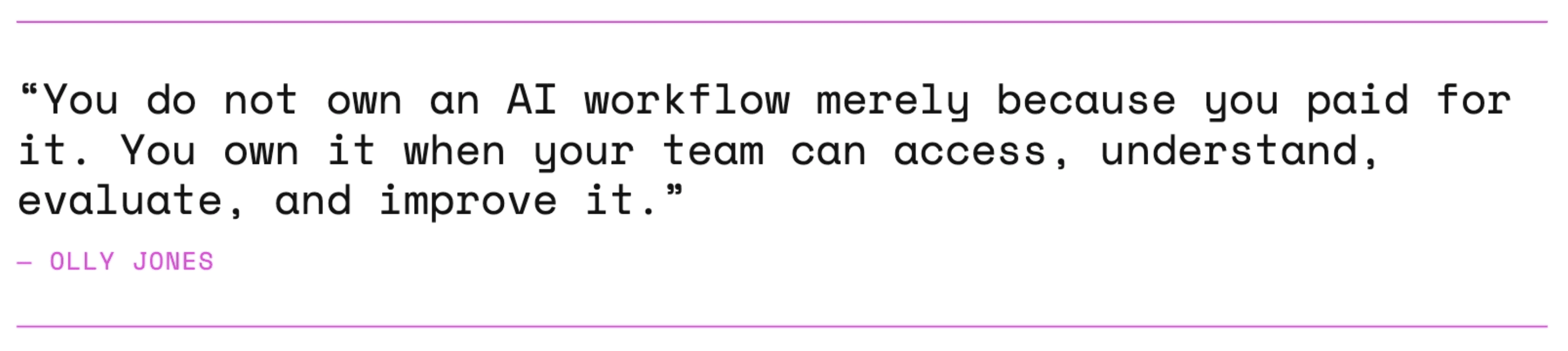
Access without evaluation capability is not ownership.
The partner must transfer not only the system, but the judgment required to operate it well.
Maintain
The internal team knows how to keep the system useful.
They understand how context is updated, how permissions are managed, what routine maintenance is required, which dependencies are fragile, and how normal failures should be handled.
This is where context ownership becomes important.
A company may possess every document used by the workflow and still lack a usable context layer. The sources may be contradictory. Nobody may know which version is current. Important decisions may never be recorded. Updates may have no owner.
The client does not truly own the context layer until someone inside the company knows how to maintain its relevance.
Improve
The company can adapt the system as the business changes.
That does not mean every marketer needs to edit code or rebuild an integration. It means the organization understands which parts can change, what skills are required, how performance should inform future decisions, and when an outside specialist is needed.
A handoff preserves the current system.
Capability transfer allows the system to evolve.
The client should be able to prioritize improvements, replace a tool, update the workflow, or transition the system to another operator without depending on undocumented knowledge from the original builder.
What should actually be left behind?
The exact handoff will vary, but a serious implementation engagement should leave behind a clear operating foundation.
The client should have access to the relevant systems, source files, prompts, configurations, and code where applicable. The workflow should be documented, including its triggers, inputs, owners, review points, handoffs, exception paths, and known limitations.
The company should retain the context the system depends on, along with clear responsibility for keeping it current. Quality standards should be explicit enough that internal owners can review the output without relying on the original partner’s intuition.
Training should happen through live use, not only through a final presentation. The internal team should operate the workflow, encounter normal failures, ask questions, and update the documentation before the engagement ends.
There should also be a clear maintenance plan and an improvement roadmap. The handoff should explain what requires regular attention, what may degrade over time, and what the company should consider building next.
Most importantly, every part of the system should have an internal owner.
The handoff should describe not only what exists, but who is responsible for keeping it useful.
How to test whether capability has transferred
Capability transfer should be demonstrated, not inferred from the presence of files.
Before the engagement ends, the internal team should be able to answer four practical questions.
Can we run the workflow without the original builder?
Can we judge whether the output is good?
Can we handle normal errors and maintain the context it requires?
Can we identify and prioritize improvements?
A fifth question reveals whether the company has real freedom:
Could another internal or external operator take over this system if necessary?
When the answer is yes, the capability has moved closer to the client.
When every answer still points back to the original provider, the handoff is incomplete.
Where forward deployed marketing fits
Forward deployed marketing is designed to build capability inside the company rather than create permanent dependence on an outside production team.
The FDM team works close to the company’s real environment, involves internal owners during the build, documents decisions as they happen, and installs quality review into the workflow.
Access, training, ownership, and capability transfer are part of the implementation design rather than tasks reserved for the end.
The purpose of an FDM engagement is to reduce the gap between what the client can do with Myosin and what the client can do without Myosin.
At the beginning of the engagement, the company may rely on the FDM team to diagnose the problem, design the workflow, build the system, and guide its operation.
By the end, designated internal owners should be able to access it, run it, evaluate its quality, handle normal failures, maintain its context, and improve it over time.
The provider’s activity should decline as the client’s capability increases. That does not mean agencies must become irrelevant. The company may still choose continued support for technical maintenance, optimization, governance, specialist expertise, or a new build phase.
The reason to continue should be new value.
It should not be that only agency knows where the system lives, how the prompts work, or what to do when something breaks.
Continued support should be a choice
The strongest end state is not a company that never needs outside help.
Modern marketing systems are complex. Tools change. Models change. Strategies change. Specialist expertise will remain valuable.
The strongest end state is a company free to choose what help it needs next.
It may operate the system independently. It may retain limited maintenance support. It may bring Myosin back to address another bottleneck. It may transition part of the work to an internal team or another specialist.
All of those are valid outcomes when the underlying capability belongs to the client.
The relationship should continue because the partner provides perspective, acceleration, expertise, or new capability.
It should not continue because the partner retained control over old value.
Leave the company with more than deliverables
A successful implementation engagement leaves behind more than completed work.
It leaves behind assets the client can use, systems the client can access, knowledge the team can apply, judgment the team can exercise, and capability the company can improve.
The real test begins after the partner leaves.
Can the team continue the work?
Can it recognize when the system is failing?
Can it maintain the context, adapt the workflow, and decide what comes next?
The real legacy of a marketing engagement is not what the partner produced.
It is what the company can now produce, operate, and improve without them.
Audit what your current marketing systems actually leave behind.


