
See what happens during a 90-day forward deployed marketing engagement, from diagnosing the bottleneck to installing and transferring an AI-enabled GTM system.
Olly Jones
BD & Growth
Aug 10, 2026
The best AI projects do more than automate tasks, they change how the company operates.
Right now, the pattern we are seeing across frontier tech is familiar. Someone identifies a promising use case for AI, tests a tool, builds a prototype, and shows leadership that the workflow can work. The demo is convincing and the potential is obvious.
Then the normal business week returns.
The workflow depends on its creator. The inputs are inconsistent. Nobody owns the review. The tool does not fit the surrounding process and so users fall back to the old way of working, and the pilot disappears.
The automation worked, the project simply stopped too early.
A 90-day forward deployed marketing engagement is designed around the harder part: turning a promising AI use case into an installed GTM capability.
The first month finds the right problem. The second month builds the system. The third month makes it part of how the team works.
What happens during a 90-day forward deployed marketing engagement?
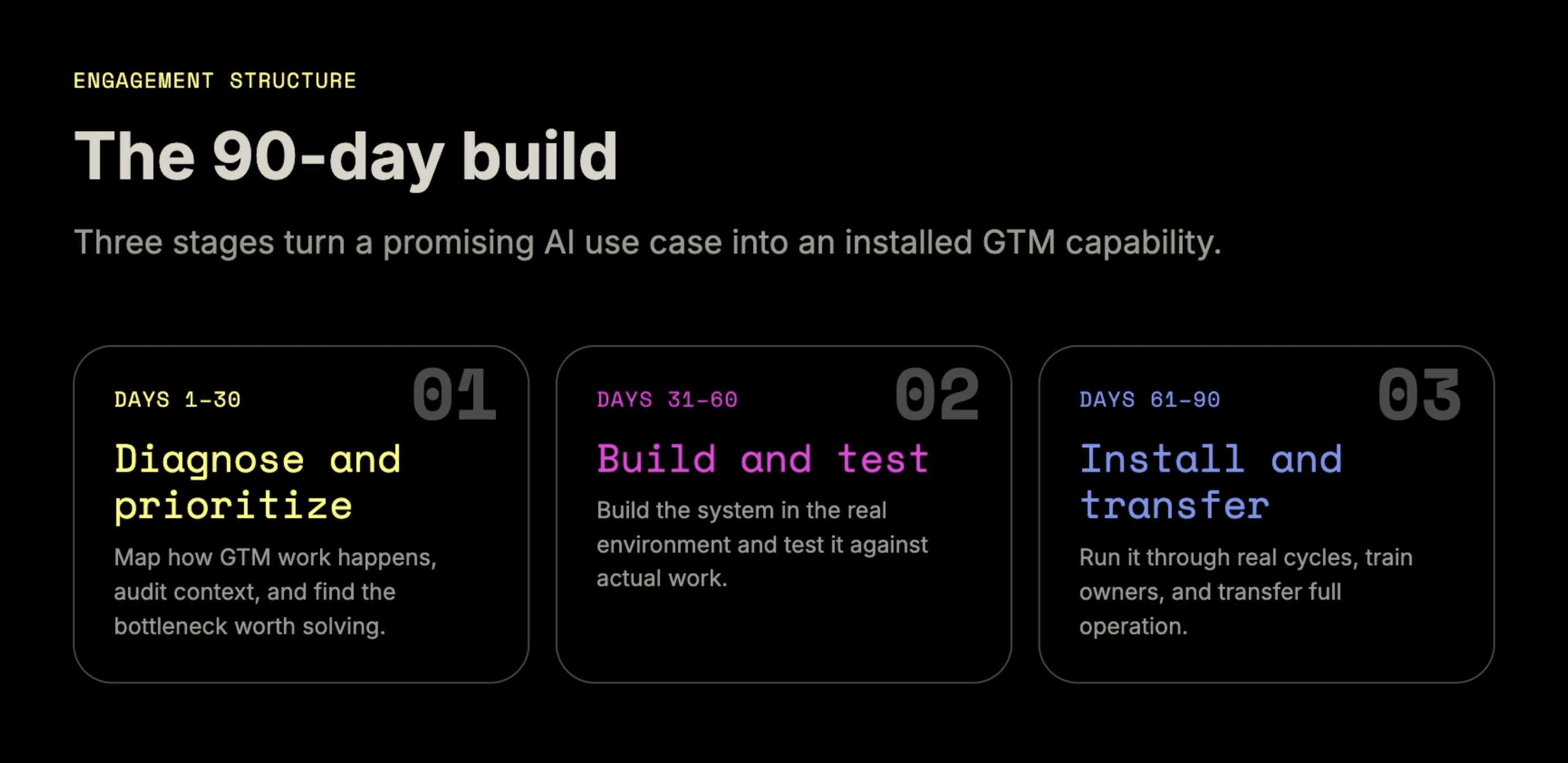
A 90-day forward deployed marketing engagement moves through three stages: diagnosis and prioritization, building and testing, and installation and transfer.
The FDM team works inside the company’s real GTM environment with its people, workflows, tools, data, customer knowledge, and operating constraints. The goal is to identify a consequential bottleneck, build a focused AI-enabled system around it, and leave the internal team able to operate and improve what was created.
By the end of the engagement, the company should have more than a prototype. It should have a working system with clear inputs, defined owners, deliberate human review, documented handoffs, performance measures, and an internal operator who knows how to run it.
Why 90 days?
90 days creates a useful constraint.
It is long enough to understand how work actually moves through the company, build a focused system, test it through repeated use, and expose the problems that only appear in real conditions. It is also short enough to force prioritization.
A two-week sprint can produce a prototype, a roadmap, or an initial automation. It rarely provides enough time to see how the workflow behaves when inputs are incomplete, deadlines are tight, users make mistakes, or the original builder is not present.
An open-ended transformation program creates the opposite risk. The work can expand indefinitely, priorities can shift, and capability transfer can remain something that happens later.
A defined end date forces a clearer question:
What should the company be able to do by day 90 that it cannot do today?
Ninety days is enough time to install a focused operating system. It is not enough time to automate an entire company.
That limitation is valuable. It keeps the work centered on the highest-leverage constraint rather than the longest possible list of AI use cases.
Myosin typically deploys two forward deployed marketers into the engagement. The pair brings wider strategic and technical range, built-in peer review, and less dependence on one person’s private knowledge.
They work part-time but remain embedded in the company’s real environment. That gives them enough proximity to understand the system and enough distance to redesign it.
The work begins with the bottleneck
A strong engagement does not begin by asking which AI tool the company should buy.
It begins by asking where GTM work repeatedly slows down, where important context gets lost, which decisions are constantly remade, and where a better system could improve speed, quality, revenue, or learning.
The bottleneck may be obvious. Customer calls are happening every week, but the insight never reaches campaigns or product decisions. Content production depends on one executive. Campaign briefs take days because the same context is reconstructed every time. Sales requests arrive through scattered channels and are difficult to prioritize.
In other cases, the stated problem is only a symptom.
A company may ask for an AI content engine when the real issue is inconsistent positioning. It may ask for lead-generation automation when the CRM data is unreliable. It may want an agent when nobody has defined who reviews the output or what the system should do when confidence is low.
The engagement starts by finding the operating problem underneath the request.
Potential builds are then evaluated against a few practical criteria. Does the workflow matter to the business? Does it happen often enough to justify systemization? Are the necessary inputs and access available? Is there an internal owner who will use it? Can the system be tested through real work within the engagement?
The work begins with the business bottleneck, not the AI tool.
Days 1–30: Diagnose and prioritize
The first month is about understanding the environment well enough to build the right thing.
The FDM team begins by mapping how GTM work currently happens. That includes the company’s strategy, customer segments, positioning, channels, team responsibilities, tools, recurring workflows, and decision points.
The goal is not to document the organization for its own sake. It is to see where signals enter, where decisions happen, how work moves between people and tools, and where the system repeatedly breaks.
The team also audits the context that future workflows will need.
This may include customer research, sales calls, product information, positioning, proof, campaign history, editorial standards, internal decisions, and prior performance. The important distinction is between usable context and a document dump.
Some information will be current and reliable. Some will be contradictory, outdated, inaccessible, or missing. The engagement needs to determine what can be reused, what needs to be cleaned, and what must be created before the workflow can produce trustworthy work.
This is the difference between building a usable context layer rather than creating another document dump.
The team then examines the recurring workflow around the bottleneck. They identify what triggers the work, which inputs are required, where handoffs occur, how decisions are made, and what happens when something goes wrong.
By the end of the first month, the company should be able to answer a small set of questions clearly:
What are we building?
Why does it matter?
Who will use it?
What context does it require?
Where does human judgment belong?
Who will own it after the engagement?
How will we know it improved the work?
The output of this phase is a focused build plan, not a broad AI roadmap.
There may be many good opportunities. The engagement should choose the one or two systems capable of changing how the company operates within the next 60 days.
Days 31–60: Build and test
The second month turns the selected opportunity into a working system.
The FDM team builds around the company’s existing environment rather than imposing a predetermined stack. Some parts of the workflow may remain in current tools. Others may require new integrations, lightweight internal products, agents, automations, or a structured knowledge layer.
The goal is not to replace every tool.
It is to make the important workflow function as a connected system.
A content workflow, for example, may need access to customer language, positioning, evidence, and editorial standards. It may need to turn research into a brief, generate a first draft, route the work for review, and capture performance after publication.
The AI model is only one part of that system.
The build must also define what AI can do independently, what it can prepare for a person, what requires approval, and what should remain fully human-led.
Good implementation does not remove people from the workflow. It places human judgment where it creates the most value.
This is especially important in marketing, where quality often depends on interpretation rather than correctness alone. A system may produce grammatically clean work that is strategically weak, unsupported, generic, or misaligned with the customer.
The review layer must be designed into the workflow before output begins moving at scale.
Testing also happens with real work.
The team uses actual customer calls, live campaign inputs, current product information, real sales requests, normal deadlines, and imperfect data. This is where the system reveals what the prototype could not.
The inputs may be missing and the instructions may be ambiguous. A handoff may create unnecessary delay.
A workflow tested only on ideal inputs is still a prototype.
The second month is where the system becomes real enough to fail in useful ways.
The FDM team documents the workflow as it is built, including its purpose, inputs, owners, instructions, approval logic, integrations, exceptions, known limitations, and maintenance needs.
Documentation is not an administrative task saved for the end. It is part of turning the system into something the company can own.
By day 60, the workflow should be functioning with actual users, data, and tools. It may still need refinement, but it should no longer depend on a polished sandbox demonstration.
Days 61–90: Install and transfer
The third month is what separates installation from prototyping.
The workflow now runs through repeated cycles of real work. Users encounter the system in the rhythm of their normal responsibilities, not only during a scheduled test.
This reveals whether the workflow is genuinely useful.
Recurring errors become visible and review burden can be measured. Ownership gaps surface and the users discover where they need more control, more context, or clearer instructions. The system may prove that some automation should be removed rather than expanded.
The goal is not to defend the original design. It is to improve the workflow until the team can rely on it.
That requires training, but not only training on where to click.
Users need to understand why the workflow exists, what inputs it needs, what good output looks like, what AI is responsible for, where human review belongs, and how to respond when the system fails.
Operational training teaches someone how to run the workflow. Judgment training teaches them how to know whether the workflow is producing valuable work. Both matter.
The company also needs explicit ownership. Someone must be responsible for daily operation, quality, context maintenance, technical maintenance, performance review, and future improvement.
Those responsibilities can be shared, but they cannot remain ambiguous.
The FDM team establishes a maintenance and governance rhythm that matches the system. A simple workflow may only need a recurring quality review and a process for updating context. A more complex system may require exception logs, performance monitoring, access controls, and a regular review of costs and integrations.
The purpose is not to create bureaucracy.
It is to prevent the system from becoming less useful through stale context, ignored failures, or unclear ownership.
Transfer happens throughout the third month. The internal team receives system access, workflow documentation, prompts and instructions, architecture notes, training materials, known limitations, baseline performance, and a prioritized improvement roadmap.
The company should understand what was built and why it works the way it does.
It should also understand what not to automate, which assumptions still need testing, and what future opportunities should wait.
The final deliverable is the company’s ability to operate and improve the automation.
What every installed workflow needs
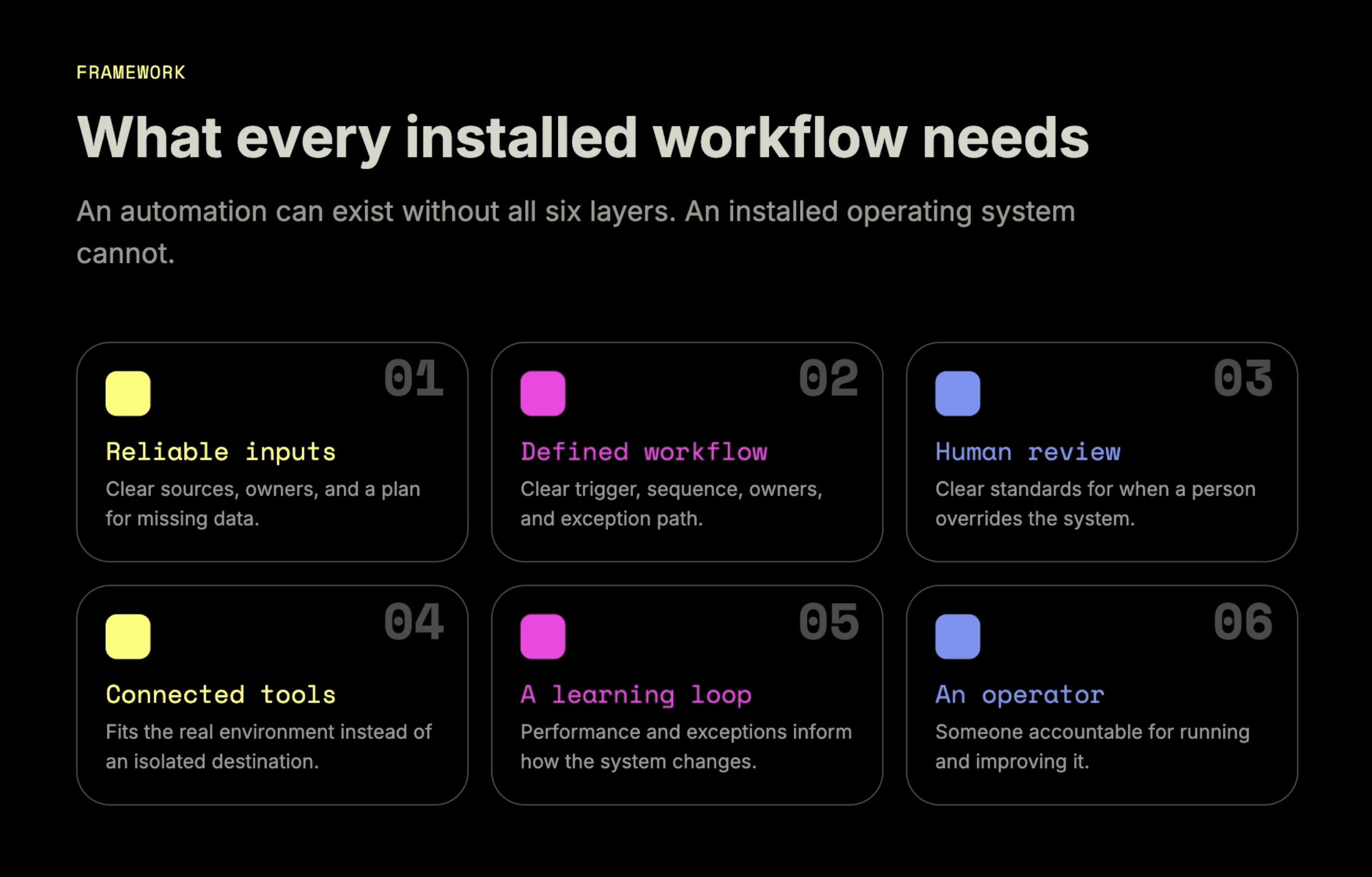
The specific system will vary from company to company, but every installed workflow needs the same basic layers.
It needs reliable inputs. The system must know where its context and data come from, who maintains them, and what happens when something is missing.
It needs a defined workflow. The trigger, sequence, owners, expected output, and exception path must be clear.
It needs deliberate human review. The team should know what requires approval, which quality standards apply, and when a person should override the system.
It needs connected tools and handoffs. The workflow must fit the company’s real environment rather than creating another isolated destination.
It needs a learning loop. Performance, user feedback, and exceptions should inform how the system changes.
And it needs an operator. Someone must remain accountable for running, maintaining, and improving the workflow.
An automation can exist without all six layers. An installed operating system cannot.
What the company should have by day 90
By the end of a 90-day engagement, the company should have a small number of working AI-enabled workflows connected to real GTM priorities.
Those workflows should have reusable context, clear owners, documented inputs, deliberate human review, functioning handoffs, and credible measures of performance.
The internal team should know how to operate the system, evaluate its output, handle normal exceptions, and maintain the knowledge it depends on.
The company should also have a clear roadmap for what comes next. That may include expanding the installed system, addressing another bottleneck, improving the context layer, retiring an old workflow, or deliberately waiting until the organization is ready.
Continued support may be useful, but it should not be required simply to understand what was built.
FDM works best for companies that already have a functioning GTM motion, recurring workflows with measurable friction, leadership participation, and a desire to own the resulting capability.
It is not a way to automate the entire marketing function in three months. It is a focused process for installing the smallest coherent system capable of materially improving how GTM work happens.
The end product is an installed capability
A 90-day forward deployed marketing engagement follows a disciplined sequence.
The first month identifies the right constraint and defines what should be built. The second month builds and tests the system in the company’s real environment. The third month turns repeated use into ownership, documentation, and internal capability.
The company should not finish with another strategy deck, a polished demo, or a collection of undocumented automations.
It should finish with working systems, clear owners, reusable context, trained users, documented workflows, performance measures, and the ability to improve what was built.
The final deliverable is not the automation.
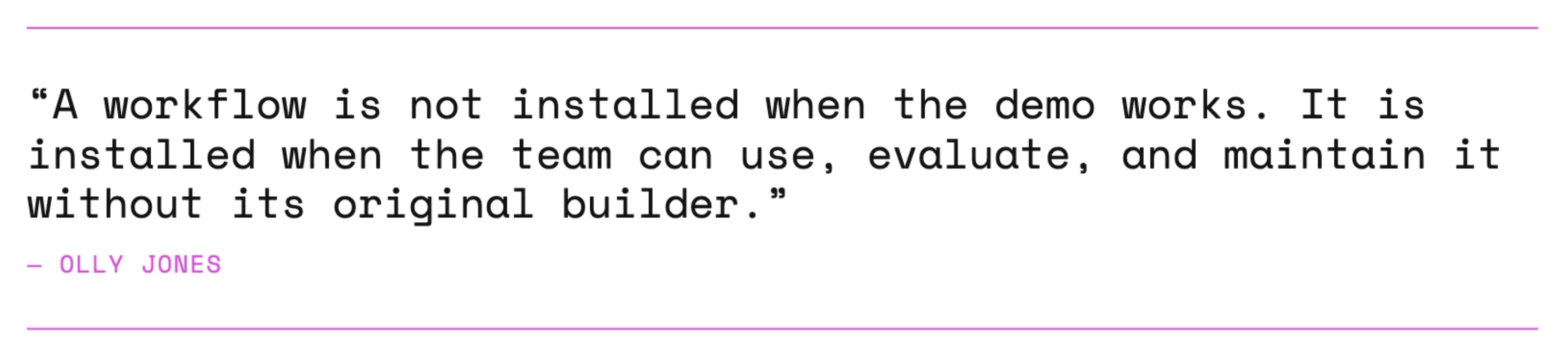
It is a company that knows how to operate and improve it.
Find the first GTM system worth installing.
Frequently asked questions
What happens during a forward deployed marketing engagement?
A forward deployed marketing engagement begins by diagnosing the company’s GTM environment and identifying the highest-value bottleneck. The FDM team then builds and tests a focused AI-enabled system, installs it through real use, trains internal owners, documents the workflow, and transfers control to the company.
Why does an FDM engagement last 90 days?
Ninety days provides enough time to understand a real operating environment, build focused systems, test them through repeated use, resolve adoption problems, and transfer ownership. It also creates a constraint that forces prioritization.
How many people work on an FDM engagement?
Myosin typically deploys two forward deployed marketers. The pair provides broader strategic and technical capability, built-in peer review, faster implementation, and less dependence on one individual builder.
What does an FDM team build?
The exact system depends on the company’s highest-value GTM bottleneck. The team may build context infrastructure, signal-capture workflows, production systems, research processes, campaign workflows, sales enablement tools, or other connected capabilities.
What does the company own after the engagement?
The company should retain access to the systems, workflows, context, documentation, prompts, configurations, code where applicable, training materials, performance measures, and operating knowledge created during the engagement.
How do you know whether an AI workflow is installed?
An AI workflow is installed when it is repeatedly used, has reliable inputs, defined ownership, deliberate human review, documented handoffs, performance measurement, and an internal team capable of operating and improving it.


