
Your AI Is Only as Good as Your Context Layer
AI marketing is hitting a context ceiling. Learn why better outputs require memory layers, clearer inputs, and systems built for judgment and learning.

People are building context layers everywhere now, even if they do not call them that yet.
Some are creating Obsidian vaults for Claude Code, dumping markdown files into project folders, and loading Claude Projects, Custom GPTs, or ChatGPT project spaces with instructions, writing samples, and reference docs. Teams are doing the same thing through Notion, Google Drive, Slack, and whatever internal wiki has become the unofficial source of truth.
Different tools. Same pattern.
Everyone is trying to solve the same problem: AI keeps missing the context.
That is the signal. The AI productivity wave is hitting its first real ceiling. The tools can generate more work, but more work is not the same as better work. Productivity does not compound when the model does not understand the company, the customer, the strategy, the decisions, the voice, or the operating reality behind the task.
AI did not fail because it could not write. It failed because it did not know what mattered.
The first wave of AI marketing was obsessed with output. Suddenly, everyone could produce more, so they did. But that also made the real problem harder to ignore.
Most teams do not have a production problem. They have a context problem.
AI did not break their marketing. It revealed that the underlying operating system was never that coherent to begin with.
The strategy lived in one deck. The ICP notes lived in someone’s head. The founder’s actual point of view lived in a handful of voice memos. The sales objections lived in call transcripts nobody listened to. The best customer language lived in scattered Slack messages. The campaign decisions lived across three meetings, two docs, and one person who is now on vacation.
Then someone opened an AI tool and asked it to “write a thought leadership post.”
Of course the output was slop. The model did not know what mattered.
The issue is not generation anymore
The market has moved past the question of whether AI can create marketing assets. It can.
It can write the launch post, the nurture email, the blog outline, the campaign brief, the ad variants, the sales enablement doc, the event recap, the executive LinkedIn post, and the internal strategy memo.
The issue is whether any of it is good.
Good does not mean grammatically correct. Good does not mean neatly formatted. Good does not mean “sounds like a startup.” Good means it has specificity. It carries a point of view. It reflects the company’s actual position in the market.
That kind of work does not come from a better prompt alone.
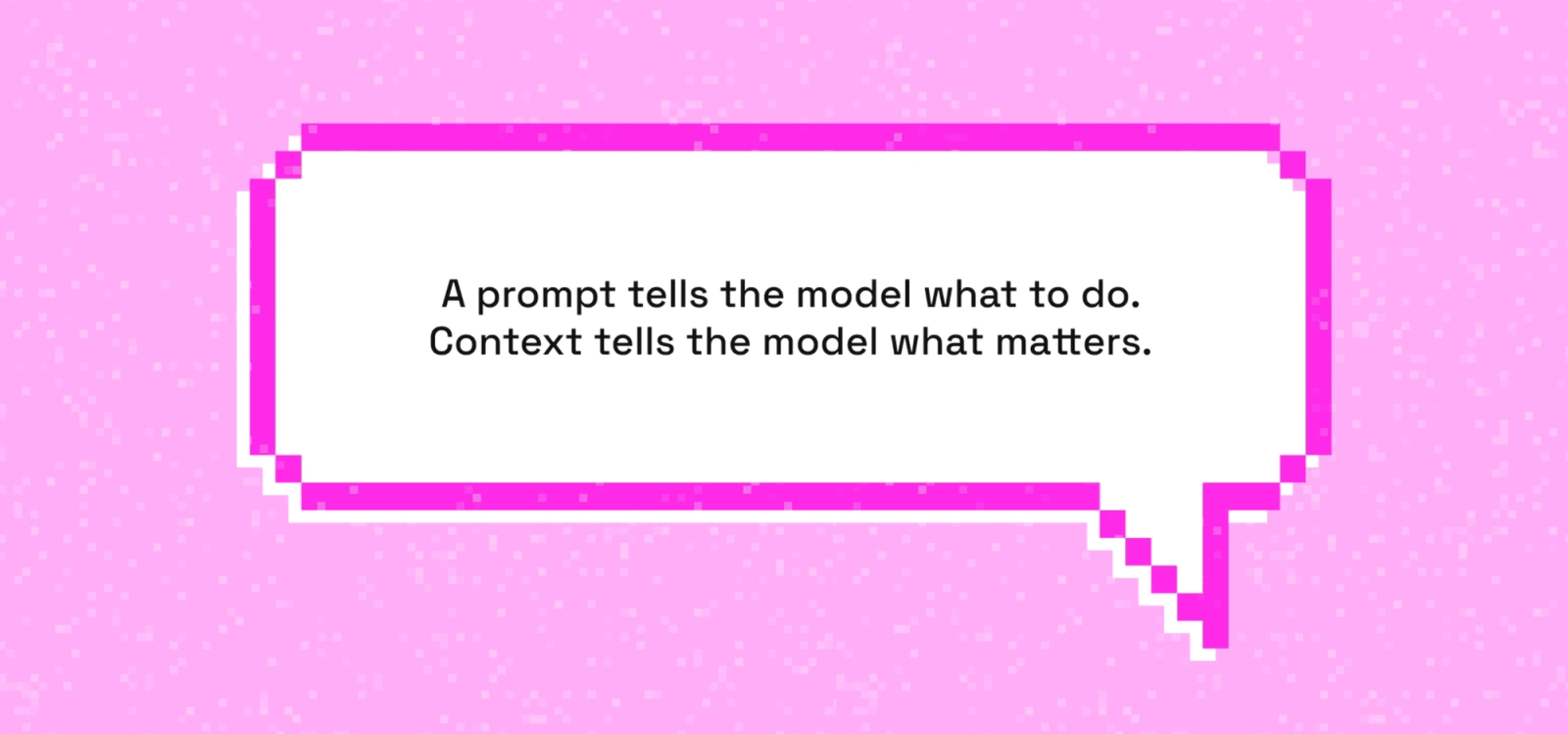
This is where we see a lot of AI marketing fall apart. Teams treat the prompt like the strategy. They collect prompt libraries, trade templates, and then ask for “better metrics,” but the actual inputs still suck. The model gets a task, but not the operating reality around the task.
A prompt says:
Write a launch post.
A context system says:
Here is who we serve. Here is what they currently believe. Here is what we need them to understand. Here is the category tension. Here is the founder’s point of view. Here are the objections we keep hearing in sales calls. Here are the proof points we can actually defend. Here is the tone that earns trust. Here is what we already tried. Here is what did not work. Here is what we are trying to learn this month.
That is a very different input layer and it produces a very different kind of work.
A prompt library is not a GTM system
Prompt libraries are useful. They can standardize recurring tasks. They can help teams move faster and reduce the friction of starting from scratch. But a prompt library is not a GTM system.
It does not know if your ICP has changed. It does not know your sales team keeps hearing the same objection. It does not know the last campaign underperformed because the audience was too broad. It does not know which proof points are strong and which ones are still aspirational.
Unless that context exists somewhere the system can use, the prompt is operating in a vacuum.
This is why so many teams get excited about AI, then slowly become disappointed by the results they are seeing. The first outputs feel impressive because the baseline was a blank page. But over time, the work starts to feel repetitive. The voice feels off and the content sounds like everyone else. The team starts spending more time editing the output than executing.
The problem is that teams are trying to automate execution before building the context layer.
Better marketing requires better inputs. Better inputs require better systems for capturing, organizing, updating, and applying what the team knows.
AI slop is usually a systems problem
It is easy to make fun of AI slop.
The vague LinkedIn post. The over-polished announcement. The startup blog that says nothing in 900 words. The campaign concept that sounds like it was built from a list of trending nouns. The deck that looks impressive until someone asks what it actually means.
But most AI slop is not really a model problem.
It is a systems problem.
A powerful model gets plugged into weak positioning. Or stale messaging. Or disconnected strategy. Or a team that has not agreed on who the work is for. Or a company that has not translated customer insight into usable language. Or a marketing function that has no memory of what it learned last month.
The result is not surprising. The AI fills in the gaps with the most statistically available version of marketing language.
That is why so much AI-generated work feels smooth but empty. It has structure without substance. It has polish without judgment. It has motion without direction.
The machine can generate. But it cannot know what the team never captured.
This is the uncomfortable part: AI makes the absence of strategy visible. It exposes unclear positioning, weak briefs, scattered context, and handoffs that were already broken.
When those people are in the room, the work can still function.
When AI becomes part of the workflow, the missing context becomes obvious.

Why everyone is reaching for vaults
This is why the Obsidian vault trend is interesting. Not because every marketing team needs to use Obsidian. They do not.
The tool is not the point. The behavior is the point.
People are building vaults because they are trying to give AI something it does not naturally have: persistent, structured, reusable memory.
Obsidian works well for this because it is simple at the base layer. Markdown files. Folders. Links. Local control. Portable knowledge. A vault can become a place where notes, decisions, references, projects, examples, and ideas connect instead of disappearing into chat histories or abandoned docs.
For individuals, that can become a second brain.
For teams, the same impulse points toward something more important: a shared context layer.
Marketing teams need a place where strategy does not die in a deck. Where customer language does not disappear after the call. Where campaign learnings do not get buried in a recap nobody opens.
Again, this does not have to be Obsidian. It could be Notion. It could be Google Drive. It could be a custom system. The specific stack matters less than the operating logic.
Can the team capture important context?
Can AI retrieve it when needed?
Can humans maintain it?
Can the system improve over time?
Those are the real questions.
Obsidian is just a clear expression of the larger shift of people moving from prompt engineering toward context engineering.
What a GTM context system needs
A useful GTM context system does not need to be complicated. In fact, the simpler it is, the more likely the team will actually use it. The point is not to collect more documents. The point is to make the context reusable at the moment work happens.
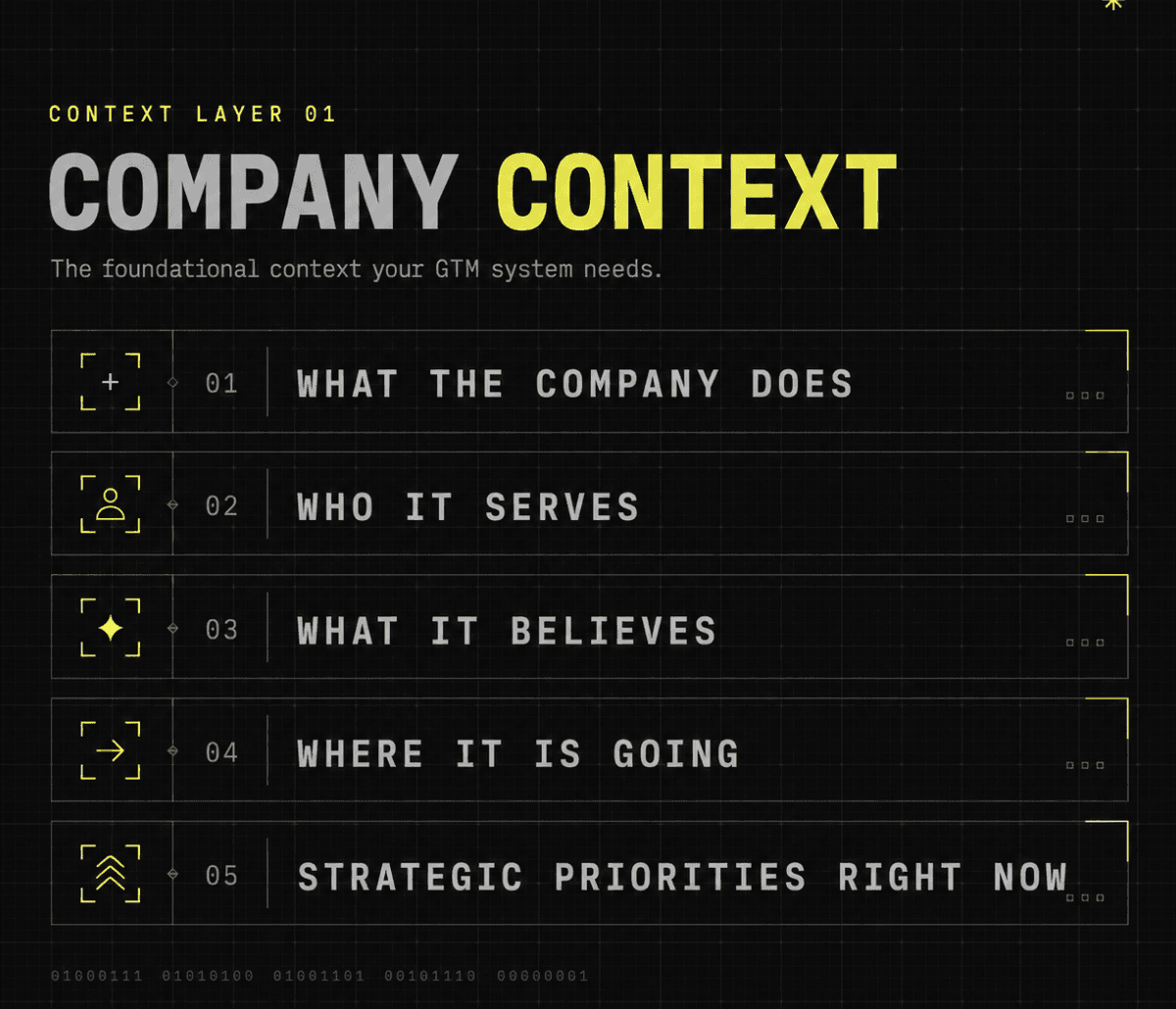
It should include company context: what the company does, who it serves, what it believes, where it is going, and what strategic priorities matter right now.
It should include ICP context: who the buyer is, what they care about, what they are trying to solve, and what objections keep showing up.
It should include positioning context: the category, the alternatives, the core belief shift, the strongest proof points, and the language the market already uses.
It should include voice and taste context: examples of strong writing, founder POV, voice and tone principles, phrases to avoid, and what “good” actually sounds like for this company.
It should include sales and BD context: common objections, customer language, deal blockers, partner conversations, competitive insights, and account intelligence.
It should include campaign context: active priorities, past experiments, performance signals, current hypotheses, and what the team is trying to learn next.
Useable memory is one of the most underrated parts of a real marketing system. Teams waste enormous energy rediscovering the same insights, reopening the same debates, and rebuilding the same context before every new initiative.
A good context layer reduces that drag and gives the team continuity.
It gives AI better inputs and human operators something stronger to work from.
The vault still needs judgment
There is one obvious trap here.
A vault can become another junk drawer.
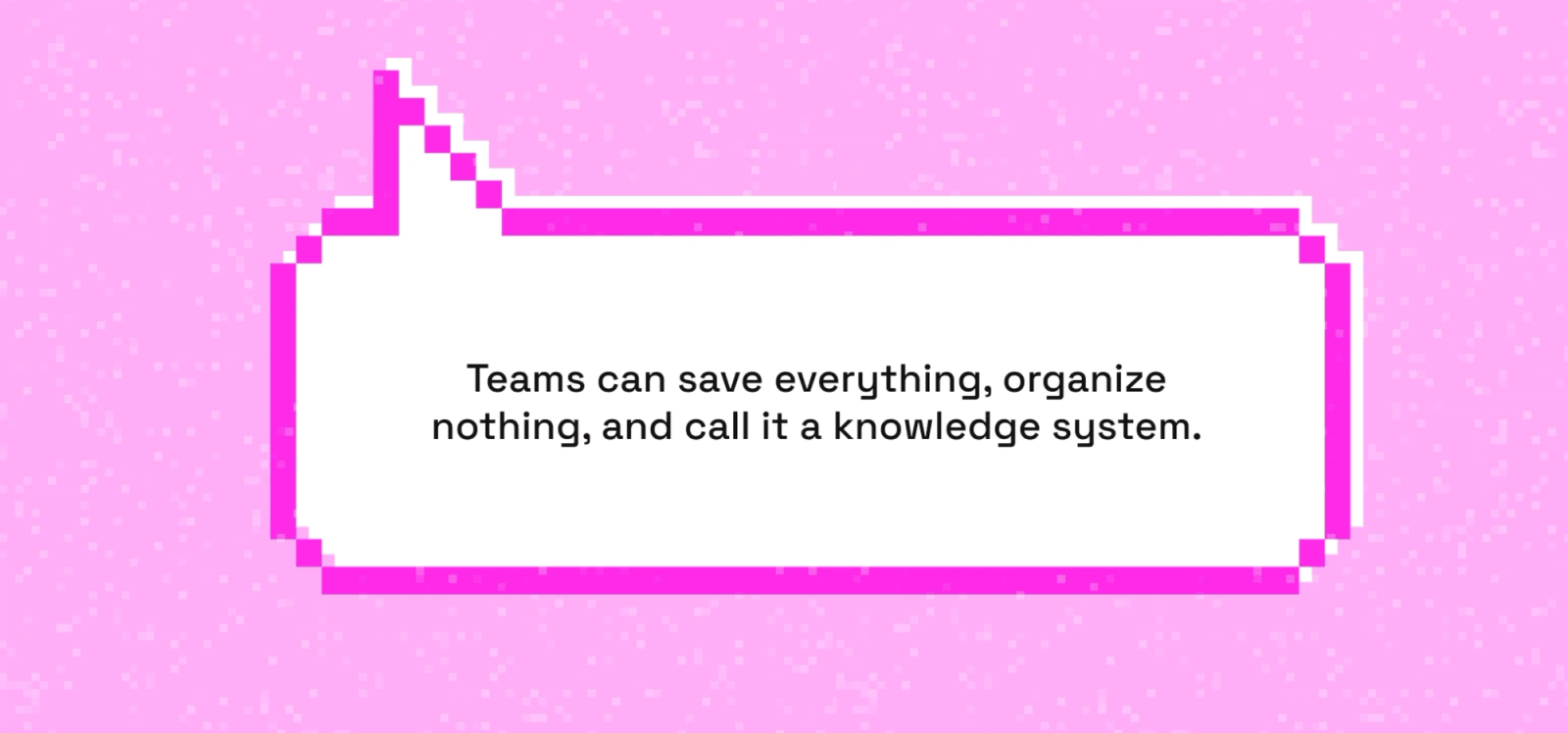
They can dump transcripts, docs, notes, and links into a folder and assume the AI will figure it out. That is not a context layer. That is a landfill with search.
The value of a vault is not storage. The value is curation. Someone still has to decide what matters.
What gets captured? What gets cleaned up? What gets updated and what gets archived?
This is where the human layer becomes even more important, not less. The future marketer is not just a prompt engineer. The future marketer is a context operator with judgment and taste and the ability to connect the dots.
That role requires editorial standards and the ability to look at messy inputs and decide what is useful. The ability to turn raw notes into a brief. The ability to turn a customer call into messaging insight. The ability to turn scattered decisions into an operating rhythm.
AI can help with all of that, but it cannot replace the need for someone to know what good looks like.
The practical next step
The good news is that teams do not need to rebuild their entire marketing organization to start.
They can begin with one recurring workflow.
Take meeting notes and turn them into a decision log. Take founder voice notes and turn them into a POV bank. Take sales calls and turn them into an objection library. Take customer conversations and turn them into campaign angles. Take campaign recaps and turn them into next experiments.
Start where context is already being lost. That is usually the easiest place to create value.
This is also why we just published a new Myosin Learns walkthrough on setting up an Obsidian vault. It gets into the practical side of building a usable context system: how to structure the vault, what to include, and how to make it useful for AI-enabled work.
The point is not that every team needs an Obsidian vault.
The point is that every AI-enabled team needs a memory layer.
Before you automate another marketing workflow, ask:
What context does the AI need to do this well?
Where does that context currently live?
Who maintains it?
How often is it updated?
How does the output feed learning back into the system?
The teams that win with AI will not be the teams that generate the most. They will be the teams that remember, judge, and learn the fastest.
And if you want to start building the memory layer yourself, watch the new Myosin Learns walkthrough on setting up an Obsidian vault.


