
Thinking/Distribution & AI Search
LLMs.txt Is Not Your AI Search Strategy
llms.txt is trending as a shortcut for AI search visibility, but is it a real GEO strategy?

Every few months, marketers get a new panic button: a new technical fix, a new acronym, a new thing everyone suddenly needs to implement before they “fall behind.”
This week, that thing was llms.txt.
The pitch is simple. Add a Markdown file to your website, tell AI systems which pages matter, and improve your visibility in AI answers. For teams trying to understand AEO, GEO, AI search, and the future of discoverability, it sounds tempting: a single file, a fast implementation, and maybe a small edge in a shifting search environment.
But this is where the hype gets ahead of the reality.
llms.txt may be useful. It may become part of the future AI-readable web. It may help agents, crawlers, and internal tools understand your site more cleanly. But it is not a magic ranking factor, a shortcut to being cited by ChatGPT, Perplexity, Gemini, or Google AI Overviews, and it is definitely not your AI search strategy.
The real lesson of the llms.txt conversation is bigger than the file itself: most websites are not built to be understood.
They are built like archives. A pile of product pages, blog posts, documentation, announcements, case studies, and landing pages stitched together over years of campaign cycles and internal priorities. Humans can sometimes navigate them because we are used to filling in the gaps. AI systems, however, are left to infer what matters, which pages are authoritative, and how the pieces fit together.
So when marketers get excited about llms.txt, they are responding to a real problem.
The web is becoming an input layer for AI. Your website is no longer just a destination for users; it is source material for answer engines, agents, search summaries, research workflows, sales tools, and automated decision systems. That means the question is changing. It is no longer only, “Can people find us on Google?” It is also, “Can AI systems understand who we are, what we do, why we matter, and when to reference us?”
That is a serious GTM question.
But the answer is not simply adding one text file.
Myth 1: LLMs.txt is a ranking factor
There is currently no strong evidence that llms.txt improves AI rankings, citations, or visibility in any consistent way. That does not mean it is useless. It means marketers should stop treating it like the new meta keywords tag: a small technical field that somehow unlocks a large discovery system.
Durable visibility does not work that way.
AI systems do not just need access to your content. They need confidence in your content. They need clear entities, consistent language, useful answers, external validation, structured information, and source material that actually resolves the questions people are asking.
If your positioning is unclear, llms.txt will not fix it. If your category narrative is weak, it will not invent one. If your site is full of vague claims, fragmented messaging, outdated docs, and generic thought leadership, AI systems will still struggle to understand why you matter.
This is where a lot of the current GEO market is getting noisy. The problem is not that agencies are helping clients implement llms.txt; that is a reasonable technical experiment. The problem is checkbox GEO services: selling isolated technical fixes as if they were a complete AI visibility strategy. Adding the file may help organize your content, but it cannot compensate for unclear positioning, weak source material, generic category language, or a lack of credible third-party validation.
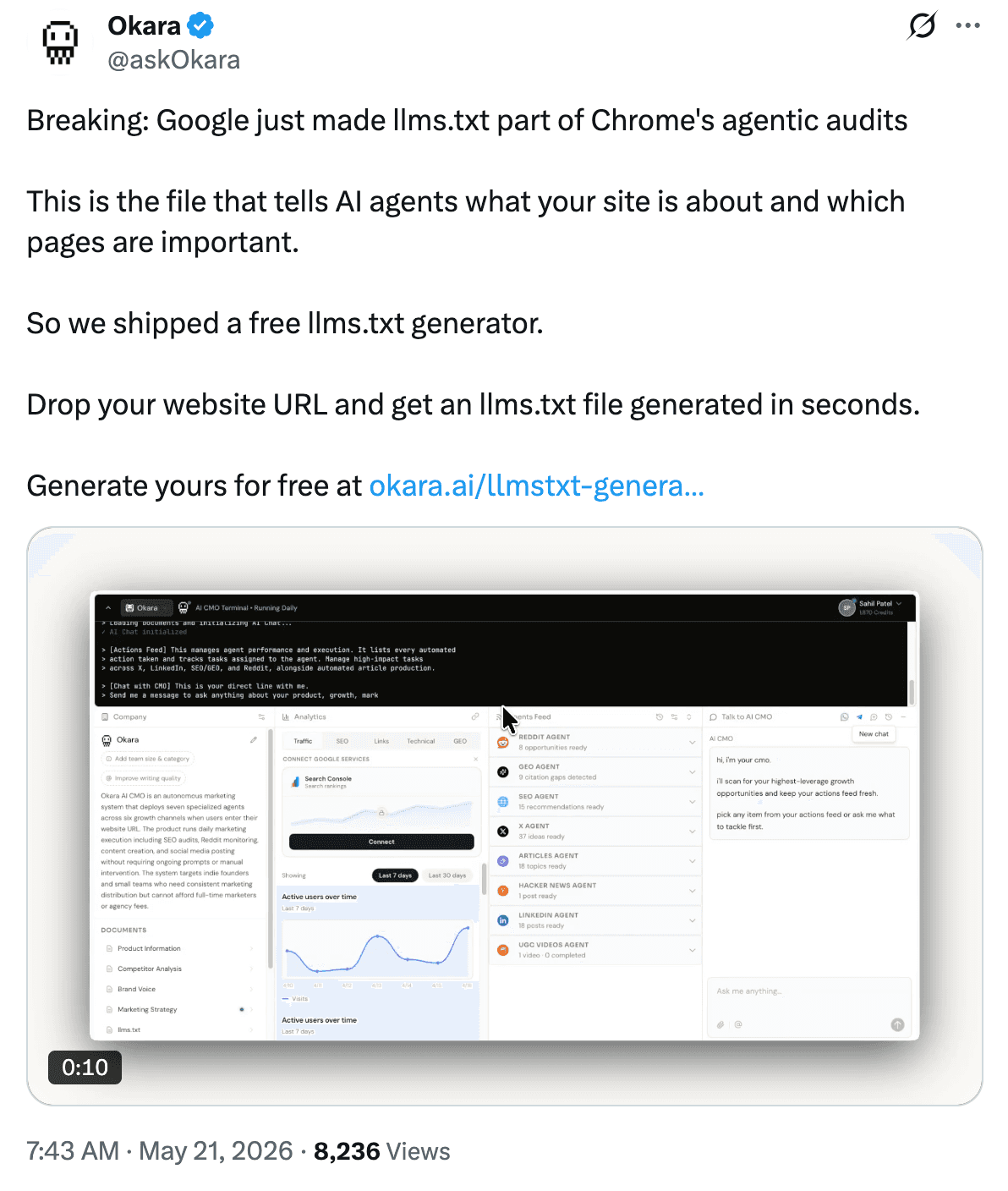
https://x.com/askOkara/status/2057472328620237130
The file can point to the house. It cannot rebuild the foundation.
Myth 2: AI engines will automatically use it
The second myth is that once you publish llms.txt, AI systems will automatically fetch it, trust it, and prioritize it. That is a big assumption.
Different AI platforms crawl, retrieve, summarize, and cite information in different ways. Some may eventually use llms.txt. Some may ignore it. Some may use it for specific tasks but not for rankings or citations. Some may treat it as a helpful hint, not a source of truth.
Publishing an llms.txt file is like leaving a clean brochure at the front desk. It may help someone who picks it up, but it does not guarantee anyone walks into the building.
Myth 3: GEO is separate from SEO
AEO and GEO are useful terms because they name a real shift. Discovery is moving from links to answers. Users are not only searching; they are asking, prompting, comparing, summarizing, and delegating. This changes how brands need to think about visibility, but it does not mean the old foundations disappear.
Even Google frames this as a myth. In its guidance on optimizing for generative AI search, Google says that while AEO and GEO are terms used to describe AI search visibility work, “from Google Search’s perspective, optimizing for generative AI search is optimizing for the search experience, and thus still SEO.

GEO is not a clean break from SEO. It is SEO expanding into a more complex environment.
The old question was, “Can this page rank?” The new question is, “Can this brand be understood, retrieved, trusted, and synthesized across answer systems?” That requires technical hygiene, but it also requires strategy: clear positioning, strong category language, source-of-truth pages, useful explainers, comparison content, FAQs, documentation, case studies, and consistent entity signals across your site, socials, media mentions, directories, communities, and third-party sources.
In other words, AI visibility is not just a search problem. It is a clarity problem.
What llms.txt is actually good for
The best reason to create an llms.txt file is not because it will magically boost your AI visibility tomorrow. The best reason is that it forces your team to decide what matters.
What are your canonical pages? How should an AI system understand your product? Which resources explain your category best? Which use cases should be surfaced first? Which pages are outdated, redundant, or strategically irrelevant?
That exercise has value.
For documentation-heavy companies, developer tools, infrastructure projects, protocols, SaaS platforms, and technical products, llms.txt may become a useful part of the AI-readable content stack. It can help point machines toward your best material, support internal agents and custom GPTs, and make your website easier to parse.
But it should sit inside a broader system, not instead of one.
The real AI search strategy
The brands that win in AI search will not be the ones chasing every new technical hack. They will be the ones that become the clearest and most credible source in their category.
That means building content infrastructure that both humans and machines can understand: clear positioning, a strong point of view, structured product and use-case pages, useful answers to real customer questions, consistent language across every channel, fresh documentation, credible third-party validation, and original insights worth citing.
If llms.txt helps you organize that system, use it. But do not confuse implementation with strategy.
The future of AI visibility will not be won by the team that added a file first. It will be won by the team that made itself impossible to misunderstand.


