
AI adoption stalls between the people who can build and the leaders who can decide. Here is the operating model that connects them.
Olly Jones
BD & Growth
Aug 3, 2026
Most companies that are adopting AI are starting to realize they have an AI ownership problem.
Inside the company, an employee is testing tools, building workflows, experimenting with agents, and automating parts of their job. Their work provides the first real proof that AI could change how the team operates.
At the same time, a senior executive is approving software budgets, setting efficiency goals, and asking where AI can create meaningful business value.
Both are necessary. Neither can carry adoption alone.
The internal builder understands what is becoming possible, but may not have the authority to redesign a cross-functional process, secure access to data, or replace the old way of working.
The executive can choose the priority, allocate resources, and authorize change, but usually cannot spend weeks mapping workflows, cleaning context, testing edge cases, training users, and refining the system after launch.
AI adoption stalls because the work between experimentation and operation belongs to no one.
Who should lead AI adoption in marketing?
AI adoption in marketing should be led through a three-part operating model: an executive sponsor who authorizes the change, an implementation operator who builds and installs the system, and an internal owner who operates and improves it over time.**
These are three different forms of ownership:
Strategic ownership: deciding what matters and removing organizational barriers.
Implementation ownership: turning the priority into a working system.
Operational ownership: running, maintaining, and improving the system after launch.
Most companies already have the first and third roles in some form. They have an executive who wants AI adoption to happen and an employee close to the work who could eventually own the workflow.
What they often lack is someone accountable for the full path between those two points.
This does not always require a new permanent title. It does require a clearly assigned implementation role.
Experimentation is not organizational capability
Most companies already have an internal AI builder.
They may be a marketer, analyst, operator, technical creative, or engineer interested in GTM. They are curious, close to the work, and willing to experiment before the company has developed a formal AI strategy.
They may have built a research assistant, reporting automation, content workflow, internal chatbot, or lightweight tool that saves the team time.
That work is valuable. The mistake is assuming that a useful individual experiment has already become an organizational capability.
The workflow may function because its creator knows which inputs to use, where the files live, how to repair weak outputs, and which steps remain manual. That knowledge may exist only in their head. When they become busy, change roles, or leave, the workflow disappears with them.
The builder should be part of the implementation process. They should not be expected to redesign the organization alone.
Executive sponsorship is not implementation
Senior leadership provides a different form of ownership.
A CMO, founder, CRO, COO, or GTM leader can define the business priority, allocate resources, approve access, resolve conflicts, and make adoption part of the company’s operating expectations.
Those powers are essential. They are not the same as implementation capacity.
The executive can decide that customer insight, campaign development, reporting, or sales enablement should work differently. They usually cannot personally make the hundreds of smaller decisions required to install the new workflow.
Someone still has to map the current process, gather usable context, connect tools and data, define human review, test real work, train users, document the system, and measure whether it is being adopted.
That is implementation ownership.
The missing role owns the path from priority to recurring use
The central problem is not that nobody owns AI. It is that the ownership required for adoption has been divided.
The executive owns the priority. The internal builder owns the experiment. The future workflow owner may eventually operate the system. But no one is accountable for moving the work through the middle: from business problem to selected use case, from prototype to production workflow, from individual knowledge to shared context, from technical capability to human adoption, and from launch to long-term ownership.
Without that role, companies accumulate pilots without changing how recurring work gets done.
A prototype can belong to one person. An installed capability requires strategic, implementation, and operational ownership to work together.
What installed AI requires
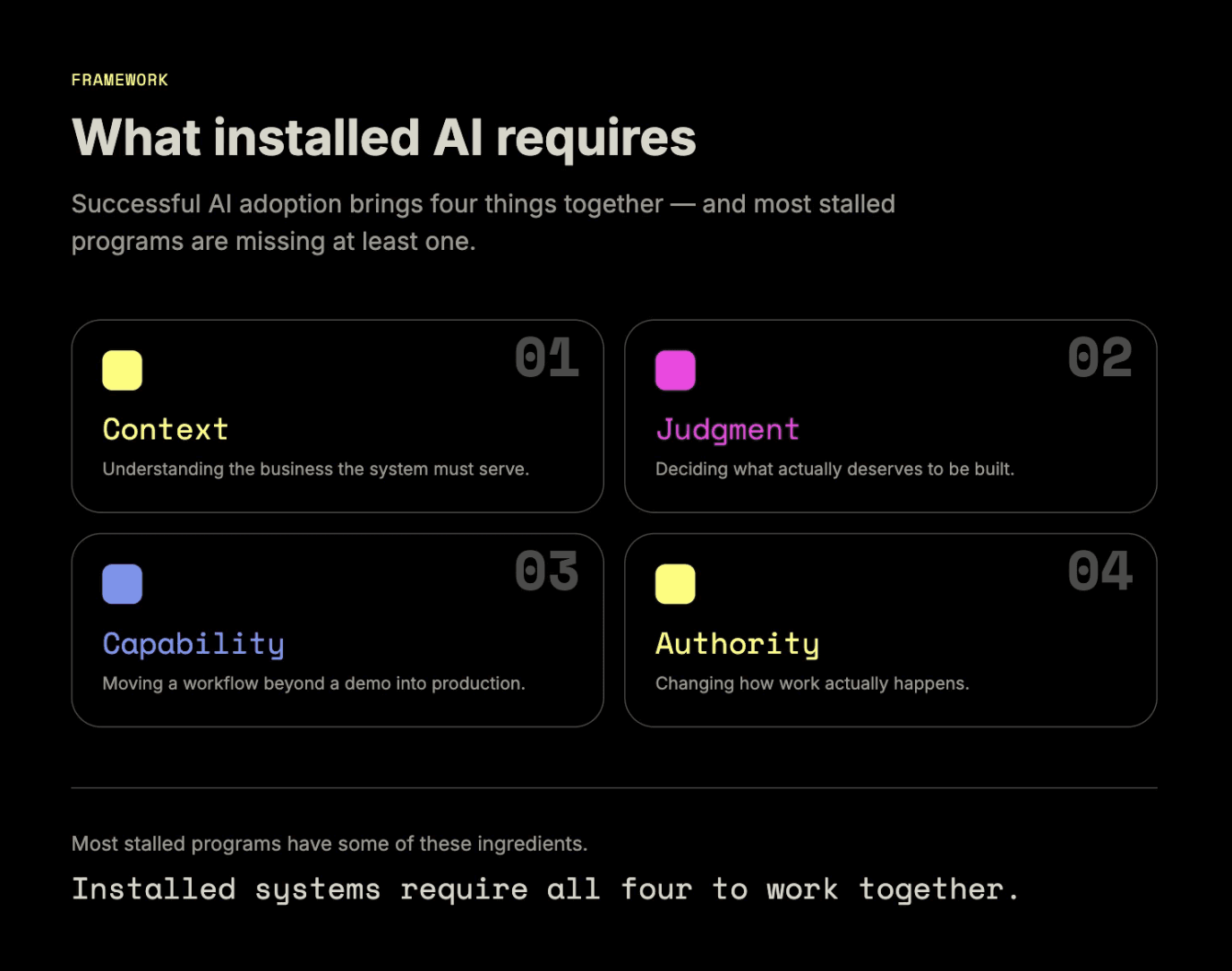
Successful AI adoption brings four things together: context, judgment, capability, and authority.
Context means understanding the business the system must serve. The workflow needs access to the company’s strategy, positioning, customer knowledge, quality standards, existing processes, and prior decisions. Tool access is not organizational context, and AI cannot reconstruct the company from a few kickoff calls.
Judgment determines what deserves to be built. The easiest workflow to automate is rarely the most important one to install. Someone must decide where AI can create meaningful leverage, what quality looks like, which assumptions need testing, and where human review belongs.
Capability means being able to move beyond a demo. A production workflow must handle real inputs, permissions, exceptions, handoffs, quality failures, user behavior, and maintenance. AI literacy creates users. Implementation capability creates systems.
Authority allows the company to change how work actually happens. Someone must be able to assign owners, secure access, remove outdated steps, establish review standards, allocate time, and resolve cross-functional blockers.
Most stalled programs have some of these ingredients. Installed systems require all four to work together.
Why promising AI pilots fail to spread
Many internal AI experiments work well for the person who created them and poorly for everyone else.
The builder remembers the hidden steps. They know what inputs are safe, what errors to expect, and how to repair the output. The workflow looks automated because one person is quietly sustaining it.
A workflow that depends on its creator is not installed.
Other pilots solve a task without redesigning the surrounding workflow. A content tool may generate a draft, while topic selection, evidence, review, distribution, and performance learning remain disconnected. The company has automated one visible step and left the real coordination problem intact.
Executive sponsorship can also remain too broad. Leadership tells every team to use more AI, find efficiencies, and experiment. That creates activity, but not implementation clarity.
Teams need a specific problem, a named owner, access to resources, and permission to change the process. Without those conditions, executive urgency produces more pilots rather than more capability.
Software purchases can create the same illusion of progress. A platform may provide useful functionality, but it cannot decide which workflow should change, who owns it, what context it needs, or how adoption will be measured.
Buying the tool solves the procurement decision. It does not solve the operating-model decision.
The missing role is an implementation operator
The missing role is often neither an engineer nor an executive.
It is an operator who can translate between them.
This person or team turns a broad goal such as “use AI to improve content” into a specific operating problem. They identify the highest-value workflow, gather the context required, design the human review layer, build or coordinate the technical system, test it with real users, and remain accountable through adoption.
They move between executive language and technical specifications, marketing strategy and system instructions, user frustration and workflow design.
They also own the part of implementation that is easy to underestimate: securing access, resolving edge cases, documenting decisions, supporting users, measuring adoption, and preparing an internal owner to take control.
The implementation operator does not replace the internal AI champion. They help that person’s experiments become useful to the organization.
They do not replace executive leadership. They make leadership intent operational.
What good AI leadership looks like
The question “Who should lead AI adoption?” often assumes the company needs one person who can do everything.
A better answer is a three-part leadership model.
Executive sponsor
The executive sponsor owns the strategic priority. They define why the work matters, allocate resources, establish decision rights, and remove organizational barriers.
They should remain close enough to make decisions without becoming the implementation bottleneck.
Implementation operator
The implementation operator owns the path from diagnosis to adoption. They select and map the workflow, design the system, coordinate technical implementation, build in human review, document the process, and measure progress.
They connect the company’s strategic intent to the details of how the work will actually change.
Internal owner
The internal owner operates and improves the workflow after launch. They contribute subject-matter expertise during the build, participate in quality decisions, provide feedback, and carry long-term accountability.
This may be the original AI champion. It may also be the person who already owns the business process being redesigned.
Together, these roles create three distinct forms of ownership:
strategic ownership, implementation ownership, and operational ownership.
Many AI programs fail because those responsibilities are collapsed into one vague assignment.
Where forward deployed marketing fits
Forward deployed marketing is designed for the space between executive intent and internal execution.
The forward deployed marketer works with leadership to define the priority, with internal builders to preserve technical knowledge and momentum, and with workflow owners to understand how the work actually happens.
The goal is not to take AI away from the internal team. It is to give that team a path from experimentation to installed capability.
The executive sponsor gains a clear implementation process. The internal builder gains access, context, support, and organizational reach. The workflow owner gains a system they can understand, operate, and improve.
FDM does not replace the people already working on AI. It gives them a way to work through the same system.
How to recognize the missing-middle problem
The clearest sign is simple:
Your company can name the executive sponsor and the people experimenting with AI, but it cannot name the person accountable for installation.
You may see useful workflows being built informally without spreading beyond their creators. Employees repeatedly explain the business to AI from scratch. New tools appear while the old process remains in place. Pilots launch, but nobody owns maintenance or adoption.
The most useful diagnostic questions are:
Who is accountable after the demo works?
Who can change the existing workflow?
Who will operate and improve the system six months later?
When those answers are unclear, the middle is missing.
What to do next
Start with one consequential workflow rather than a company-wide AI transformation program.
Choose a recurring process with clear friction, measurable value, real users, and an internal owner. Name an executive sponsor who can authorize the change. Assign one implementation operator responsibility from diagnosis through adoption.
Bring the internal owner into the process before the system is built. They should help shape the workflow, define quality, test the system, and understand how it will be maintained.
Then measure installation rather than novelty.
A useful AI system should improve repeated use, quality, cycle time, human effort, or a meaningful business outcome. The team should also become increasingly capable of operating it without the original builder.
Individual experimentation becomes organizational capability when it is connected to executive priorities, real workflows, and accountable owners.
Connect the person who can build to the person who can decide
Most companies already have many of the ingredients required for AI adoption.
They have executive intent, curious employees, available tools, functioning workflows, and business problems worth solving.
What they lack is the operating layer that brings those ingredients together.
The internal builder should not be expected to transform the organization alone. The senior executive should not be expected to personally install every workflow.
The company needs a clear connection between the person who can build and the person who can decide, with someone responsible for everything in between.
AI adoption becomes real when it changes how recurring work happens and the company can continue operating the system.
Find the missing layer in your AI GTM operating model.
Frequently asked questions
Who should lead AI adoption in marketing?
AI adoption in marketing should be led through a three-part model: an executive sponsor who authorizes the change, an implementation operator who builds and installs the system, and an internal owner who operates and improves it over time.
What is an internal AI champion?
An internal AI champion is an employee who actively experiments with AI, shares useful practices, and identifies opportunities. They can be an important catalyst, but usually need executive support, implementation capacity, and cross-functional access to scale their work.
Why do internal AI pilots fail?
Internal AI pilots often fail because they are not connected to a specific business priority, a complete workflow, named owners, quality standards, or long-term maintenance. A successful demo proves that something can work. It does not prove that the organization can adopt it.
What role does a forward deployed marketer play in AI adoption?
A forward deployed marketer acts as the implementation layer between executive priorities and internal teams. They identify the right GTM problem, build the system, design human review, install it into the workflow, and transfer ownership to the company.


