
Thinking/Forward Deployed Marketing
What Is Forward Deployed Marketing?
Why We Built a New Model for AI-Enabled GTM

The work marketers can do has changed faster than the categories companies use to hire them.
A marketer can now research a market, synthesize customer signals, build internal tools, connect workflows, design AI agents, and create systems that improve how knowledge moves through a company.
That is a broader mandate than producing campaigns or managing channels.
Yet most companies still purchase this work through familiar models. They hire an agency to execute, a consultant to advise, a fractional CMO to lead, or a software vendor to provide a tool.
Each model solves a useful part of the problem. The gap appears when a company needs someone to understand the strategy, work inside the real operating environment, build the system, install it into the workflow, and transfer it to the internal team.
That gap is why we started using the term forward deployed marketing.
What is forward deployed marketing?
Forward deployed marketing is an embedded operating model in which marketers work inside a company’s real GTM environment to build, install, and transfer AI-enabled systems.
Forward deployed marketers work directly with the company’s people, tools, data, workflows, customer knowledge, and organizational constraints. Their goal is to create a capability the internal team can continue operating, maintaining, and improving.
In plain language, an FDM does more than perform marketing for a company. They help the company become better at performing marketing itself.
Forward deployed marketing describes both a role and an operating model. The forward deployed marketer is the practitioner. FDM describes how that practitioner works inside the organization.
Why the existing categories stopped fitting
New categories are only useful when the existing ones no longer describe the work accurately.
Agencies are generally structured to produce campaigns, content, creative, media, and other marketing outputs. Consultants diagnose problems and recommend a path forward. Fractional CMOs provide senior leadership and strategic direction. Software vendors give companies access to defined technical capabilities.
All of those models remain valuable.
The problem is that AI-enabled GTM work increasingly crosses their boundaries.
A company may need strategic judgment to decide what should be built, technical fluency to build it, operational skill to connect it to real workflows, and enough change-management experience to help the team adopt it.
Those responsibilities have often been separated.
Forward deployed marketing brings them together.
The category became necessary because strategy, technical implementation, workflow design, and organizational adoption are becoming part of the same job.
Why “forward deployed”?
The idea of forward deployment comes from technical roles in which builders work close to the environment where the system must function.
That proximity changes the work.
Forward deployment means working close enough to the operating environment to understand the actual problem, not merely the brief describing it.
A company may ask for an AI content engine. From outside, that can sound like a prompt-and-publishing project.
Inside the company, the real work may involve rebuilding positioning, organizing customer evidence, defining standards for claims, designing the review process, connecting distribution, and assigning ownership.
The tool is only one part of the system.
The same pattern appears across GTM.
A lead-generation problem may begin with weak market definition. A campaign bottleneck may come from unclear approval rights. An AI agent may underperform because the company’s context is scattered across tools. A workflow may appear automated while still depending on one employee who remembers every hidden step.
A provider working from the brief may complete the requested task.
A forward deployed marketer works inside the environment long enough to uncover the operating problem beneath it.
The defining feature of FDM is not where the marketer is employed. It is where the system is built.
Why “marketing”?
Marketing is not simply the department receiving the system. It is the discipline required to determine what the system should do.
An automation can function correctly while solving the wrong problem. A model can produce more content while weakening the positioning. A tool can increase output without improving demand, customer understanding, or revenue.
The system still needs marketing judgment.
A forward deployed marketer must understand how the company creates value, who the customer is, what the customer believes, which signals matter, and what claims the company can defend. They need to know how channels behave differently, where human review belongs, and what the team can realistically adopt.
This is the missing translation layer between technical capability and GTM strategy.
An engineer can make the system work.
A marketer must decide whether the system is doing work worth scaling.
AI has made building easier. It has made judgment more important.
What does a forward deployed marketer do?
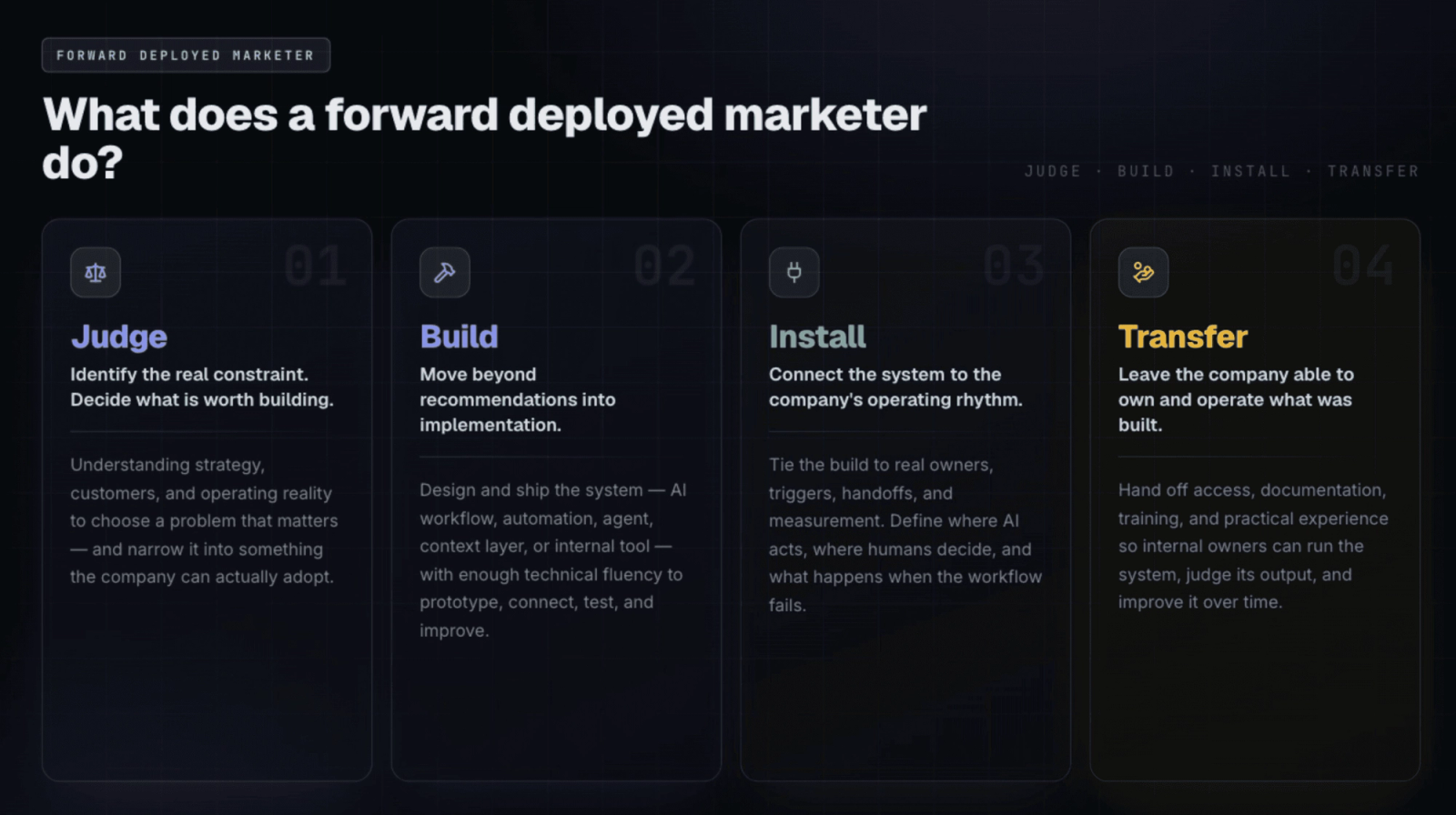
The role combines four capabilities:
Judge. Build. Install. Transfer.
Judge
The FDM identifies the real constraint and decides what is worth building.
That requires understanding the company’s strategy, customer, workflows, and operating reality. The goal is to choose a problem that matters enough to solve and narrow it into a system the company can actually adopt.
A technically impressive build can still be strategically irrelevant. Judgment keeps the work tied to a meaningful business outcome.
Build
The FDM moves beyond recommendations into implementation.
Depending on the problem, that may involve an AI workflow, automation, internal tool, agent, context layer, data connection, reporting environment, or lightweight product.
The practitioner does not need to be a traditional software engineer. They do need enough technical fluency to prototype, configure, connect, test, and improve the system.
Install
A working prototype becomes valuable when it enters the operating rhythm of the company.
Installation connects the system to real owners, triggers, reviews, handoffs, exceptions, and measurement. It defines where AI acts, where humans decide, and what happens when the workflow fails.
This is the part many AI projects skip.
A demo proves that the system can work. Installation proves that the company can use it.
Transfer
The company should leave the engagement able to operate what has been built.
That means internal owners can access the system, run it, judge its output, maintain its context, handle normal failures, and improve it over time.
The transfer includes access, documentation, training, ownership, and practical experience.
The goal is to increase what the organization can do for itself.
How FDM differs from an agency, consultant, fractional CMO, and software vendor
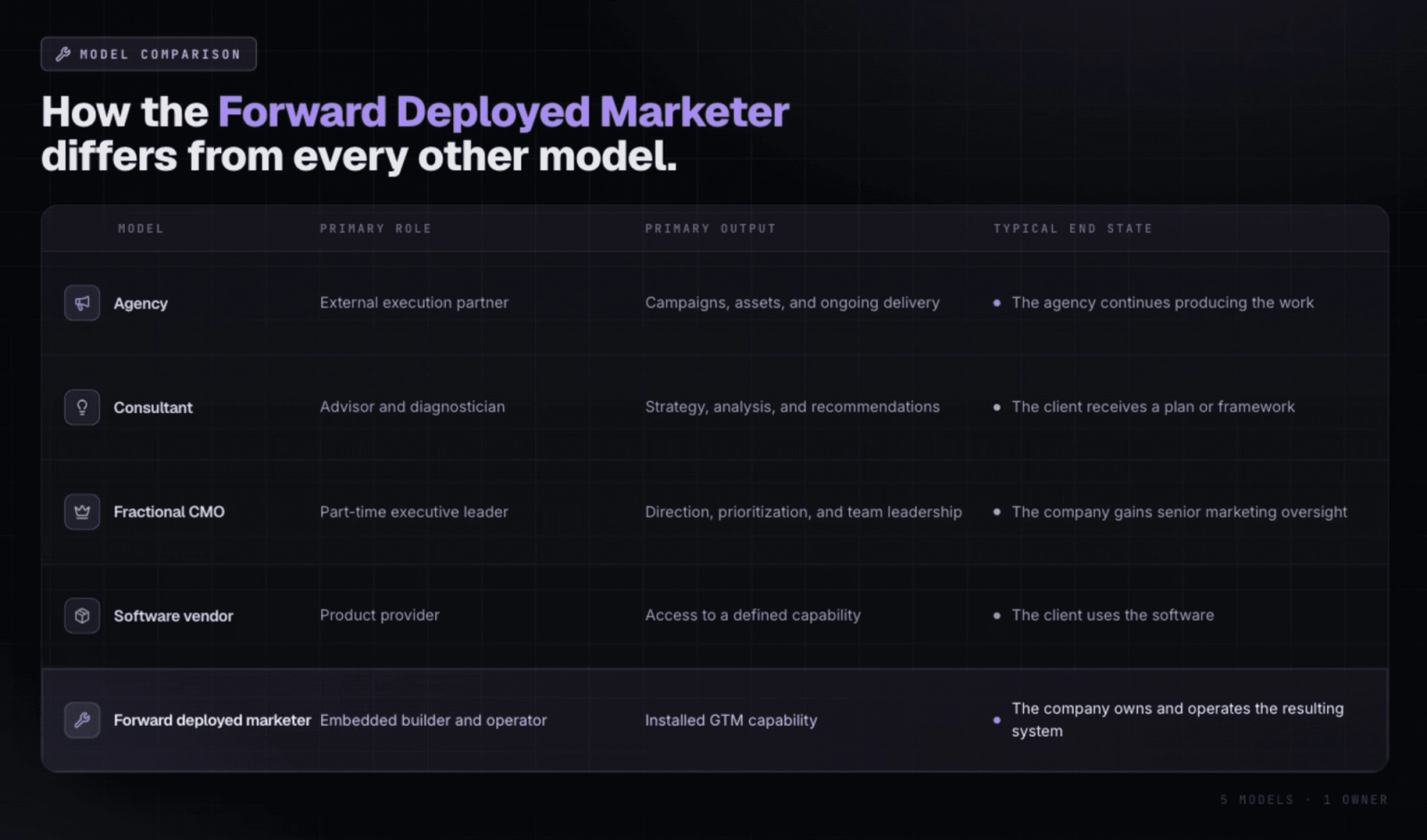
FDM does not replace every other model.
A company may still need an agency for production, a consultant for specialized expertise, a fractional CMO for leadership, and software to support its workflows.
The difference is the unit of value.
An agency typically delivers marketing outputs. A consultant delivers analysis and recommendations. A fractional executive provides leadership. A software vendor provides a product.
A forward deployed marketer builds capability inside the company.
FDM is most useful when the company needs a system designed, built, installed, and transferred.
Internal capability built with external acceleration
Forward deployed marketing is not simply outsourced marketing.
Traditional outsourcing asks how an external provider can perform the work for the company.
Forward deployment asks what system would allow the company to perform the work better.
We describe the result as internal capability built with external acceleration.
The capability is internal because the workflows, context, tools, judgment, and ownership remain with the company.
The acceleration is external because experienced operators help the company avoid years of disconnected experimentation, fragmented implementation, and slow internal hiring.
This changes how the engagement is designed.
The system should be built close to the company’s real environment. Internal owners should participate before the work is finished. Documentation and training should happen throughout the build. Success should be measured by what the company can operate afterward.
FDM is therefore a strong fit for companies with a functioning GTM motion, recurring workflow friction, leadership participation, and a desire to own the resulting capability.
It is less suited to companies that primarily want ongoing production, a fully outsourced black box, or a one-off automation demo.
Why companies need this model now
AI has made custom systems easier to build.
A company can now create research workflows, customer-signal systems, content processes, internal knowledge tools, and AI-assisted revenue workflows without assembling a large engineering team.
That creates opportunity. It also creates fragmentation.
Teams accumulate tools, prototypes, prompt libraries, and isolated automations. Context remains scattered. Workflows still depend on individual memory. Human review is added late. Nobody owns adoption.
The result is often more AI activity without a more capable operating system.
Companies increasingly need someone who can connect the pieces: understand the business, choose the right problem, build the system, install it into the workflow, and leave the team able to operate it.
That is the role forward deployed marketing is designed to fill.
A more capable marketing organization
Forward deployed marketing combines four responsibilities that have often been separated:
marketing judgment, technical building, workflow installation, and capability transfer.
AI-enabled GTM increasingly requires all four.
The system must reflect the company’s strategy. It must function technically. It must fit the way the team actually works. And it must remain useful after the original builder steps away.
The long-term value of an FDM should be measured by what the company can now do.
What can the team operate?
What can it evaluate?
What can it maintain?
What can it improve?
What no longer needs to be rebuilt from zero?
Forward deployed marketers do not leave behind more marketing.
They leave behind a more capable marketing organization.
See what a 90-day forward deployed marketing engagement looks like.
Frequently asked questions
What is forward deployed marketing?
Forward deployed marketing is an embedded operating model in which marketers work inside a company’s real GTM environment to build, install, and transfer AI-enabled systems. The goal is to create a capability the company can continue operating.
What does a forward deployed marketer do?
A forward deployed marketer identifies high-value GTM problems, builds AI-enabled systems, installs them into real workflows, trains internal owners, and transfers control to the company.
How is forward deployed marketing different from an agency?
An agency usually produces marketing work for the company. A forward deployed marketer builds systems inside the company so its internal team can perform the work more effectively.
Does the company own what the FDM builds?
The FDM model should be designed around client ownership. The company should retain access to the workflows, context, documentation, tools, accounts, and operating knowledge created during the engagement.


