
Learn how to turn AI marketing workflows into an installed GTM system with reusable inputs, review layers, learning loops, and Forward Deployed Marketers.
Olly Jones
Forward Deployed Marketer
Jul 20, 2026
The AI pilot is not the hard part anymore.
Most teams have already tested the tools. They have prompts, demos, experiments, internal docs, and a few workflows that worked well enough to prove something is possible. Someone on the team has found a better way to research, draft, summarize, repurpose, or report. The first run helped. The demo looked impressive.
Then Monday came back.
The workflow lived in a doc so the context went stale. The review step belonged to no one. The handoff was still manual and the team got busy and returned to the old path.
That is the gap most companies are standing in now. MIT NANDA’s 2025 State of AI in Business report found that only 5 percent of custom enterprise AI tools reach production. McKinsey’s 2025 State of AI survey tells a similar story: 88 percent of organizations are using AI in at least one business function, but nearly two-thirds have not begun scaling AI across the enterprise.
The problem is not that teams are failing to try AI. They are trying it everywhere. The problem is that experiments are not becoming installed systems.
One AI workflow creates value. A connected set of workflows creates leverage. An installed system creates durable advantage. The bottleneck is not access to more AI tools. It is having an embedded operator who installs the system, connects it to how the team already works, and improves it over time.
Most AI workflows die as experiments
Most teams do not lack ideas for how to use AI.
They have prompt libraries. They have workflow diagrams. They have internal demos. They have tool trials. They have a few examples that made everyone say, “We should be doing more of this.”
The problem is that the workflow never becomes part of how the team works.
It depends on one person remembering to run it. It depends on context that is not maintained. It depends on a review step nobody owns. It depends on handoffs that still happen manually. It depends on the team choosing the new path when the old path feels faster under pressure.
This is why so many AI workflows stall. They create a moment of value, but they do not create durable behavior.
MIT’s report also described a “shadow AI economy,” where workers at more than 90 percent of surveyed companies reported regular use of personal AI tools, while only 40 percent of companies had purchased an official LLM subscription. That distinction matters. AI may already be inside the work, but that does not mean it has been installed into the operating system.
A workflow that only works when the person who built it is paying attention is not installed. It is borrowed attention.
Built is not the same as explained. Shipped is not the same as demoed. Results are what happen when the workflow survives real work.
One workflow is not a system
A single workflow can absolutely create value.
A better input layer helps. It stops the model from starting from scratch every time. A clearer automate, assist, keep-human line helps. It keeps people close to the decisions where judgment matters. A stronger review pass helps. It catches outputs that are technically clean but strategically weak.
Each one matters, but leverage appears when the pieces connect.
Research feeds positioning. Positioning feeds briefs. Briefs feed content. Content feeds sales enablement. Campaign outputs feed measurement. Measurement feeds the next strategy pass.
That is the difference between an isolated workflow and an AI GTM system. A workflow completes a task. A system improves the next task.
This is where most teams underestimate the work. They treat AI implementation like a tool rollout, when the real change is in the operating model. McKinsey found that AI high performers are nearly three times more likely than others to have fundamentally redesigned workflows. The teams getting value are not just using AI tools. They are redesigning the work around them.
That is the actual job.
Not adding another app to the stack. Not writing another prompt doc. Not running another impressive demo that only one person knows how to repeat.
The job is to turn useful workflows into a connected system the team can run, trust, and improve.
The installed system has three parts
At Myosin, this is why the system has three parts: the Forward Deployed Marketer (FDM), the products, and Hivemind.
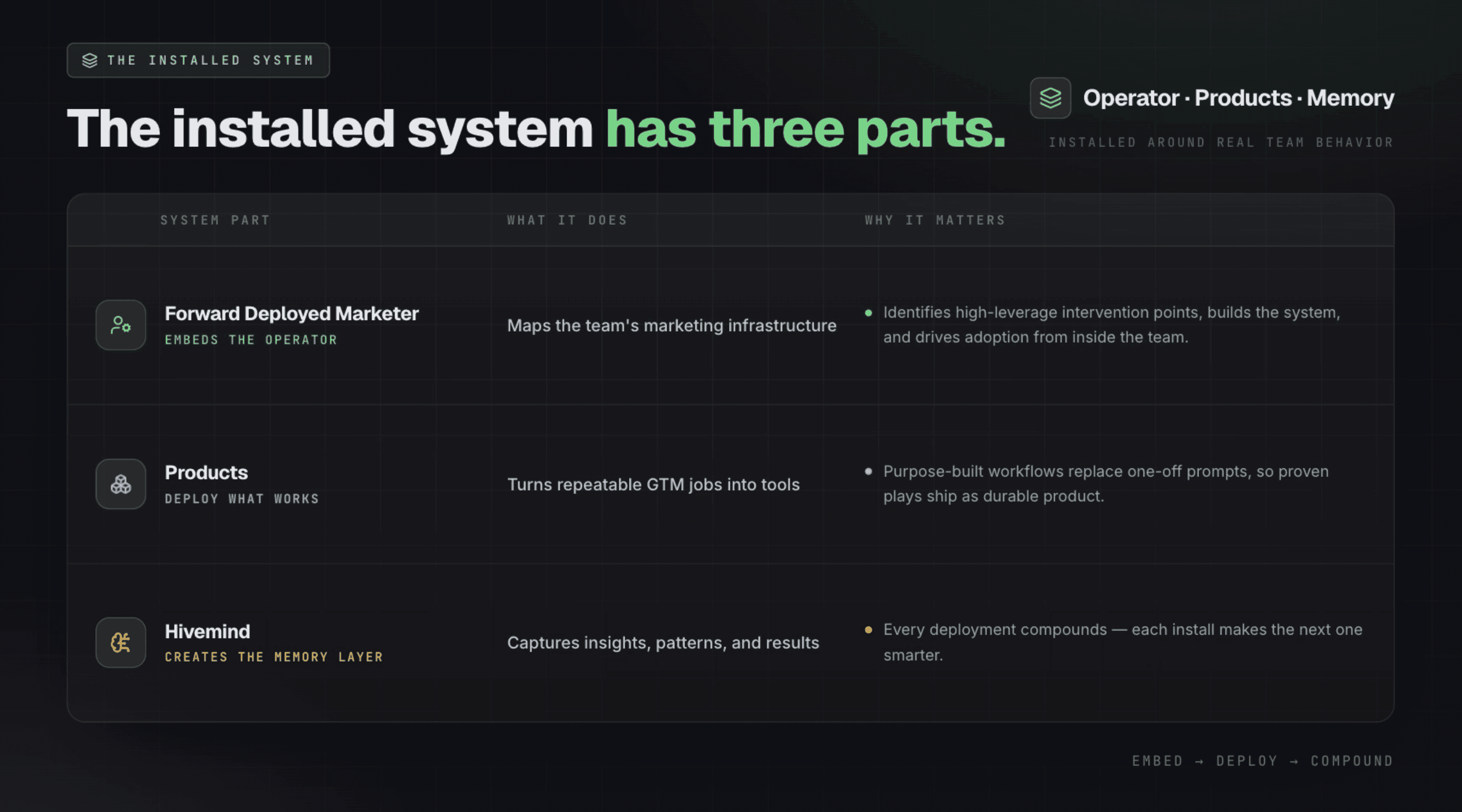
The Forward Deployed Marketer is the operator. They go inside the team, understand how GTM work actually happens, identify the highest-leverage intervention points, and install the system around real team behavior.
The product layer matters because teams should not rebuild every workflow from scratch. When a workflow works, it should become deployable. It should become easier to run again, adapt to another client or campaign, and connect to the next part of the system.
Hivemind is the memory layer. It keeps the system from forgetting. Every insight, every system pattern, every decision, and every result becomes part of the intelligence layer that improves future work.
The FDM installs the system. The products deploy what works. Hivemind makes sure the system does not forget.
That is how AI-enabled GTM starts to compound.
What an installed AI GTM system actually includes
Installed is a specific word.
It does not mean the team has access to a tool. It does not mean someone wrote a process doc. It does not mean there is a prompt library in Notion or a workflow diagram in a deck.
Installed means the workflow is part of how the team operates.
It has inputs, owners, review points. It has handoffs and rhythm. It captures what it learns. It can survive a busy week.
An installed AI GTM system usually includes six layers:
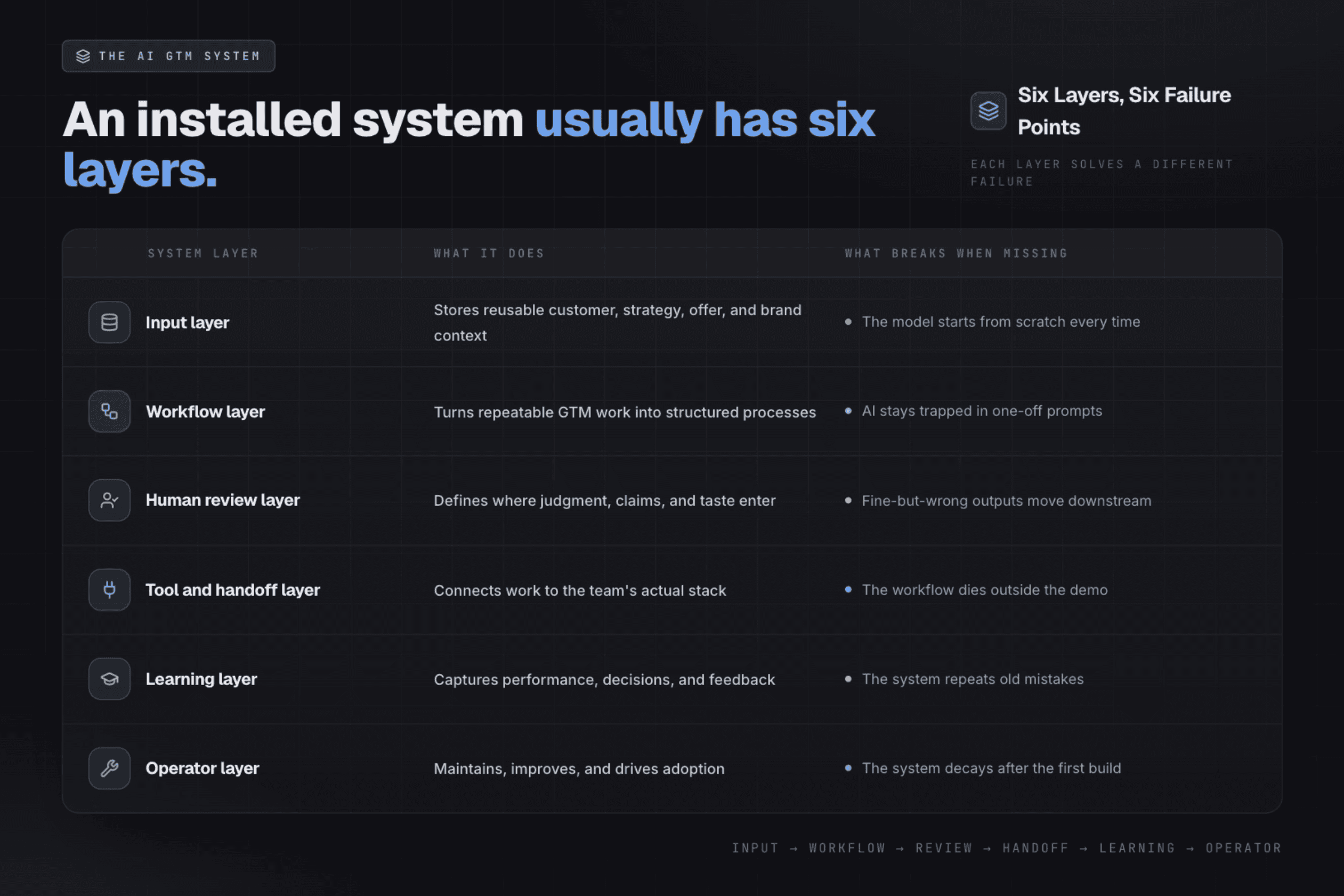
Each layer solves a different failure point.
The input layer keeps the model from relearning the business every time. The workflow layer turns isolated prompts into repeatable motion. The human review layer protects judgment, claims, and taste. The tool and handoff layer makes sure the process lives where the team already works. The learning layer captures what changed. The operator layer keeps the system from drifting.
Tools can generate the workflow. Operators make it survive contact with the team.
Tools do not create adoption. Operators do.
Most AI GTM failures are not caused by a lack of software. They are caused by a lack of ownership.
Someone has to map how work actually happens, not how the org chart says it happens. Someone has to gather and maintain the inputs. Someone has to build the workflow around the tools the team already uses. Someone has to define the review points. Someone has to train the team. Someone has to notice when the process breaks. Someone has to improve the system after the first few runs.
That is the role of the Forward Deployed Marketer.
An FDM is part strategist, part operator, part systems designer. They do not just explain what the workflow should be. They install it into the team’s real GTM motion and stay close enough to improve it.
That role matters because AI-enabled GTM is not a clean-room exercise. It has to work inside actual calendars, messy Slack threads, sales pressure, founder opinions, changing priorities, partial data, and the normal friction of a team trying to move fast.
The tool does not solve that on its own.
The operator does.
The FDM is the implementation layer between AI strategy and team behavior.
How to know if your AI workflow is installed
A useful AI workflow is not always an installed workflow.
You can tell the difference by asking a few practical questions.
Does the workflow have a clear business outcome?
Does it have a clear owner?
Are the inputs reusable and maintained?
Does the team know when to use it?
Is it connected to the tools where work already happens?
Are human review points defined?
Can someone other than the builder run it?
Does it still work during a busy week?
Is anyone responsible for improving it after the first version?
If the answer is no to most of these, the workflow may still be useful. It may have created value once. It may have shown the team what is possible. But it is not installed yet.
The test of an installed system is whether it still runs when the person who built it is not in the room.
That is the difference between a promising experiment and a real operating system.
Understanding was never the bottleneck
By now, the problem is not hard to understand.
Teams need better inputs. They need clearer automation boundaries. They need stronger review layers. They need workflows that connect. They need systems that learn.
But understanding the system is not the same as installing it.
That is where most AI efforts stall. They reach the point where everyone agrees on the direction, but no one owns the operating change. No one has the time, context, or mandate to install the workflow into how the team actually works.
The advantage goes to the teams that turn insight into operating rhythm. The teams that do not just test AI workflows, but embed them into how GTM work gets done, reviewed, measured, and improved.
AI-enabled GTM is not a tool stack. It is an installed system.
If you want this installed instead of explained, that is what Forward Deployed Marketers are built to do.


