
Learn how to choose the right first AI workflow in marketing by balancing business value, readiness, ownership, risk, and long-term leverage.
Olly Jones
BD & Growth
The easiest marketing task to automate is rarely the best place to begin.
Teams often start with what a tool can do quickly. Generate social posts. Summarize a document. Rewrite an email. Build a chatbot. Create a demo that makes AI feel tangible.
These experiments can be useful. They help people learn the tools and see what is possible.
They do not always create durable value.
A good first AI workflow should do more than save time. It should remove a meaningful GTM constraint, fit into the way the team already works, and create context or learning that makes the next workflow easier to build.
The goal is not to find the smallest possible automation.
It is to find the smallest coherent system worth installing.
What should you automate first in marketing?
Start with a recurring workflow that has meaningful business value, understandable inputs, a clear owner, measurable friction, and a manageable cost of failure.
The best first workflow should be narrow enough to implement, but connected enough to create value beyond the task itself.
That additional value may come from reusable customer insight, a better context layer, clearer quality standards, a new feedback loop, or a repeatable pattern for future AI implementation.
A strong first workflow creates value twice: once through the work it completes and again through what the company learns or reuses.
Task, workflow, and system
Not every use of AI needs to become an installed system.
A task automation helps one person complete one action faster. It might summarize a document, create headline variations, transcribe a call, or clean a list.
These are often useful. They can reduce friction in someone’s day without changing how work moves across the organization.
A workflow connects multiple steps, decisions, people, or tools.
Customer-call synthesis, for example, might begin with a recorded conversation, extract themes, route the most important insights to marketing and product, and store the language for future use.
A research-to-brief workflow might gather sources, organize evidence, produce a structured brief, and route it to a strategist for approval.
A system goes one step further. It creates infrastructure or learning that improves several workflows over time.
A customer-signal repository can support positioning, content, sales enablement, product feedback, and campaign planning. A shared quality framework can improve every AI-assisted asset the company produces.
Task automation creates local efficiency. Installed systems create organizational leverage.
The first build does not need to be a massive system. It should be a manageable workflow that begins creating system-level capability.

Why companies choose the wrong first workflow
The wrong first workflow is often selected for understandable reasons.
Sometimes the company starts with the tool. It purchases a platform and then searches for a use case that justifies it.
This reverses the sequence. The workflow should determine which capabilities, integrations, controls, and tools are required. A new workflow should not be invented simply because the software is available.
Other teams start with the easiest demo.
A fast prototype can be visually impressive and easy to explain to leadership. That says little about whether the workflow will be adopted, whether its inputs are reliable, or whether anyone will own it after the demonstration.
Demo readiness is not implementation readiness.
Another common approach is to automate the task that consumes the most time. Time matters, but it is not enough on its own.
A task may be slow and still have little strategic value. It may happen infrequently, depend heavily on expert judgment, or remain disconnected from any meaningful business outcome.
Teams also tend to overvalue autonomy. The most ambitious workflow can appear to be the one that removes the most people from the process.
That often creates more risk, weaker judgment, and greater review burden.
A strong first workflow usually assists and structures human work before it attempts to replace the entire process.
Finally, companies choose workflows without identifying a future owner.
The project may have a builder, but nobody is responsible for defining quality, testing the system, handling exceptions, maintaining context, or measuring adoption.
A workflow without a future owner is not an implementation opportunity. It is an experiment.
Five criteria for choosing the first workflow
A strong first workflow should be evaluated across five dimensions:
value, recurrence, readiness, ownership, and leverage with manageable risk.
These criteria help the company compare opportunities without reducing the decision to technical feasibility or theoretical time savings.
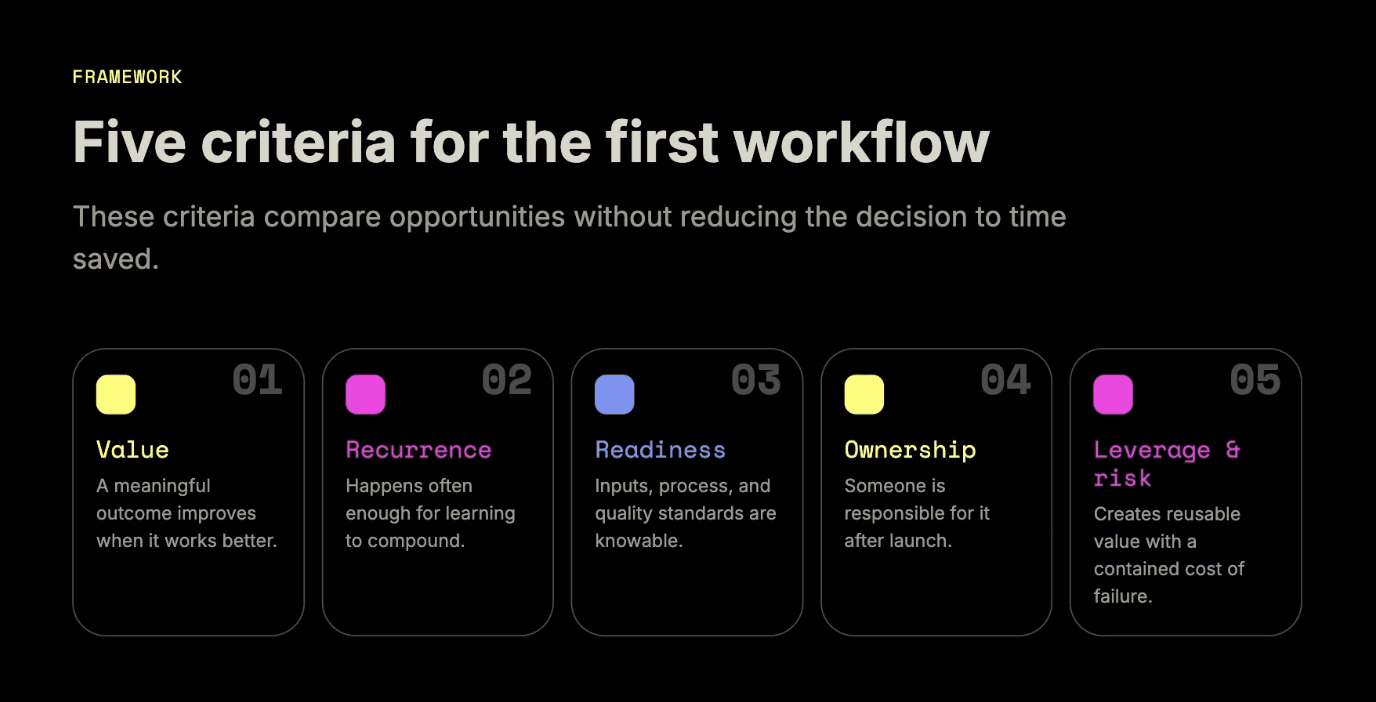
1. Value
The first question is simple:
What meaningful outcome improves when this workflow works better?
The answer might involve faster campaign cycles, better customer insight, improved sales preparation, stronger quality, lower manual effort, or quicker decision-making.
The outcome should matter enough that people will notice when it improves.
An internal summary that saves five minutes may be useful. A customer-insight workflow that improves positioning, content, and sales enablement has broader value.
Time saved matters when it creates room for better work or improves a business result.
2. Recurrence
Strong first workflows happen often enough for the value and learning to compound.
A workflow that runs every week creates more opportunities to test assumptions, encounter exceptions, measure adoption, and improve the system.
That makes recurrence valuable for implementation, not only efficiency.
Frequency cannot replace business value. Automating a trivial daily task may still be a poor investment.
The strongest candidates combine meaningful value with repeated use.
3. Readiness
A workflow is not ready for AI simply because the task is repetitive.
Its inputs, process, and quality standards must also be understandable.
The company should know what triggers the work, which information it requires, where decisions happen, who reviews the result, and what a good output looks like.
The workflow does not need to be efficient.
It does need to be knowable.
Readiness also depends on context. If the positioning is inconsistent, the customer data is inaccessible, or every user supplies different instructions, the workflow may need foundational work before automation begins.
Automation does not clarify a confused workflow. It makes the confusion run faster.
Sometimes the right first step is to repair the data, clarify the strategy, or document the process before adding AI.
4. Ownership
The first workflow needs a real owner.
Someone must be responsible for helping define the system, testing it with live work, evaluating quality, handling normal exceptions, and maintaining it after launch.
That person does not have to build the technical system alone. They do need to care whether it continues working.
The workflow also needs users who will participate in the implementation and an executive sponsor who can remove blockers when the process crosses teams or tools.
The best technical workflow can still fail when the organization is not prepared to use it.
Ownership turns the project from a side experiment into a change in how work happens.
5. Leverage and risk
The strongest first workflow creates value beyond its immediate output.
It may generate reusable customer language, structured evidence, shared context, quality standards, data connections, or a feedback loop that supports other work.
This is learning leverage.
A customer-call synthesis workflow may improve its immediate task while also creating inputs for positioning, content planning, sales training, and product decisions.
An isolated caption generator may complete its task without making anything else easier.
Risk must be considered alongside leverage.
The first workflow should create meaningful value without forcing the company to solve its hardest governance problem on day one.
Internal research support, draft preparation, call synthesis, and performance reporting often allow for human review before the work creates external consequences.
Autonomous publishing, unsupervised customer communication, and automatic strategic decisions carry higher failure costs.
The ideal first workflow has enough value to matter and enough containment to learn safely.
Choose a foundational quick win
Companies often frame the decision as a choice between a quick win and a strategic build.
The better option is a foundational quick win.
A foundational quick win creates an immediate improvement while building something the company can reuse. It should be narrow enough to implement, useful enough to earn attention, frequent enough to test, and safe enough to improve through real use. It should also create context, standards, integrations, or learning that make future workflows easier to install.
Customer-call synthesis is one example. It can reduce manual review while building a repository of customer language and recurring themes.
A research-to-brief workflow can speed up campaign development while establishing source standards, evidence requirements, and reusable strategic context.
A recurring performance-synthesis workflow can reduce reporting effort while creating a stronger learning loop between execution and planning.
These projects are contained, but they do not end at the task.
That is what makes them foundational. There is no universal best first workflow. The right choice depends on the company’s real GTM constraint.
Several categories tend to score well because they combine recurrence, clear users, manageable risk, and reusable value.
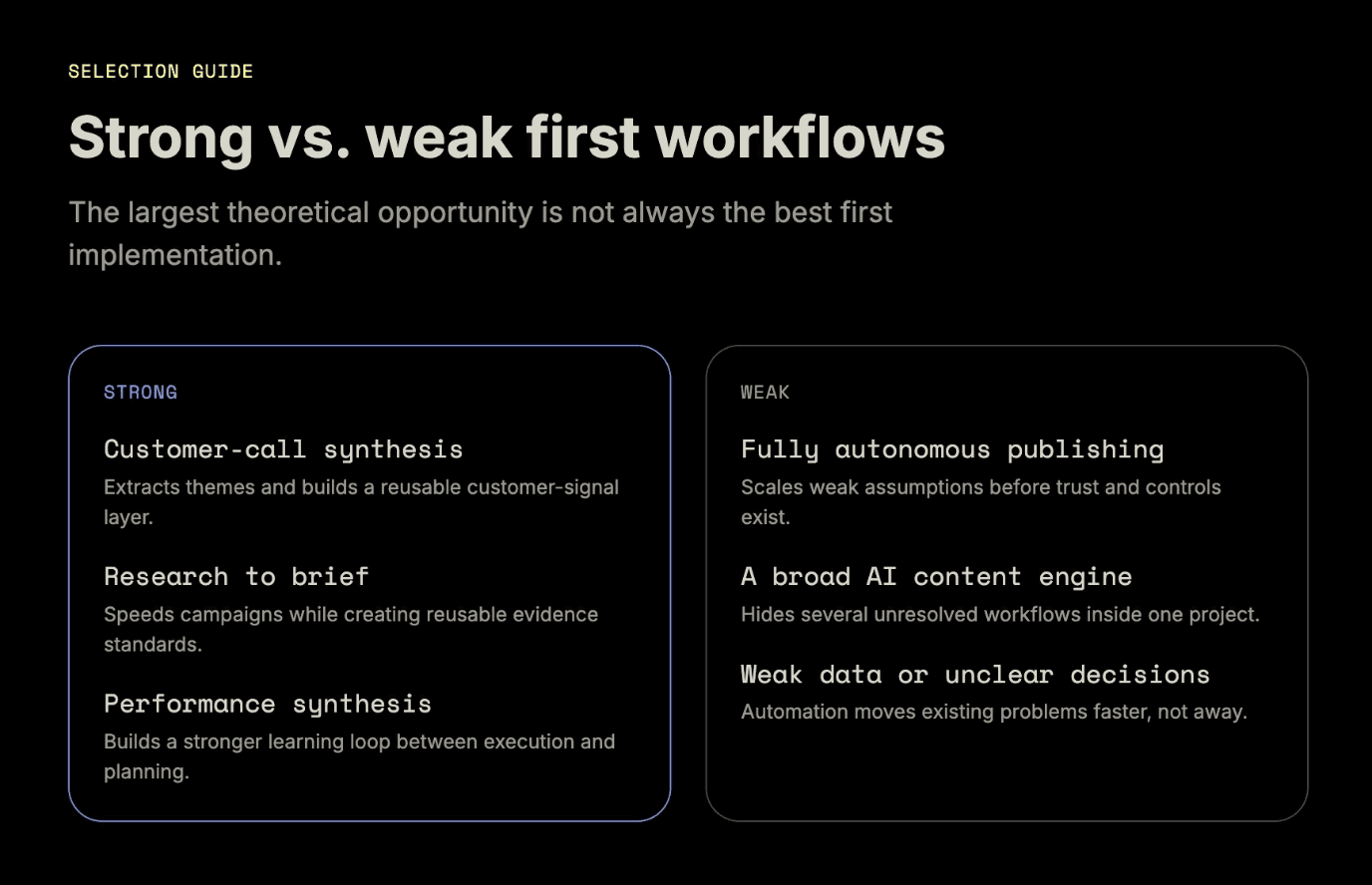
Workflows built on weak data or unclear decisions
Automation cannot repair unreliable CRM data, conflicting positioning, or a decision process the company has not defined.
It can move those problems faster and spread them further.
If nobody agrees on what a qualified lead is, automating lead qualification will not create alignment.
If the company does not know what makes a strong campaign, an autonomous campaign workflow will not answer the question.
Sometimes the right first AI implementation step is fixing the system before adding AI to it.
A simple comparison
Imagine a B2B software company considering four projects:
automated social posting
customer-call synthesis
autonomous campaign creation
weekly performance synthesis
Automated social posting is easy to build and runs frequently, but it may have limited business value and create little reusable learning.
Autonomous campaign creation has a large theoretical upside, but it also requires strong context, clear quality standards, and a much higher tolerance for failure.
Weekly performance synthesis is recurring, measurable, and connected to a real operating rhythm.
Customer-call synthesis may be the strongest first build because it combines frequent use, manageable risk, clear internal users, and high learning leverage. It solves an immediate problem while creating reusable customer evidence for several other workflows.
The largest theoretical opportunity is not always the best first implementation.

The first workflow should teach the company how to build
The first AI workflow is also the company’s first lesson in becoming capable of installing AI.
Through the project, the team learns how to organize context, assign ownership, design human review, handle exceptions, document decisions, test real users, and measure adoption.
It also learns where AI creates genuine leverage and where human judgment remains essential.
That implementation experience becomes part of the value.
Once the workflow is stable, the company can identify what it created that other systems can reuse. That may include data connections, customer language, quality standards, review processes, trained owners, or shared context.
The second workflow should be easier to install because of what the first workflow created.
That is how isolated automation begins to become GTM infrastructure.
How a forward deployed marketer chooses the first build
A forward deployed marketer does not begin with a preferred tool or a list of generic AI use cases.
They begin by studying how the company’s GTM work actually moves, where recurring constraints appear, what context exists, and which workflows have real owners.
The decision combines business strategy, workflow readiness, technical feasibility, adoption, and system-level leverage.
The FDM’s first job is not to build. It is to identify what is worth building.
That usually means choosing the smallest coherent workflow capable of improving a meaningful outcome and creating the foundation for what comes next.
Choose the workflow that makes the next one easier
The first workflow should be commercially meaningful, recurring, understandable, owned, adoptable, and safe enough to learn from.
It should create an immediate improvement without becoming another isolated tool.
The goal is not to automate as much as possible.
It is to install one workflow well enough that the company becomes better at installing the next one.
Choose the first workflow by the capability it creates, not merely the minutes it saves.


