
The Best AI Content Systems Start Before the Blank Page
Inside Content Desk, the AI content system Myosin built with CloudCoCo.
Using AI to write copy that doesn’t sound like it was AI generated is a constant battle.
If you start with a prompt, you’re most likely doomed to produce copy that reads…not exactly bad, but not exactly good. Which sounds authoritative, but is unfounded. And which is scattered - dare i say littered - with unnecessary em dashes.
The better approach is to start not with writing, but with context and framing. Which sources are worth paying attention to? Which stories matter to the audience? What angle does the company actually have a right to take? Who should say it? And so on, and so forth.
That was the starting point for Content Desk, a content system Myosin built for CloudCoCo as part of a forward deployed marketing engagement.
CloudCoCo operates across a wide range of technology categories, from cloud, cybersecurity, connectivity, and managed IT to AI infrastructure and enablement. That creates a content problem with more moving parts than simply producing more copy. The team has to keep track of a fast-moving market, decide which developments actually matter to its audiences, determine where CloudCoCo has something useful to say, and then translate that judgment across different channels and voices.
Instead of building another interface for generating copy, we built around the way that content operation actually worked.
The result is a system with four connected parts: Signal Radar, Draft Studio, Voice Guides, and an Image Library. Together, they turn a much larger content workflow into something the CloudCoCo team can operate.
Start with the workflow, not the AI
The easiest way to approach content automation is to identify a task AI can already do. Writing is an obvious candidate.
The more useful approach is to map the work first.
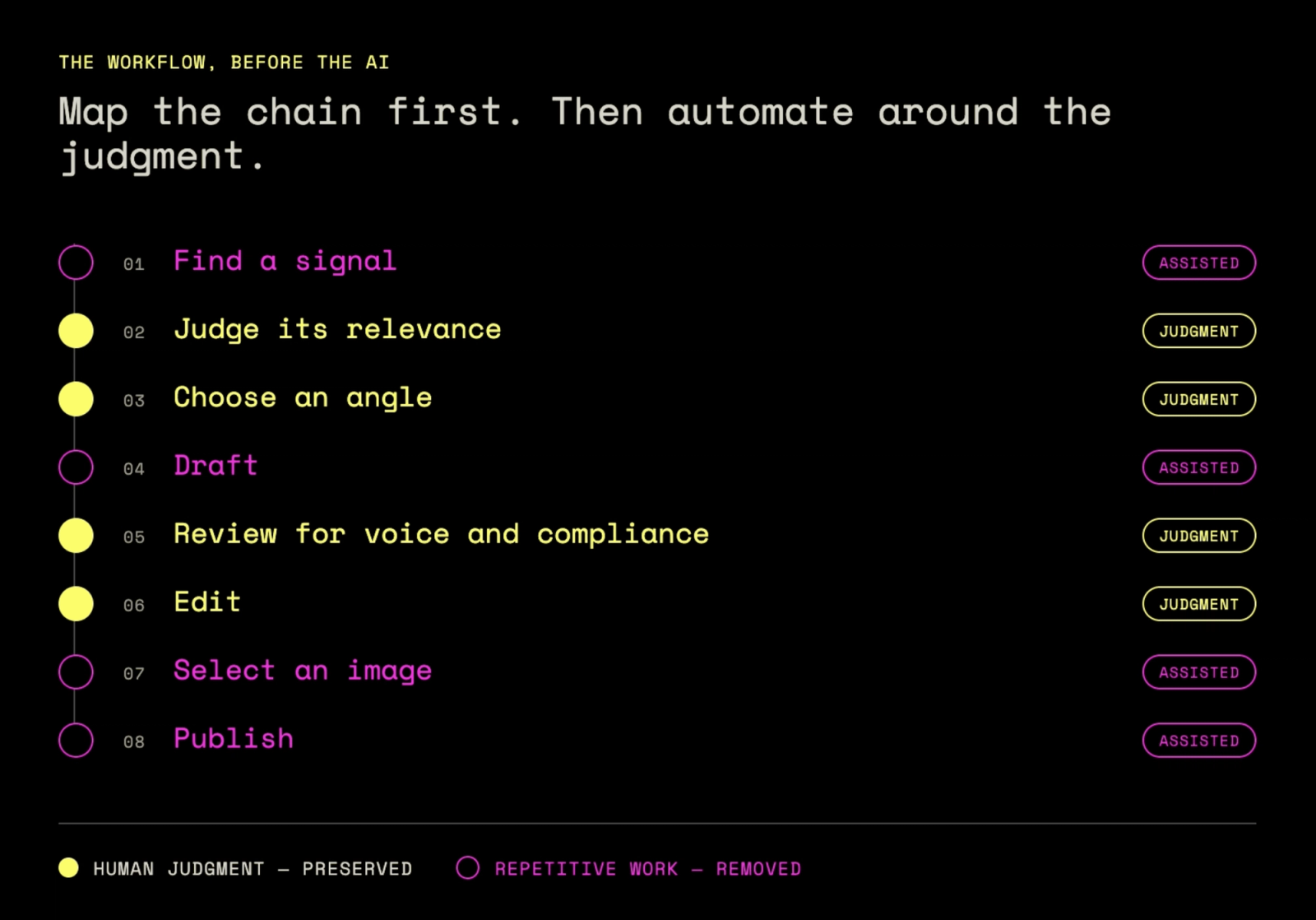
Once you see the whole chain, the automation opportunity changes. The goal is no longer to make AI write a post. It is to remove repetitive work around the decisions humans are already making, while preserving the places where their judgment matters.
That became the architecture for Content Desk.
Signal Radar narrows the field
The content process starts well before anyone writes.
For CloudCoCo, the content process starts well before anyone writes. The company operates across markets that move quickly and overlap with one another: AI, cloud infrastructure, cybersecurity, connectivity, Microsoft, managed IT, and more. Keeping up means monitoring industry publications, vendor announcements, regulatory developments, trade press, and other sources the team trusts, then deciding which of those signals actually matter to the audiences CloudCoCo serves.
Signal Radar handles much of that first pass. It automatically pulls stories from a curated set of vetted sources and ranks them according to their relevance to CloudCoCo's ICPs and content pillars. Sources can be organized by priority, new ones can be added, and individual URLs can be dropped into the system when the team finds something elsewhere.
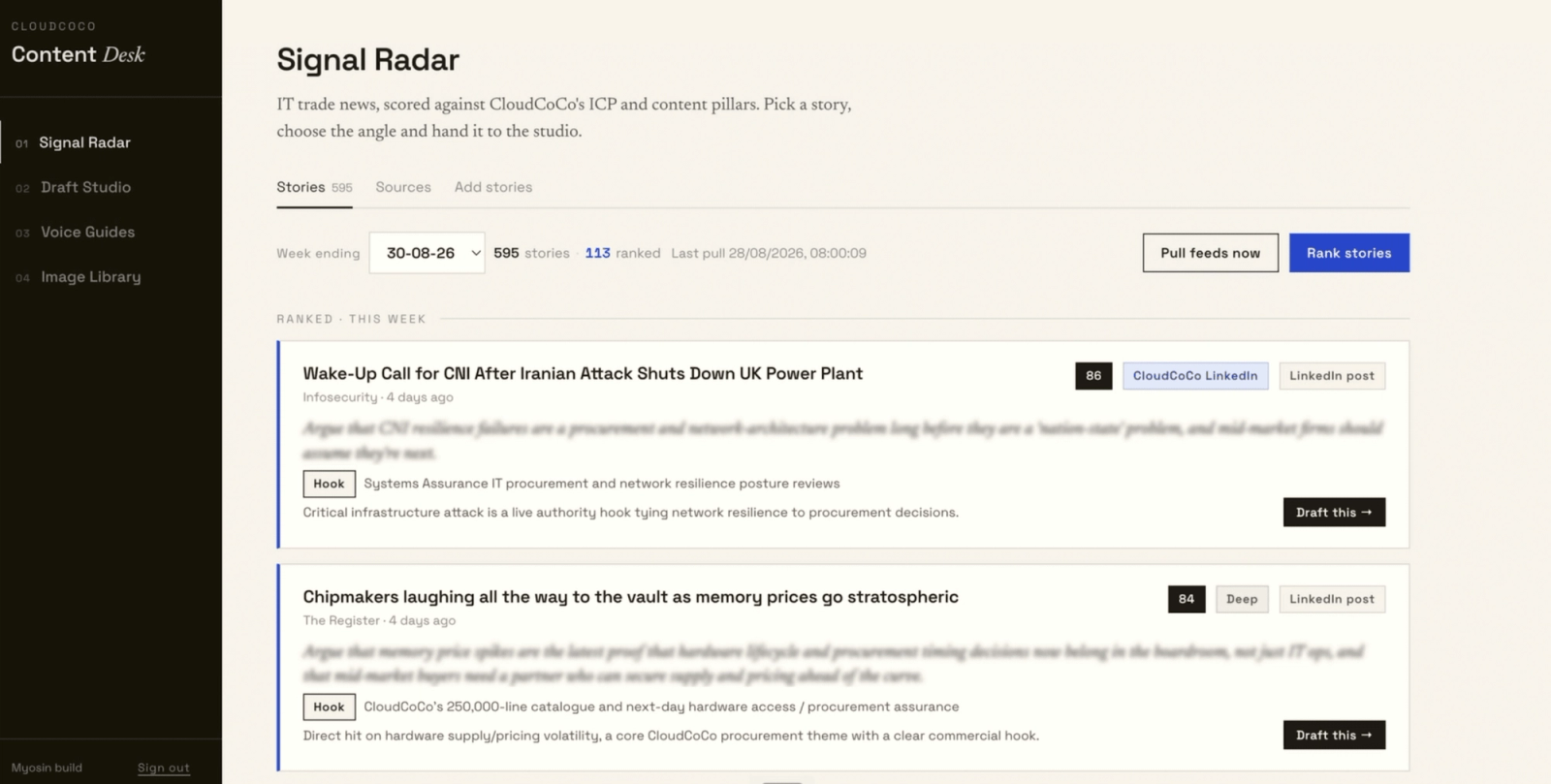
Instead of beginning the week with dozens of tabs, the marketer gets a ranked set of potential stories. Signal Radar does not decide what CloudCoCo believes or which story deserves to become a post. It reduces the search space so the human can spend more time making those decisions.
Draft Studio starts with context
Once someone finds a promising story, they can send it directly into Draft Studio.
By that point, the model already knows much more than a generic writing assistant would. It knows the source material, the selected angle, the target format, which company or executive voice should be speaking, and which compliance rules apply.
The system can then generate opening variants and a full first draft, while checking how well the result fits the selected voice and flagging potential compliance issues. The human still reviews the work and can change anything they want.
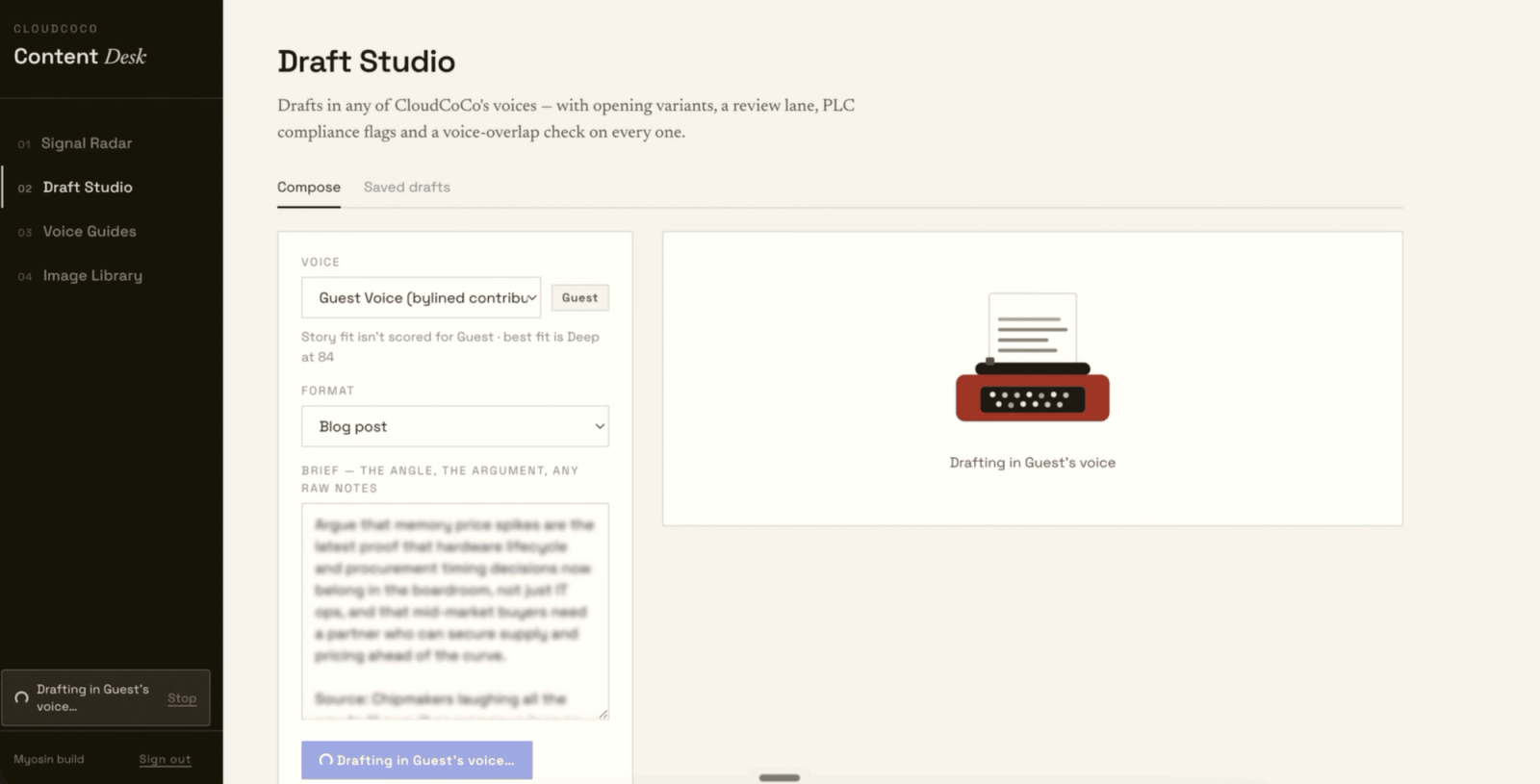
That sounds like a subtle difference from asking ChatGPT to write a LinkedIn post, but architecturally it is a large one. The quality of the draft is not primarily coming from a clever prompt. It comes from the context the system has accumulated before generation begins.
A good AI content system should know more than how to write. It should know what it is writing about, why it matters, who is speaking, what that person sounds like, and what constraints govern the output.
Voice is infrastructure
One of the harder parts of building a useful content system is that companies rarely have one voice.
CloudCoco has several: different company channels, different executives, guest contributors, and a separate compliance layer. Each has its own expectations.
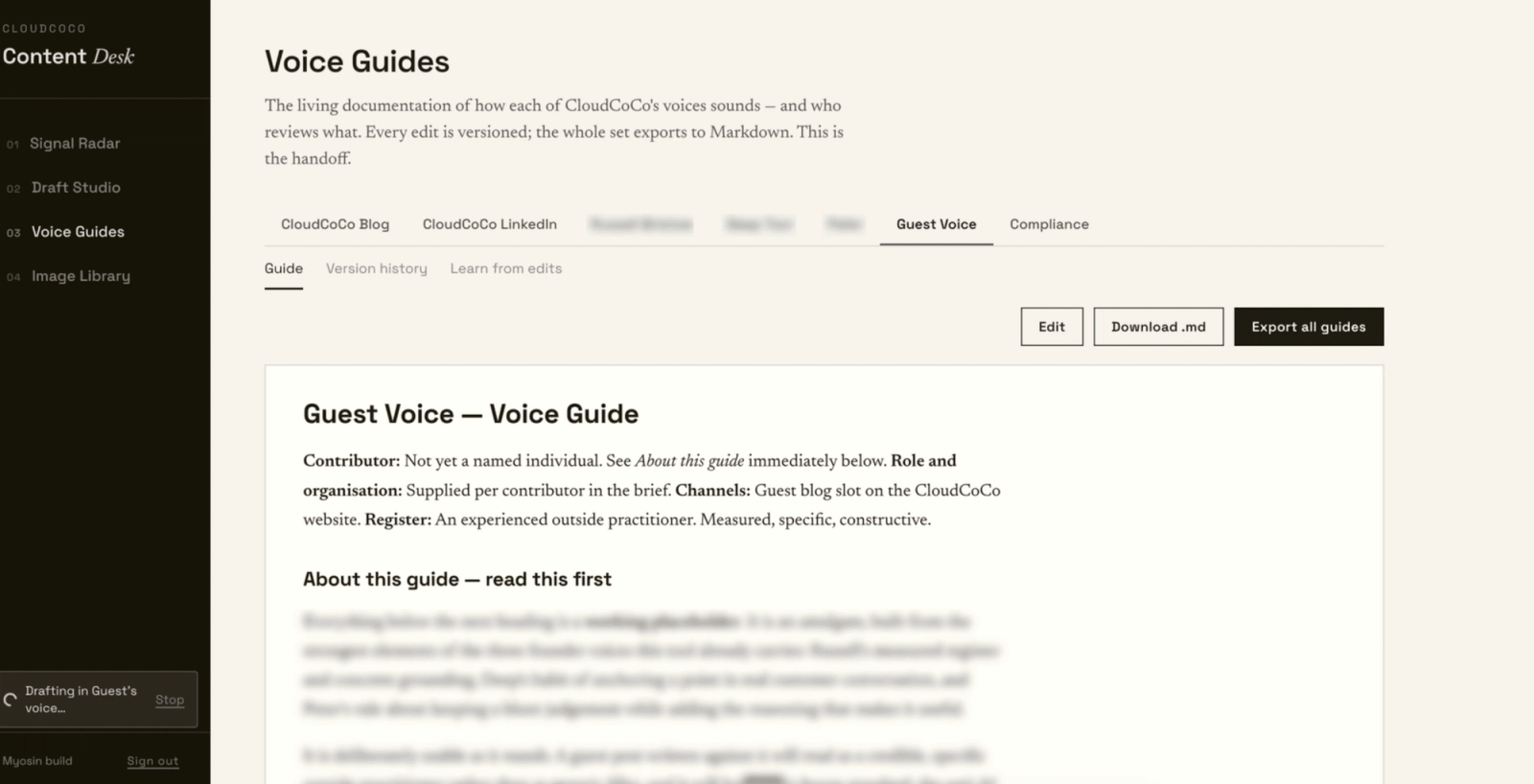
Content Desk includes six distinct voice guides alongside the compliance guidance. Different company channels and contributors can carry their own expectations, while the compliance layer gives the team another set of constraints to work within.
That matters because much of what makes good content good is usually tacit. An experienced editor knows that one executive is more understated, while another makes sharper claims. The company blog should sound institutional without becoming generic. Certain phrases feel natural in one channel and completely wrong in another.
Teams often carry that knowledge around in people’s heads. AI forces you to make it explicit.
That is one of the more important opportunities in building these systems. You are not simply teaching a model to imitate previous posts. You are converting organizational knowledge into infrastructure the rest of the workflow can use.
Human edits should make the system better
There is another problem with many AI content workflows.
The model drafts something and a human fixes it. The post goes live, and then the model makes the same mistake next week.
The human is technically in the loop, but the loop does not learn anything.
Content Desk is designed so the review process can feed back into the system. When someone changes a draft, those edits can be used to improve the relevant voice guide.
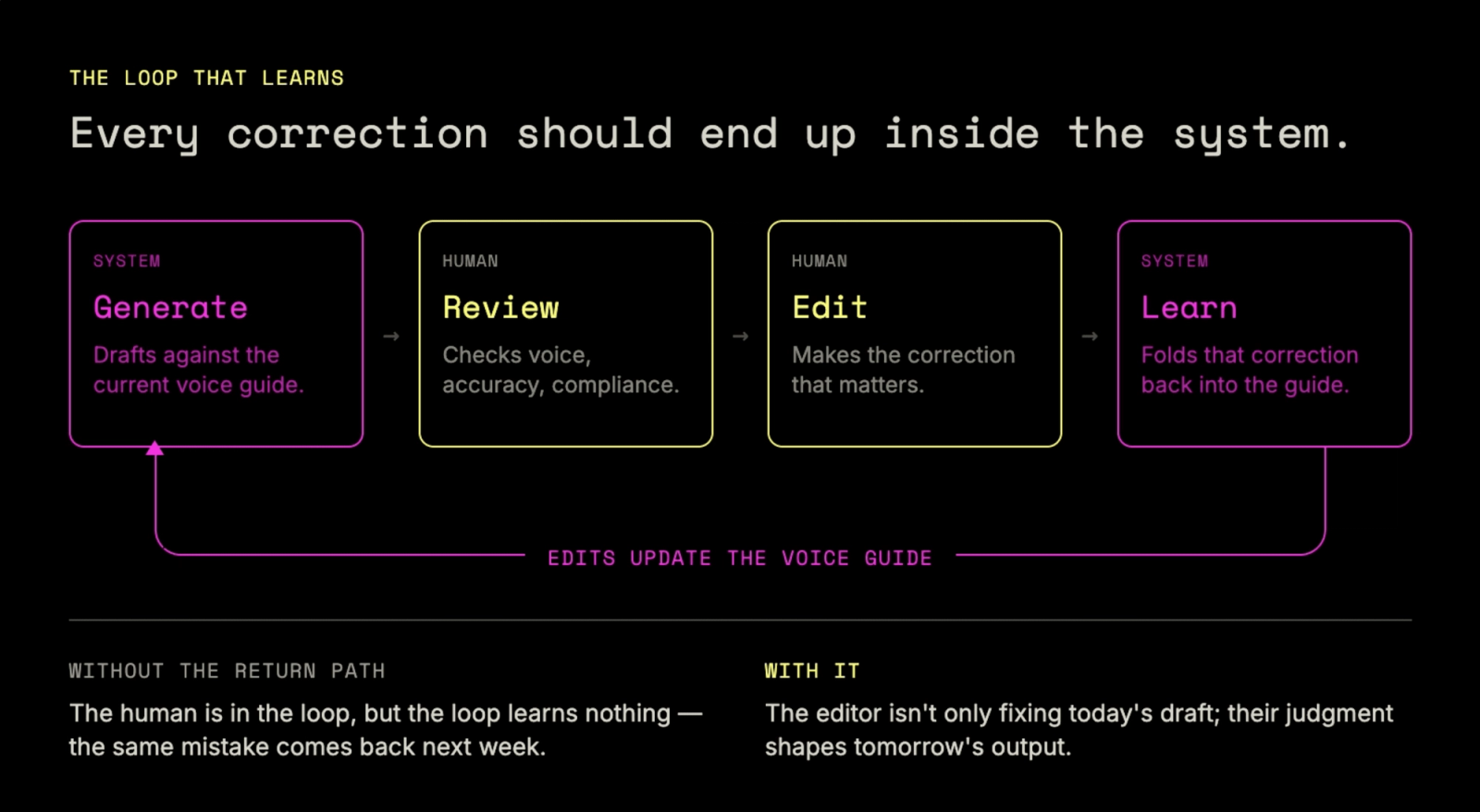
This cycle changes the role of human review. The editor is not only fixing today’s output; their judgment is helping shape tomorrow’s system.
This is an important test for any AI workflow. If someone repeatedly makes the same correction, that correction should eventually become part of the system. Otherwise you have automated generation without automating learning.
The workflow does not end when the words are finished
Then there are the small parts of the job that rarely make it into an AI demo.
The post needs an image. Someone searches through folders, checks whether the photograph is approved, realizes they used the same image last month, then goes looking for another one.
None of these tasks is strategically important, but together they create friction.
Content Desk includes a categorized library of approved photography so the team can find an appropriate asset inside the same workflow. New images can be added and categorized as the library grows.
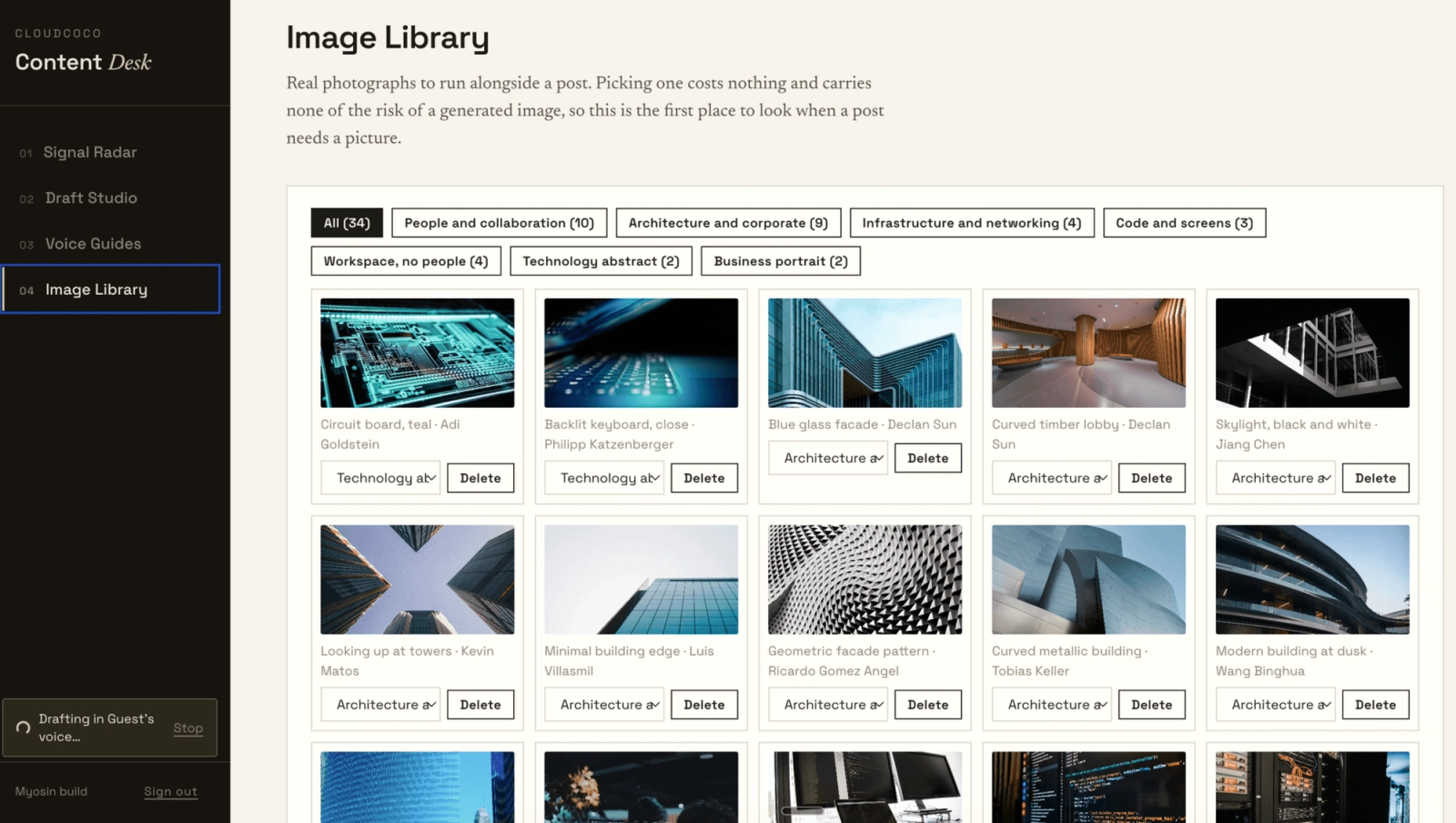
The Image Library is probably the least sophisticated part of the system, but it is also part of what makes the system useful. Real workflows are full of small handoffs like this. If you automate the impressive middle and leave all of the surrounding work untouched, people still have to stitch the process together manually.
What we automated, and what we didn’t
What became clear while building Content Desk with CloudCoCo is that the useful automation boundary sits around the judgment, rather than through the middle of it.
The system can monitor sources, collect stories, rank relevance, produce first drafts, generate opening variants, check against voice guidance, surface compliance concerns, and organize approved assets. Those are meaningful parts of the content operation, and removing their repetitive work gives the team considerably more room to operate.
But CloudCoCo's marketers still decide which story deserves attention, what the company actually thinks about it, which claims are worth making, and whether the final draft is good enough to publish.
That boundary is intentional. The objective was never to automate the marketer out of the workflow. It was to concentrate their attention on the decisions where their knowledge of the market, audience, and company creates the most value.
This is what an installed AI system looks like
Content Desk is useful as a content tool, but the more interesting part is what Myosin and CloudCoCo had to make explicit in order to build it.
The system needed to understand CloudCoco’s trusted sources, audiences, content pillars, editorial judgment, different voices, compliance expectations, review process, approved imagery, and feedback loops. None of those things are novel AI capabilities on their own. They are pieces of how the company already operates.
That is the point.
Forward deployed marketing is not just about finding a task a model can perform. It is about understanding the operating logic around the work, deciding which parts should be automated, and installing that logic into a system the team can actually use.
Content Desk happened to be built for content. The same principle extends much further.
The software is only part of the deliverable. The real deliverable is a company’s way of working, made explicit enough that people and AI can operate it together.
The opportunity in AI content is not to hand the thinking to a model. It is to make good human judgment easier to carry through the system, so people do not have to manually recreate the same context, decisions, and corrections every time the work begins again.


