
What Happens to Marketing When AI Becomes Infrastructure?
AI is changing how marketing operates inside the company at the same time it is changing how companies reach the market.

For the past few years, most marketing teams have treated AI as something you use to do the work.
You use it to draft an article, analyze campaign performance, generate creative, summarize research, or automate a workflow. The models keep getting better, the tools get easier to use, and more pieces of the marketing function become AI-assisted.
That has made the first phase of adoption mostly a tool question: What can AI do? Where should we use it? Which tasks should we automate?
Those questions are still being worked out, but they become less useful once AI starts running through the work itself.
When AI participates in research, strategy, content, creative, analytics, workflow execution, customer interaction, and discovery, it is no longer sitting at the edge of the marketing function. It is becoming part of its underlying infrastructure.
And AI is entering marketing from both directions.
Inside the company, it changes how capability is built, how work gets done, and how much of an outcome one person or team can own.
Outside the company, it increasingly sits between the customer intent and company offer, helping people discover, compare, evaluate, recommend, and eventually act.
Marketing sits between those two changes.
Follow them far enough and the result is not simply a more efficient version of the marketing function we have today. The whole economics change. The roles change and the sources of advantage change. The market itself starts working differently.
AI capability has to become part of how the work runs
Giving marketers access to AI is easy.
Turning that access into organizational capability is definitely harder.
Most companies already have people using ChatGPT, Claude, Copilot, agents, automation platforms, and an expanding collection of AI features inside the software they already own. Yet access to those tools tells you very little about whether the business has actually become better at marketing.
The difference appears when the capability moves from individual experimentation into the operating system of the team.
A useful workflow has to be identified. The inputs need to be reliable and the system has to be designed around the real work rather than an imagined process. Someone needs to know where judgment belongs, what happens when the output is wrong, who owns the result, and how the rest of the team will actually use it.
Then that capability has to survive the person who built it.
That is the work we have been outlining through the Forward Deployed Marketer (FDM): diagnosing where AI can create meaningful leverage, building it into the workflow, testing it against real work, and transferring it into the organization so the team can operate it themselves.
The deliverable is not the automation. It is a new capability.
Once that starts happening across the function, the more interesting question is no longer whether AI can perform a marketing task. It is what happens to marketing once a meaningful share of those tasks becomes cheap and accessible.
When production gets cheaper, advantage moves
A simplified marketing value chain looks something like this:
Understand → Decide → Produce → Distribute → Earn Trust
For a long time, a significant amount of marketing cost and organizational complexity accumulated in the middle.
Production was expensive.
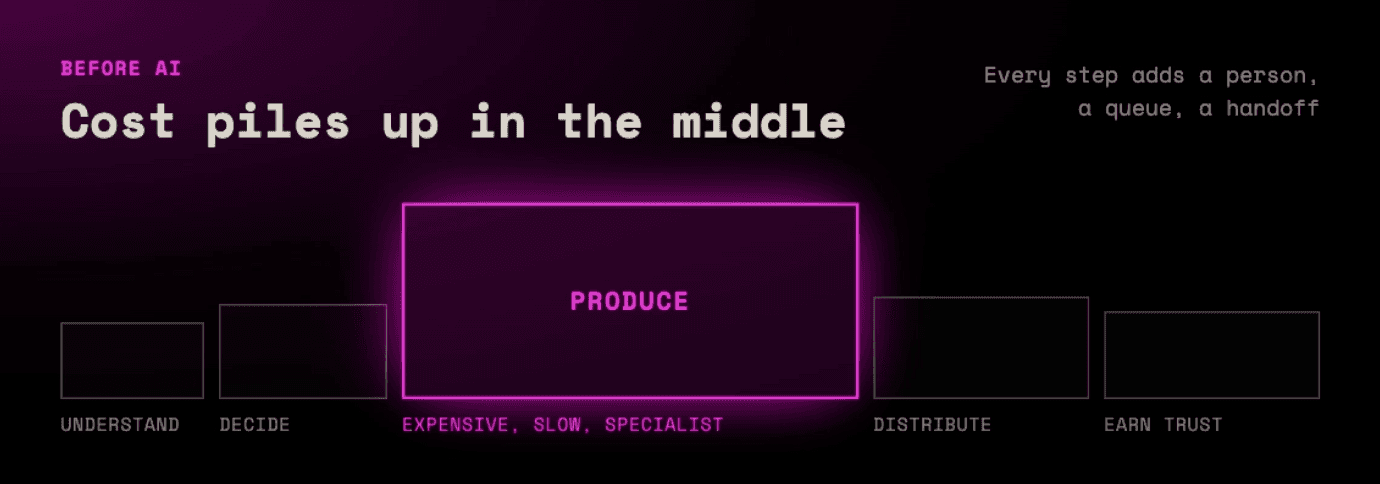
Research took time. Analysis required specialists. Copy had to be written and creative had to be designed. Content had to be adapted to different formats and channels. Every step introduced another person, another queue, another handoff, and another constraint on how quickly an idea could move into the market.
AI compresses much of that production layer.
It does not make good marketing automatic, but it makes competent execution dramatically easier to access across writing, research, analysis, creative development, repurposing, campaign operations, and other forms of routine production.
That changes where scarcity lives.
Before production, customer understanding becomes more valuable because everyone can produce against a brief, but fewer companies have genuinely better inputs. Positioning matters more because abundant execution magnifies whatever strategic choice came before it. Judgment, taste, proprietary knowledge, and point of view become harder to substitute because the model can generate options more easily than it can determine which option deserves to exist.
After production, distribution becomes more important because producing another piece of content does not mean anyone will see it. Brand matters because familiarity and trust are harder to manufacture than output. Customer relationships matter because access to people becomes more defensible as access to production becomes more common.
AI does not eliminate competitive advantage. It changes where companies have to look for it.
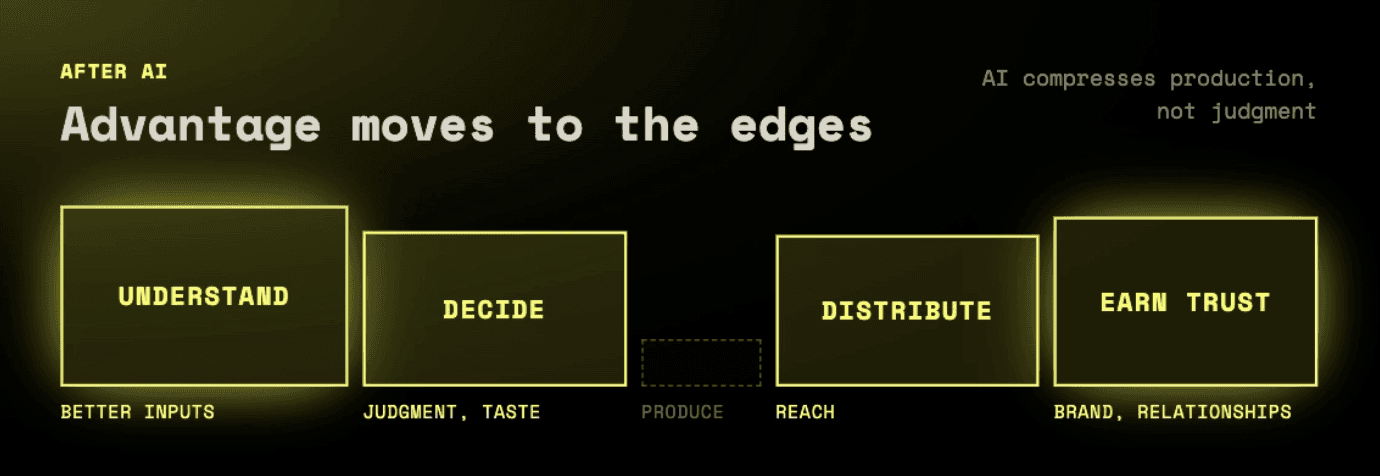
The businesses that win will not necessarily be the ones capable of producing the most. Increasingly, nearly everyone will be able to produce more. The advantage shifts toward knowing something worth producing, making better decisions about what enters the system, and having a credible way to reach people once the output comes out the other side.
The marketer's operating range gets wider
The same economics change the role of the marketer.
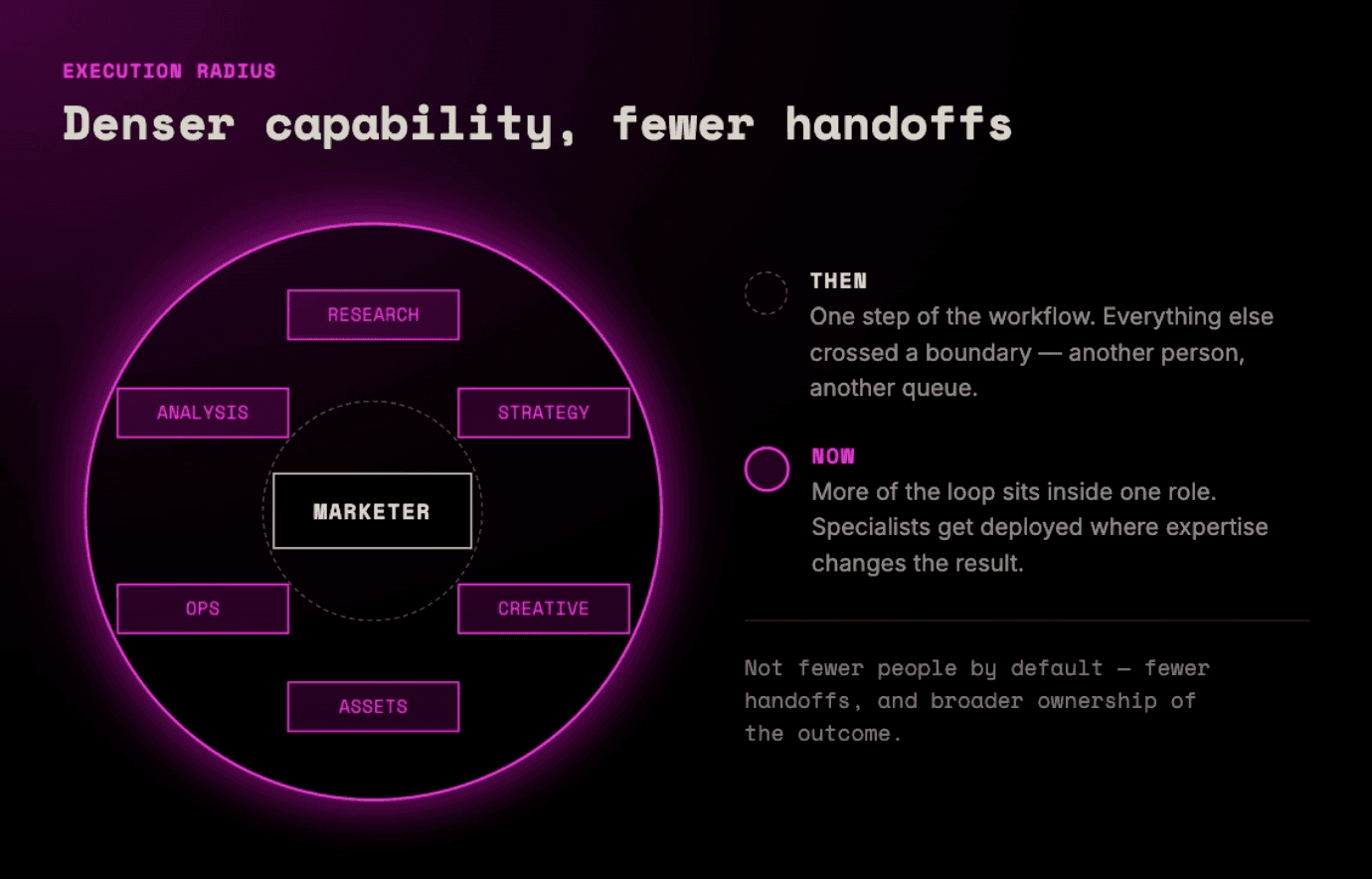
Traditional marketing organizations developed around the cost of specialization. Research passed to strategy. Strategy passed to copy. Copy passed to design. Creative passed to campaign operations. Performance data passed back to an analyst, who turned it into another round of decisions.
There are good reasons for specialization, and many of those specialists remain valuable. What changes is the cost of crossing the boundaries between them.
A marketer who previously needed five handoffs to move from an initial customer insight to a live campaign can increasingly carry more of that loop themself. AI can help conduct research, interrogate data, develop an outline, draft creative, produce variants, prepare assets, coordinate execution, and interpret the first round of results.
That does not turn every marketer into an expert in every discipline. It does make a broader span of ownership possible.
The marketer's stack starts to look different as a result. Software still matters, but more of the differentiation moves above the software: what the marketer understands about the domain and customer, what context the AI can access, what reusable methods have been encoded into the workflow, what execution capabilities the tools provide, and what judgment governs the whole system.
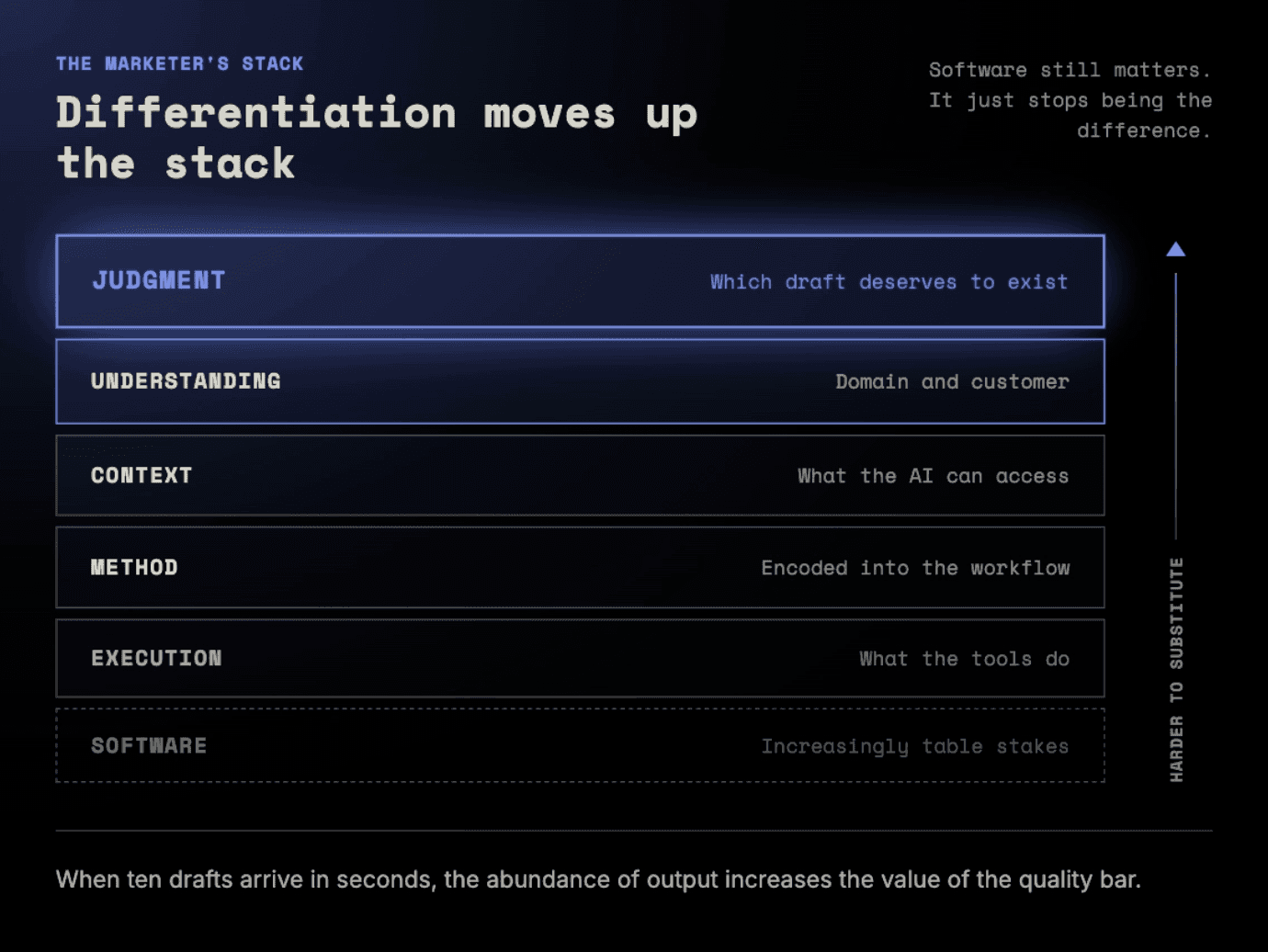
That last layer becomes particularly important.
When generating a draft is difficult, the person who can generate it has value.
When ten drafts arrive in seconds, value moves toward the person who can tell which one is generic, which one misunderstands the customer, which one creates risk, which one violates the strategy, and which one is actually good.
The abundance of output increases the value of the quality bar.
That is why the AI-enabled marketer is unlikely to be defined primarily by mastery of AI tools. Tools will change too quickly, and many of their capabilities will become embedded into software by default.
The more durable advantage is the ability to understand more of the system, direct more capability, make better decisions, and remain accountable for a larger outcome.
Denser capability changes the shape of the team
Once individuals can operate across a wider portion of the workflow, the organizational unit required to produce an outcome changes too.
The simplistic version of this argument is that AI replaces marketing jobs.
The more useful version is that AI increases the amount of capability that can sit inside a role.
A strong marketer supported by good systems may be able to perform work that previously required several tightly coordinated specialists. A specialist can spend less time on repetitive production and more time applying expertise where it actually changes the result. A small team can access capabilities that once required a much larger department or a network of agencies.
That can lead to smaller teams, but headcount is not the most interesting consequence.
The deeper change is organizational density.
Teams can potentially carry more capability with fewer handoffs, less coordination overhead, and broader ownership of outcomes. Specialists become more selectively deployed. Generalists can go deeper. Managers may spend less time coordinating production and more time setting direction, developing judgment, and designing the systems through which the work gets done.
This also changes the career question for marketers.
Being excellent at a narrow production task may still matter, particularly where genuine expertise is required. But the opportunity expands for people who can connect disciplines, understand how the pieces fit together, supervise AI across those boundaries, and take responsibility for what the whole system produces.
AI gives the marketer a larger execution radius.
The question is what they are capable of doing with it.
At the same time, AI is entering the market from the other side
Everything so far happens inside the company.
But AI is also changing what happens outside it.
Customers increasingly use AI systems to research a problem, understand a category, compare products, evaluate alternatives, build a shortlist, or decide what to do next. Search engines are incorporating generated answers. AI assistants are becoming research interfaces. Agents are beginning to navigate software and take actions on behalf of users.
That puts a new layer of software between the customer intent and company offer.
This matters because companies have spent decades building go-to-market systems primarily for human navigation.
Websites are designed for people. Brands are built to create human recognition. Advertising earns human attention. Content persuades human readers. Salespeople answer human questions.
None of that disappears, but a second audience is emerging alongside the first.
An agent trying to help someone make a decision needs something different. It needs to determine what the company is, what the product does, who it is for, how it compares, whether its claims can be substantiated, and whether trusted sources corroborate what the company says about itself.
Marketing still has to persuade people.
It also has to become legible to the systems helping people decide.
That creates a new progression for GTM. A company first has to be discoverable by AI, then understandable. Its claims need to be verifiable. Its relevance needs to be strong enough that the system can recommend it in the right context. Eventually, its information and interfaces may need to become actionable enough that an agent can take the next step without requiring a person to reconstruct everything manually.
The implication goes well beyond another version of SEO.
It pushes companies toward more structured product information, clearer positioning, stronger external evidence, more consistent entity signals, accessible pricing and integration data, and a market presence machines can reliably interpret.
The machine-readable company starts becoming part of the GTM stack.
Marketing now operates between two kinds of infrastructure
This is where the two sides meet.
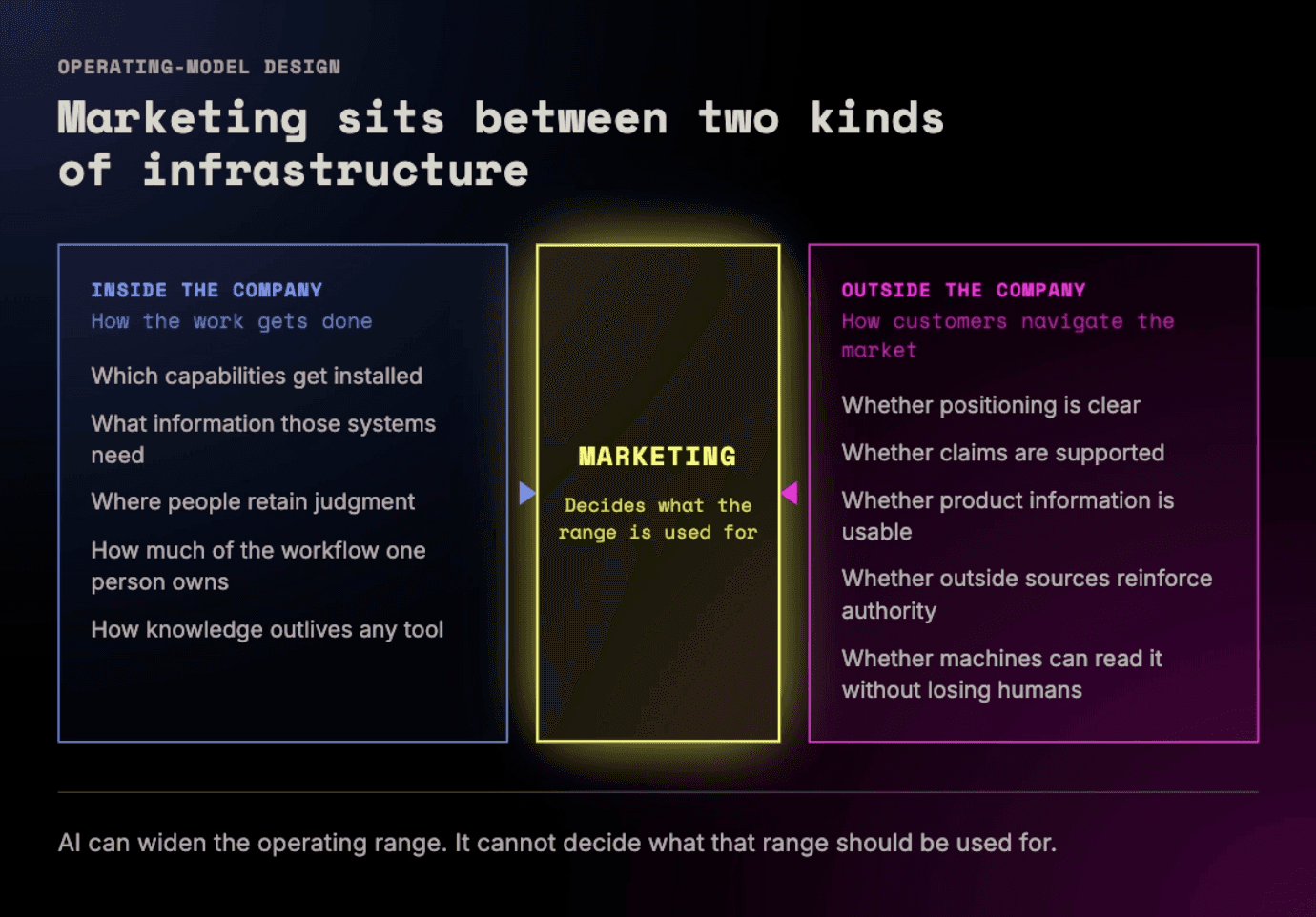
Inside the company, AI is changing the infrastructure through which marketing work gets done.
Outside the company, AI is changing the infrastructure through which customers navigate the market.
Marketing sits in the middle.
That means the job is no longer simply to add AI to the existing marketing stack. Leaders increasingly have to rethink the system itself.
They need to decide what capabilities should be installed, what information those systems require, where people retain judgment, how much of the workflow an individual should own, and how knowledge survives beyond any single person or tool.
At the same time, they have to think about how the company appears to an AI-mediated market: whether its positioning is clear, whether its claims are supported, whether product information is usable, whether external sources reinforce its authority, and whether the business can be reliably understood by machines without becoming less compelling to humans.
These are not separate AI initiatives.
They are becoming part of marketing operating-model design and they return responsibility to the marketer rather than removing it.
The better AI becomes at execution, the less defensible it is to spend most of a marketer's time moving information between systems, producing routine variations, or manually assembling work that a well-designed system can handle. The human responsibility moves toward understanding the customer, choosing what matters, maintaining the quality bar, building trust, and deciding how capability should be directed.
AI can widen the operating range.
It cannot decide what that range should be used for.
The marketing function is being redesigned from both sides
A marketing leader can respond to all of this by buying better tools.
There will be plenty worth buying.
But treating AI primarily as a software upgrade risks optimizing a marketing function whose underlying assumptions are already changing.
If execution becomes cheaper, the organization has to know where advantage moves.
If marketers can own more of the loop, roles and teams have to be designed around that capability.
If judgment becomes the constraint, companies need to develop it rather than automate around it.
And if AI increasingly participates in discovery and evaluation, the company's market presence has to work for systems as well as people.
The companies that understand this will start making different choices. They will invest less energy in adding AI to every task and more in deciding which capabilities deserve to become part of the business. They will build teams around ownership rather than handoffs. They will protect the knowledge, relationships, judgment, and trust that become more valuable as production gets easier. And they will make the business itself easier for both people and machines to understand.
AI is not simply making today's marketing function more efficient.
It is changing what the marketing function is.


