
Your First Marketing Hire in Web3 Is Not a Marketing Hire
Victoria Mariscal
Head of Operations
Mar 31, 2026
We're still out here writing the same job description we wrote in 2021, and then acting confused when the results don't match the moment we're actually in.
Five to eight years of marketing experience. Proven growth metrics. Deep crypto industry knowledge. Top tech company logos on the resume. And then six months later everyone is confused because the Telegram is quiet, the launches fell flat, and the "Head of Marketing" is asking for a bigger ad budget like that's the variable that's going to fix everything.
It's not. It was never the budget.
The problem is that we've been hiring for the wrong job entirely, optimizing for a credential when what we actually needed was conviction. Your first marketing hire in Web3? It's not a marketing hire. It's a BELIEF hire. Someone whose actual job is to take the messy, urgent, half-formed thing living inside your head and translate it into something other people genuinely want to believe in.
Most founders optimize for the resume. The founders who build real movements optimize for alignment. And in 2026, that distinction is everything.
The Talent Market Looks Nothing Like It Did
Here's something that's wild when you stop to look. Right now there is more marketing talent available than at any point in the last decade. Over the past two years, thousands of agency strategists got laid off and are looking to build something with actual stakes. Brand storytellers are exhausted from selling products they don't believe in. Community builders are leaving traditional tech, burned out on growth-for-growth's-sake environments, actively looking for something that feels real.
These people exist. They are good at what they do. A lot of founders are filtering them out because they're not "crypto native," which I think is one of the most expensive mistakes you can make in an early-stage hire.
Crypto knowledge can be learned, it’s a lot faster than what people assume when someone is motivated and curious. Conviction cannot be learned. You either have it or you don’t. We forget that early-stage marketing runs entirely on conviction. The person who has spent three years in the space but never developed real narrative instincts is a much harder problem to fix than someone who understands storytelling at a cellular level and is genuinely excited about Web3 as an industry. One of those gaps closes with time and exposure. The other one doesn't really close at all.
Narrative First. Everything Else Follows.
Most people, when they think about marketing, think about distribution. Channels. Campaigns. Growth funnels. Acquisition cost. And look, that stuff matters, but it's not where early-stage marketing starts.
Early-stage marketing starts with narrative. Before anyone on your team can promote the project with any real conviction, they need to understand why it exists. Not the product features. Not the technical architecture. The belief system. The frustration that made you start building in the first place. The broken thing you identified that everyone else was ignoring. The future you think should exist but doesn't yet.
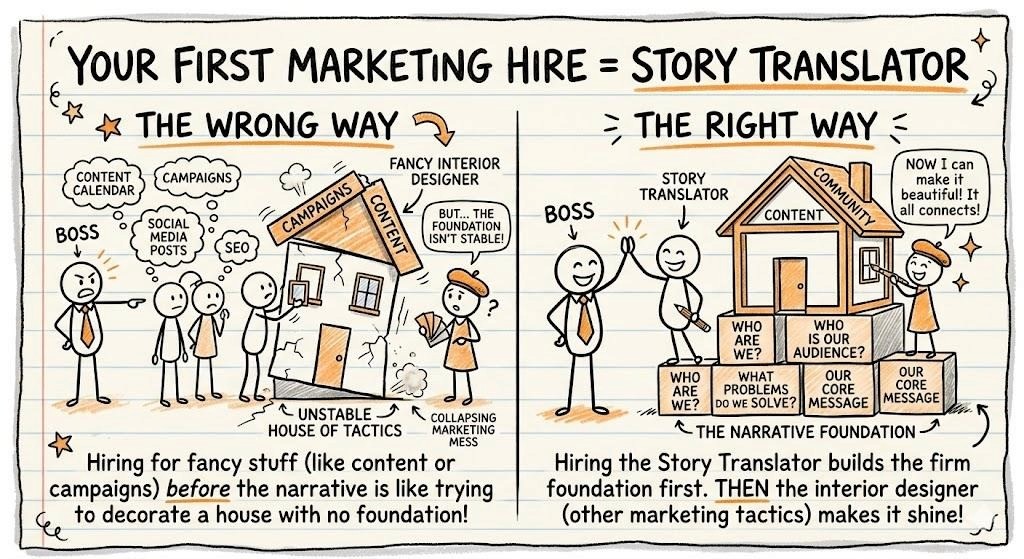
Your first marketing hire is a story translator. If they can't do that, nothing else they do is going to land the way you want it to. Think about it like building a house. You can hire the best interior designer in the world, but if there's no foundation, none of the beautiful decisions they make inside it are going to matter. The narrative is the foundation. The campaigns, the content calendar, the community strategy, those are the interior design. You need the foundation first, and you need someone who cares about building it right.
Why Hires Keep Failing
I've watched this pattern play out enough times to recognize it immediately, and there are usually four ways onboarding usually goes wrong.
The first is what I'd call the resume hire, which is the most common. You bring on someone with impressive logos and large campaign experience, they look like a dream on paper. The problem is that this person has spent their career operating inside companies that already have brand awareness, established teams, actual budgets, and product-market fit. Early-stage crypto has none of those things. You don't need someone who knows how to scale what already exists. You need someone who knows how to build from zero, which is a completely different skill set, a different psychological orientation, and honestly a different personality type.
The second is the traditional playbook problem. A hire comes in and starts running the tactics they know because those tactics worked before. Campaign launches. Content calendars. Growth experiments. None of it works, not because those things are inherently wrong, but because crypto communities don't behave like traditional marketing audiences. They behave like tribes. Tribal behavior is governed by identity, by shared belief, by the feeling of being part of something that matters. If the narrative doesn't resonate at that level, no tactic is going to compensate for it.
The third is the metrics mirage, and this is the one that hurts the most because it's so easy to miss until it's too late. You hire someone talented. They optimize everything. The numbers move. Followers increase. Impressions are up and the dashboard looks great. Yet something is still missing. The community isn't defending the project in other channels. Nobody is explaining the protocol to their friends. Nobody is posting about it organically. Numbers moved but belief didn't. Those are not the same thing and we need to stop treating them like they are.
The fourth is the "crypto native" illusion. Some founders will only look at candidates who have been in the space for years, assuming time in the industry automatically translates to marketing skill. It doesn't. Someone who has been in crypto for five years but lacks narrative instincts and community empathy will struggle in this role just as much as someone coming in from the outside without that context. Background can give you credibility in certain rooms. It cannot give you the ability to tell a story that makes people feel something.
My Hot Take: Crypto-Native Is Overrated
I know this is going to be a slightly unpopular thing to say in certain circles, so let me be clear about what I am and am not saying. I'm not saying crypto knowledge doesn't matter. I'm saying it shouldn't be the primary filter for your first marketing hire, and it definitely shouldn't be weighted above the instincts and orientations that actually make someone effective in an early-stage role.
What your first marketing hire actually needs is three things. Genuine curiosity, the obsessive-learner kind where someone dives into communities and conversations and culture because they actually want to understand it, not because they're performing interest to get the job. Narrative thinking, which is the ability to take a complex, technical, abstract idea and explain it in a way that makes people care, not just understand. Those are different things. Understanding is intellectual. Caring is emotional. Great marketers know how to activate both. And then what I'd call builder energy, the kind of person who finds ambiguity exciting rather than stressful, who can operate without a complete playbook, who treats "we're figuring this out as we go" as a feature of the role rather than a bug.
Those three things? You cannot really train them. Either someone has them or they don't. Crypto knowledge you can build through three months of deep immersion in the right communities and conversations. The instincts are either there or they aren't.
What to Actually Look For in the Room
When I'm evaluating candidates for early-stage marketing roles, credentials are pretty far down my list. What I care about is how they think, and there are a few signals that tell me almost everything.
Do they ask about the origin story before they start pitching strategy? The best candidates want to understand why the project exists before they start talking about tactics. If someone jumps into campaign ideas in the first twenty minutes of the conversation, they're thinking too small and too tactically. That's the energy of someone who wants to execute, not someone who wants to understand. You need both eventually, but in the early days you need understanding first.
Can they explain complicated things simply? I genuinely love asking candidates to read something technical and then explain it back to me in thirty seconds as if I know nothing. The best answers lead with the transformation the product enables, not the technology behind it. That instinct, the ability to lead with meaning rather than mechanics, is what builds communities around products.
Do they have real taste and real opinions? Great marketers have things they find compelling and things they find boring and they can articulate the difference. Ask them about a project in any industry that they genuinely admire and why. If they struggle to go beyond "I thought the branding was good," that tells you something important.
Do they see the community as the protagonist? The best Web3 marketing doesn't center the company. It centers the people who believe in it. That instinct, treating users and community members as the heroes of the story rather than the audience for the story, is hard to teach and incredibly valuable.
The First 30 Days: Slow Down to Speed Up
Most founders rush this part because they're used to operating at speed and they want output immediately. Content calendars. Campaign launches. Growth plans. That energy makes sense in a lot of contexts but it's actually counterproductive here.
The first 30 days of a great early-stage marketing hire should look like deep absorption. Reading everything the founder has written publicly. Spending real time in Discord, in Telegram, in community channels, not just observing but understanding the language, the memes, the inside references, the cultural markers of the tribe. Mapping the emotional landscape of the community: what gets people excited, what makes them defensive, what language resonates.
Only after that should the new hire start creating anything. The first real deliverable shouldn't be a campaign. It should be a narrative asset. A manifesto, an origin story, a positioning document that clearly articulates what the project stands for and why that matters right now. Something the whole team can use as a reference point. Everything else, every piece of content, every community activation, every partnership conversation, grows from that foundation.
If You Can't Answer These Questions, Don't Hire Yet
Sometimes the most honest advice is the simplest: you're not ready. And that's okay, but it's worth being clear about it before you bring someone in and set them up to fail.
If you cannot clearly articulate why this project exists, why this moment in time is the right moment to build it, and why you are specifically the person building it, a marketing hire is not going to solve that problem. They'll be trying to tell a story that doesn't fully exist yet, and the audience will feel that gap even if they can't name it.
Early-stage crypto still rewards founder-led storytelling more than almost anything else. Founders who show up publicly, in conversations, in communities, in written pieces that show their thinking, build trust faster than any marketing team can manufacture it from scratch. The first marketing hire should be amplifying that presence and giving it more surface area. Not replacing it.

The Founders Who Win Are Hiring Believers
The projects that actually win in this space don't usually start with a perfectly structured marketing team and a full content strategy. They start with people who genuinely believe in the mission, because that belief creates energy, and energy creates narrative, and narrative creates community, and community becomes your most durable form of distribution.
In 2026, the talent is out there. The market is full of people who are ready to build something real, who are tired of optimizing for metrics that don't mean anything, who want to pour their skills into a project that actually matters to them. They might not have the perfect crypto background on paper. They might be coming from brand strategy, or editorial, or community management in a totally different vertical. What they have is curiosity and conviction and the ability to tell a story that makes people want to be part of something.
That's the hire. That's who you're looking for.
Stop filtering for logos. Start looking for believers who are ready to learn how to market.


