
Growth exposes the manual work, hidden dependencies, and missing infrastructure your current team has learned to work around.
Olly Jones
BD & Growth
Sep 17, 2026
Salesforce’s 2026 State of Sales research, based on a survey of 4,050 sales professionals, found that the average rep spends only 40% of the week selling.
The obvious conclusion is that sales teams have an efficiency problem. Automate the administrative work, give the time back to the reps, and let them spend more of the week with customers.
Some of that is true. But “non-selling work” hides an important distinction.
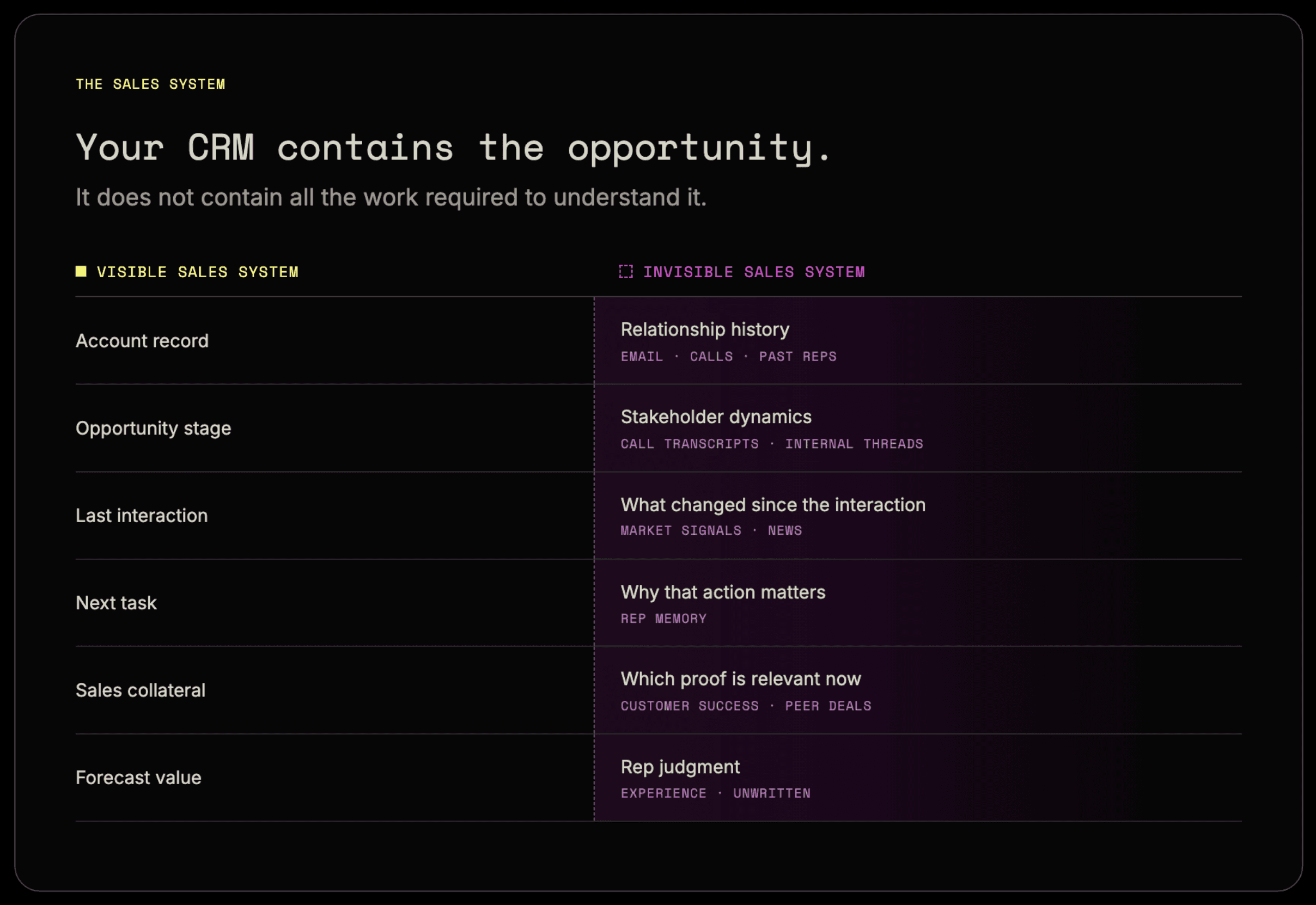
Some of that work is administrative, like entering notes, creating quotes, and chasing approvals. Some of it is the work that makes a sales conversation useful in the first place: researching the account, finding the right customer proof, understanding the people involved, and deciding what matters now.
An experienced account executive does not simply open the CRM and follow the next task. Before an important call, she checks an old email thread, rereads the discovery notes, looks up the executive who recently joined the account, and finds the case study she remembers being relevant.
Then she makes a judgment call about what matters, what to leave out, and how to move the conversation forward.
The CRM contains the opportunity. It does not contain all the work required to understand it.
This is the invisible sales system: the research, memory, judgment, relationships, and coordination that capable people contribute around the formal process.
At the current scale, it may work remarkably well. A sales motion can work long before it is ready to scale.
Growth is what reveals its limits.
Growth exposes what the team has been holding together
When the number of accounts increases, the existing work does not simply repeat at a higher volume. It begins to change.
Research gets thinner because reps have less time to prepare. Follow-up becomes less consistent because more opportunities compete for attention. Personalization becomes generic because assembling useful context is too expensive. Customer knowledge gets spread across more calls, inboxes, documents, and people. The strongest reps continue to perform, but the judgment behind their performance becomes harder to reproduce across the team.
The pressure is increasing from the other direction, too. Fifty-seven percent of sales professionals say sales cycles are getting longer. A longer cycle creates more conversations, more stakeholders, more changes in the account, and more opportunities for context to decay between one interaction and the next.
The team has not suddenly become less capable. The informal system has reached its limit.
This is one reason a company can have a pipeline problem even when it is generating leads. The constraint may sit somewhere between the appearance of an opportunity and the team’s ability to recognize it, understand it, act on it, and learn from the result.
At a smaller scale, individual effort can close those gaps. A founder remembers the relationship that can open an account and a sales leader notices that an opportunity has stalled and steps in. Someone in marketing finds the right customer story before the next call.
As volume grows, these interventions become harder to perform consistently. More opportunities enter the system, but the number of people capable of making sense of them does not increase at the same rate.
The company needs more pipeline. The system surrounding the pipeline is already struggling to absorb what it has.
Most companies add activity around the constraint
The usual responses are understandable.
Hire more SDRs, buy another outbound platform, increase activity targets, produce more content, and ask everyone to keep the CRM up to date.
The modern sales stack already carries plenty of weight. Salesforce reports that the average seller uses eight tools to close a deal, while 42% of reps feel overwhelmed by the number of tools they have to navigate. The number itself is not the problem. It is evidence of how much of the motion has been divided across separate systems, each holding one part of the work.
Any one of those decisions might help. But none tells you why the current motion has stopped producing more growth.
If the team cannot distinguish a meaningful account signal from background noise, adding more leads creates more noise. If useful account context takes too long to assemble, increasing outreach creates more generic messages. If the right customer proof is difficult to find, producing more content expands the library without making it more useful in a sales conversation.
Hiring can reproduce the same problem. A new rep inherits the CRM, the playbook, and the tools. They do not automatically inherit the pattern recognition of the people who built the motion. Unless that judgment has been captured in the system, growth makes the organization more dependent on the same experienced people it is trying to scale beyond.
When the constraint is unclear, growth investments tend to add more activity around it.
This can create the appearance of progress. More emails are sent. More accounts are added. More data enters the CRM. More AI-generated research appears before meetings. But if the opportunity conversion rate stays flat and experienced reps remain the only people who can reliably move complex deals, the underlying capacity of the sales motion has not changed.
The useful question is not whether the team is doing more.
It is whether the system can carry more.
Diagnose before you automate
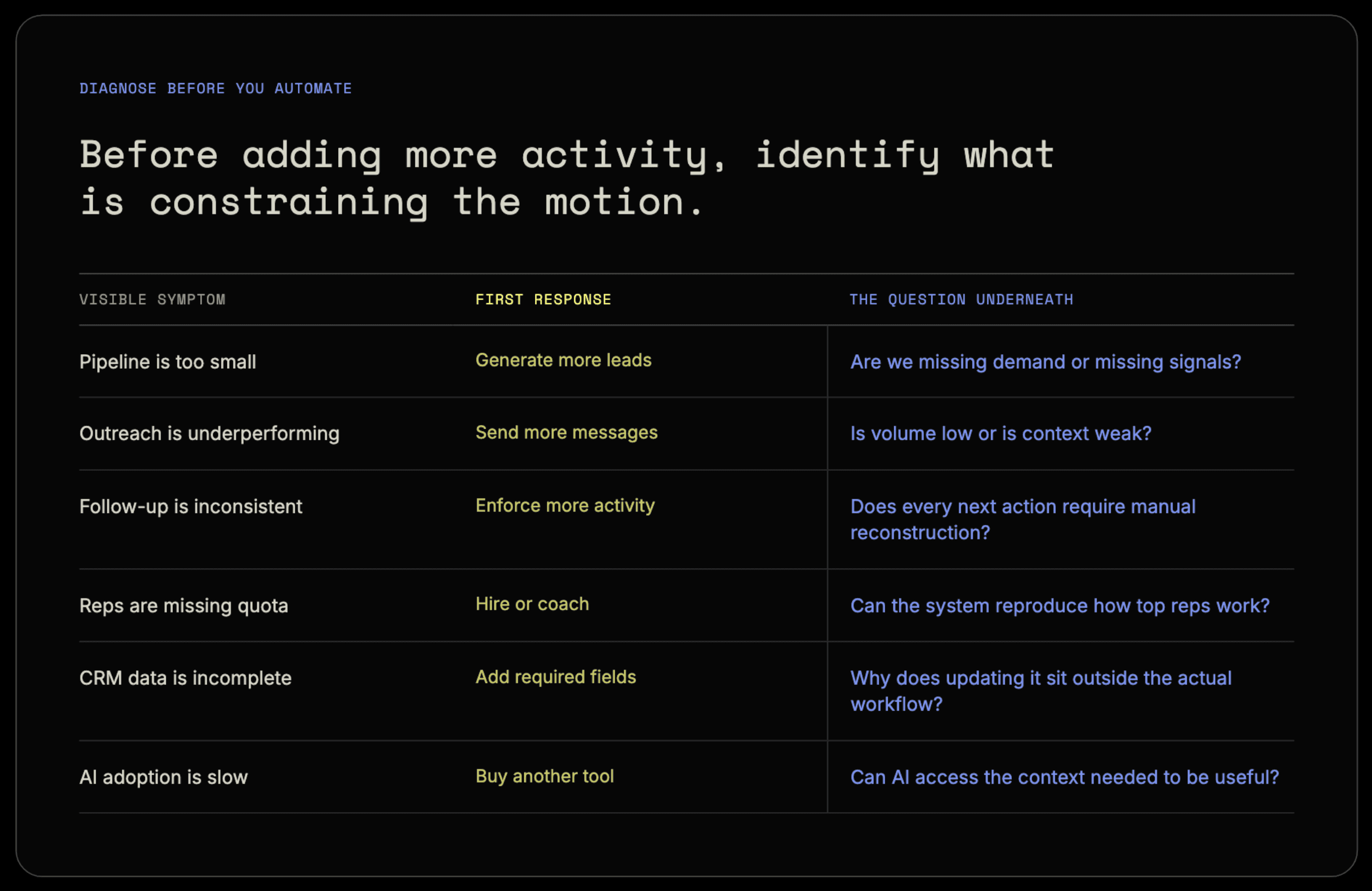
One way to expose the constraint is to ask:
What would break if you had to double revenue without doubling the team?
Would the team run out of leads? Or would it struggle to identify which accounts deserve attention?
Would reps need more opportunities? Or would they need better context on the opportunities they already have?
Would more outreach improve the pipeline? Or would it create more activity that buyers learn to ignore?
Would the CRM fail? Or would the work around the CRM become impossible to maintain?
These distinctions matter because the visible symptom and the actual constraint are rarely the same thing.
A CRO may see inconsistent follow-up and conclude that the team needs more discipline. Looking closer might reveal that the next action depends on information scattered across a call transcript, an email thread, and a customer success note. The rep is not ignoring the process. The process requires too much reconstruction every time it runs.
Another team may believe it needs more top-of-funnel activity. But its best opportunities arrive through market events, leadership changes, existing relationships, and signs of operational urgency that nobody is consistently capturing. The problem is not a shortage of signals. It is the absence of a system for turning those signals into coordinated action.
Diagnosis changes what gets built.
Instead of automating the most visible task, the team can address the dependency limiting the entire motion.
AI should increase the capacity of the motion
Most conversations about AI in sales begin at the task level.
Can it write the email? Summarize the call? Research the account? Update the CRM? Draft the proposal?
Those are reasonable questions, but they are downstream questions. A task can become faster without the sales motion becoming stronger.
The obstacle is increasingly visible in the data. Fifty-one percent of sales leaders using AI say disconnected systems are delaying or limiting their initiatives. Sales leaders also estimate that 19% of their company’s data is inaccessible. A more capable model cannot act on customer context it cannot reach.
AI creates more meaningful value when it is applied to the constraint itself.
Imagine that a company is missing opportunities because useful buying signals are scattered across market news, account activity, CRM history, and the personal networks of its team. An AI-enabled system could monitor those sources, identify changes that fit the company’s actual sales thesis, assemble the relevant account context, recommend a next action, and send it to the person responsible for deciding what happens next.
That is more than automated research. It connects context, pattern recognition, workflow, and human judgment around a commercial decision.
The human role does not disappear. Someone still determines whether the signal matters, whether the proposed action fits the relationship, and what the company is prepared to promise. But that person is no longer spending the same amount of attention finding and assembling the raw material for the decision.
The result is not simply time saved. More of the right accounts can receive thoughtful attention. Useful context becomes available beyond the people who happen to remember it. The team can respond to market changes sooner. Every decision can create feedback that improves what the system recognizes next time.
AI has increased the capacity of the motion because it has reduced a specific dependency inside it.
That is a different standard from adoption. It does not ask how many reps are using an AI tool or how many tasks the company has automated. It asks what the revenue organization can now do reliably that it could not do before.
From a working motion to an installed capability
The hardest part is rarely proving that AI can perform one of these tasks. The harder part is making the new capability work inside the reality of the company.
The system needs the right inputs. It needs to fit the way the team sells. Someone needs to decide where human review belongs, who owns the workflow, how success will be measured, and what happens when the output is wrong. Reps need to trust it enough to use it. Leaders need to know whether it is changing the commercial outcome that justified building it.
This is the gap Forward Deployed Marketing is designed to close.
The work begins by diagnosing the growth constraint with the people closest to it. Then the team builds the smallest useful system that can test whether removing that constraint changes performance. If it works, the system is installed into the actual tools, roles, and decisions of the revenue motion. Ownership is then transferred to the people who will operate and improve it.
The deliverable is not an automation sitting beside the sales process. It is a stronger sales process that the company can run without the original builder in the room.
For the CRO, this requires a different posture toward AI. The job is not to become an expert in every model or tool. It is to become more precise about where growth is constrained, which decisions require human judgment, and what capability the organization needs to build next.
What cannot the current motion absorb?
The sales motion that got a company to product-market fit is often held together by talented people doing more than the formal system can see.
That is the reality of many companies learning to sell.
But the next stage of growth asks the organization to recognize what those people have been carrying. Some of that work should remain human. Some can be supported by better information. Some can be automated. And some needs to be redesigned entirely.
The starting point is not another tool or a general mandate to use more AI.
It is a more honest look at the current motion:
Where does judgment live? What work depends on memory? Which handoffs lose context? Where does volume reduce quality? Which people are quietly preventing the process from breaking?
Your current sales motion got you here. What it cannot absorb will tell you what needs to be built next.
Where would your sales motion break under more demand?
Myosin works with CROs and revenue leaders to identify the constraint, build and install the right AI-enabled system, and leave the team owning what works.
If your sales motion is producing revenue but not scaling fast enough, let’s find out what is holding it back.


