
Learn what to automate, assist, and keep human-led in an agentic marketing workflow, and how Forward Deployed Marketers design the human layer inside AI-enabled GTM systems.
Greg Patenaude
Narrative & GTM Strategist
Jun 30, 2026
Agentic marketing workflows are moving from demos to operating reality.
McKinsey’s 2025 State of AI survey found that 23 percent of organizations are already scaling agentic AI systems somewhere in the enterprise, while another 39 percent are experimenting. Marketing teams are moving quickly too. Salesforce’s 2026 State of Marketing research found that 75 percent of marketers have adopted AI, yet 84 percent still say they are running generic campaigns.
That is the gap.
AI adoption is rising. Agentic workflows are getting more powerful. The marketing stack is becoming more connected, but more automation does not automatically create better marketing.
Once AI can research, draft, distribute, and repurpose work across the stack, the instinct is to automate the whole chain. Build more steps and outputs and just 10x the whole system. The workflow looks impressive because the system keeps moving.
Then someone reads the work.
The campaign is technically complete, but the message falls flat. The claims are too loose and the offer is not quite right. The voice sounds like everyone else. The workflow did what it was told to do, but no one drew the line between what should be automated, what should be assisted, and what needed a human call.
In an agentic marketing workflow, teams need to automate repetitive execution, assist strategic work, and keep judgment, claims, and taste human-led. The teams that win are the ones to design the clearest boundary between AI leverage and human ownership.
The trap is automating the whole chain
Agentic workflows make it easy to imagine a marketing system that runs itself.
The system researches the ICP, summarizes the market and drafts the campaign. It generates the assets, writes the copy, and pushes the work into the calendar.
That promise is real. A lot of marketing work is repetitive, structured, and slow because it moves through too many tools and too many handoffs. AI can help compress that work and remove friction from the parts of the process that never needed much human judgment in the first place.
But the risk starts when every step looks automatable because the system can technically perform it.
That is the wrong test.
The better question is not only, “Can AI do this?” It is, “What happens if this is wrong and no one catches it?”
A bad summary can shape the wrong brief. A weak brief can create the wrong campaign. A generic campaign can become five generic assets. The workflow did not fail. It worked exactly as designed.
That is what makes agentic marketing workflows different from one-off prompts. The issue is not just the output. It is what the output becomes next.
The Myosin AI-enabled GTM framework
Most marketing teams do not need a philosophical debate about AI replacing marketers. They need a practical way to decide where AI belongs in the workflow.
A useful starting point is to divide the work into three layers.
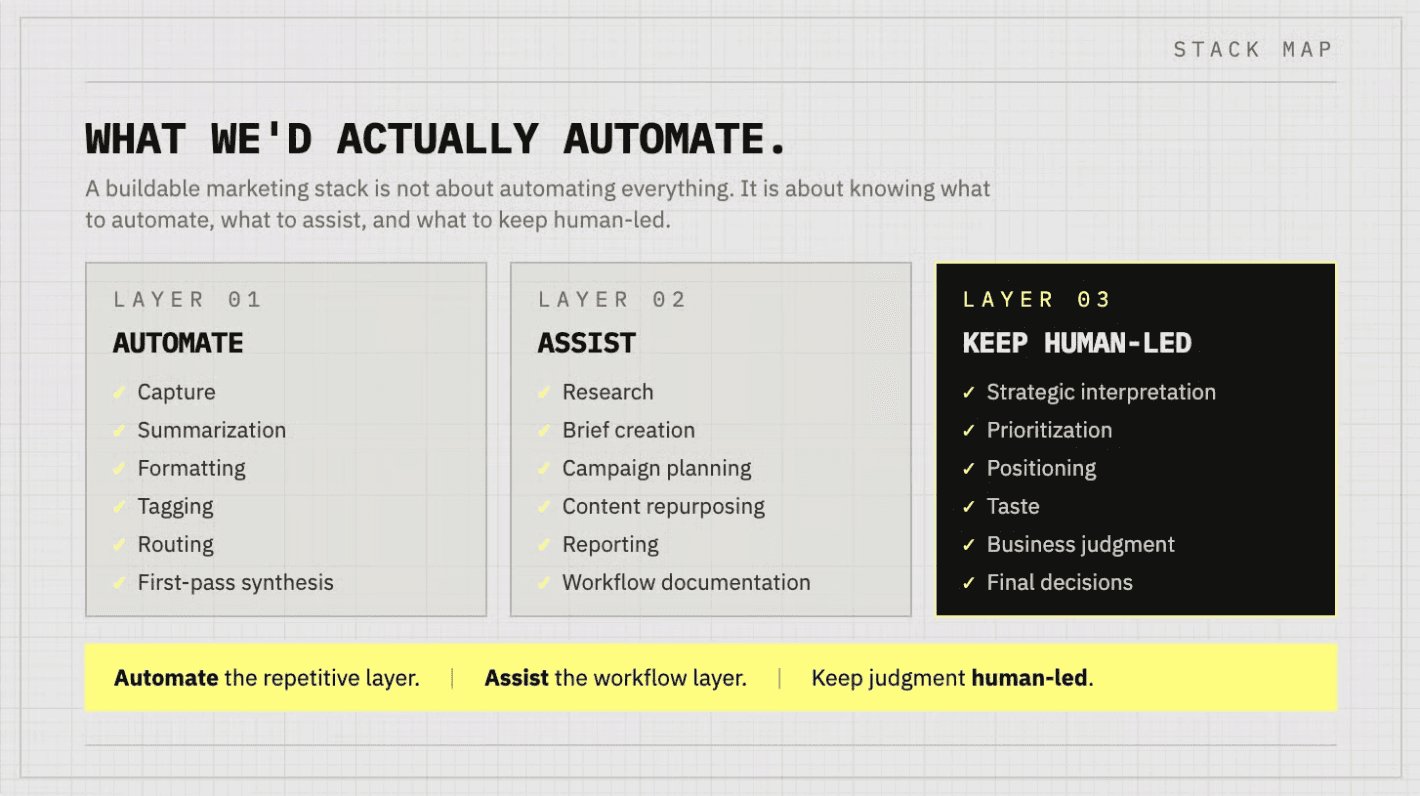
Automation belongs where the rules are clear and the downside of being wrong is low. If the task is structured, repeatable, and easy to review, AI should probably take more of the load. No marketer needs to manually reformat the same transcript, resize the same asset, summarize the same call, or pull the same reporting fields every week.
Assistance belongs where AI can expand the option set. It can generate angles, synthesize inputs, compare patterns, build first drafts, and help a team see more possibilities than they would have seen on their own. But the direction still needs a human. Strategy is not just choosing from a list. It is knowing which option fits the customer, the market, the timing, and the company’s actual point of view.
Human-led work belongs where the cost of being wrong is strategic, reputational, legal, or relational. Claims need ownership. Positioning needs judgment. Taste needs a person who understands the brand and the audience.
The more a task depends on judgment, the closer a human should stay to the decision.
That does not mean a human needs to touch everything. It means the workflow needs to know where human judgment creates the most leverage.
Why the line moves when you go agentic
The automate / assist / keep-human line matters in any AI workflow. It matters more when the workflow becomes agentic.
In a single-prompt world, a human usually reviews the output before it goes anywhere. You ask for a draft and then you decide whether it is useful. The loop is contained.
In an agentic workflow, one output becomes the input for the next step. That changes the risk profile.
If the system misreads the ICP in step one, it can generate the wrong messaging in step two. That messaging can become the wrong content angles in step three, and the whole thing spirals downhill from there.
Agentic workflows do not just produce outputs. They pass assumptions downstream.
That is why scaling AI inside a business is harder than giving everyone access to a model. Deloitte’s 2025 State of Generative AI in the Enterprise found that more than two-thirds of respondents expected 30 percent or fewer of their GenAI experiments to fully scale in the next three to six months. Adoption is moving faster than operational maturity.
Marketing teams feel this gap quickly because GTM work is full of judgment calls. The more autonomous the workflow becomes, the more important those boundaries become. A weak judgment call in a manual workflow creates extra work. A weak judgment call in an agentic workflow can travel.
Where Forward Deployed Marketers fit
This is the role of the Forward Deployed Marketer: to make sure agentic workflows do not just move faster, but move in the right direction.
The FDM is not just a marketer who uses AI. They are the person who designs the human layer inside an AI-enabled GTM system.
Their job is not to manually do every task. Their job is to understand the business context, map the workflow, define the inputs, decide which steps can run on their own, and protect the places where human judgment matters.
They know enough about the customer to see when the output is plausible but wrong. They know enough about the company’s positioning to catch generic language before it becomes the campaign. They know enough about the GTM motion to decide which tasks should be automated, which should be assisted, and which should stay human-led.
That role matters because agentic workflows do not manage themselves. Someone has to decide what the system is allowed to decide.
A Forward Deployed Marketer asks a different set of questions:
What context does this workflow need before it starts?
Which steps are structured enough to automate?
Where should AI generate options instead of making the call?
Where does a human need to approve the direction?
Where could an error compound?
What does good look like at each stage?
Those questions are the work of designing a GTM system that can actually use AI well.
The FDM does not sit outside the AI workflow. They design the human layer inside it.
How to find your human line
Every team has a different boundary between automate, assist, and keep human-led. The line depends on the workflow, the customer, the risk, the maturity of the inputs, and the quality bar for the output.
A good way to find that line is to look for the places where a bad call gets expensive.
What happens if this step is wrong and nobody catches it?
Does this task require customer context that is not written down?
Would we be comfortable shipping this output unreviewed?
Does this step involve a claim, promise, or positioning choice?
Is the output reversible, or does it create reputational risk?
Is AI making the decision, or creating options for a human to choose from?
Does this step depend on taste, timing, or relationship context?
Will this output become an input for downstream steps?
That last question matters most in agentic workflows. If an output becomes the input for another step, the review threshold should be higher. A weak draft is one problem. A weak draft that becomes the source material for ten downstream assets is another.
A human does not need to touch every step. A human needs to own the steps where a bad call compounds.
The goal is knowing where the human belongs
The goal of AI-enabled GTM is not maximum automation.
The goal is leverage.
AI can reduce the drag in the system. It can help teams move faster across the work that used to get stuck between tools, people, and handoffs.
But the system still needs humans to own judgment, taste, claims, relationships, and strategic direction. Those are not inefficiencies to remove. They are the parts of the work that make the output worth trusting.
That is the real work of agentic marketing workflow design.
The teams that win will not be the ones that automate the most. They will be the ones that build the clearest boundary between AI execution and human ownership.
That boundary is where the Forward Deployed Marketer belongs.


