
How to Build an AI GTM Strategy Around a Sales Motion That Already Works
Build an AI go-to-market strategy around a proven B2B sales motion. Choose workflows, preserve judgment, and measure commercial progress.

Your best sellers already know things an AI system would need to learn.
They know which accounts deserve attention, what makes a buyer ready to act, and which customer story helps someone explain the purchase to their colleagues. Before a call, they assemble context from the CRM, previous conversations, market news, and their own experience. Then they decide what matters.
That knowledge helps the company win. Applying it across more accounts is where the work becomes difficult.
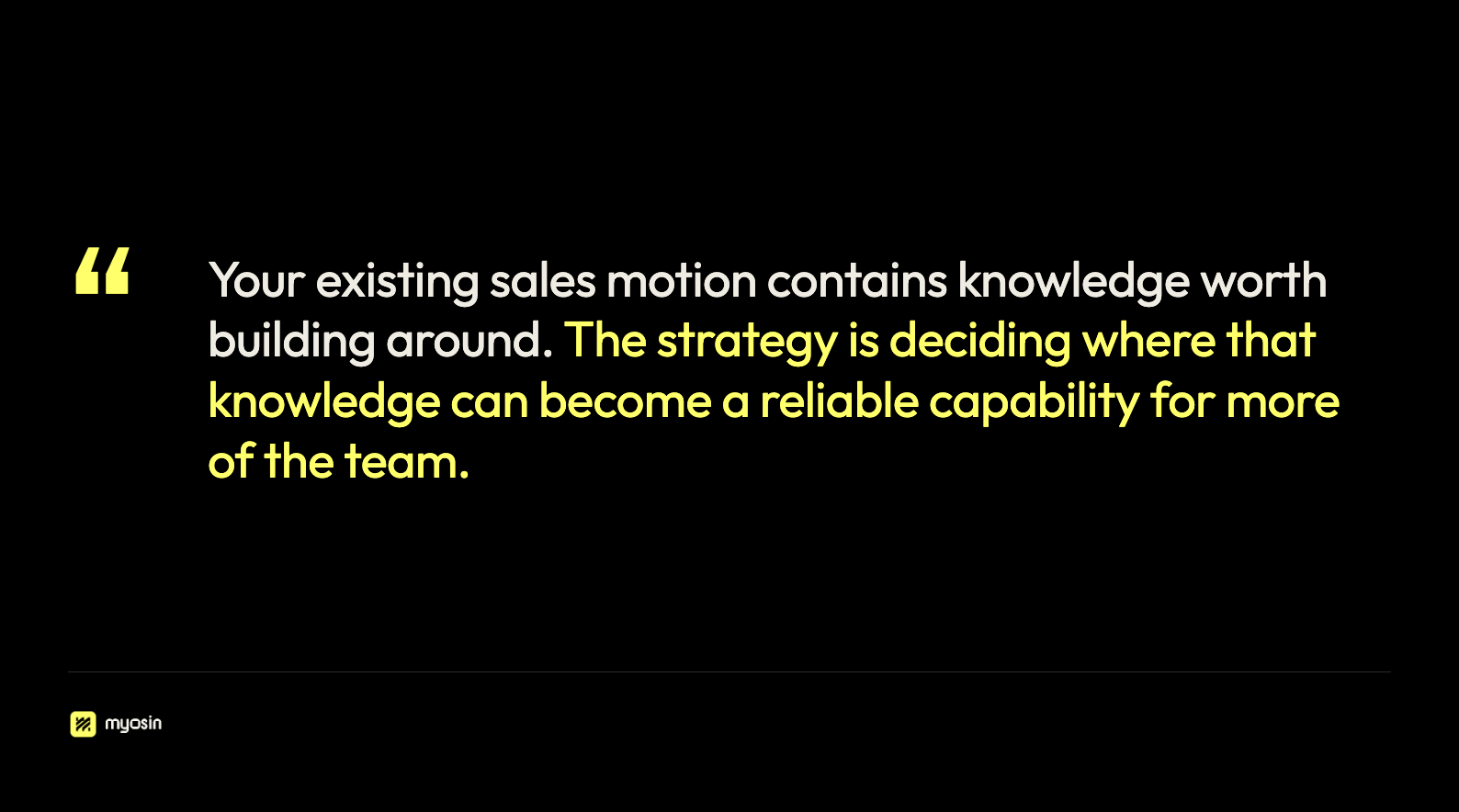
An AI go-to-market strategy should begin with that difficulty. The company has evidence of what works. The strategic task is to decide where AI can help more of the team put that evidence to work, and what would demonstrate that the investment is improving the commercial motion.
What is an AI go-to-market strategy?
An AI go-to-market strategy defines how a company will use AI across sales and marketing to improve specific commercial outcomes. It connects buyer understanding, customer knowledge, workflows, human decisions, and measurement to a set of implementation priorities.
For a B2B company with a working sales motion, those priorities should follow from how customers already buy and where the team struggles to support them.
A company might need to cover more qualified accounts, make customer proof easier to use, or respond sooner when an existing opportunity changes. Each goal requires different information, workflows, and decisions. Choosing a model or buying a platform comes after understanding those requirements.
The first question is how repeatable the current success really is. Several deals closed through a founder’s personal network provide useful evidence, but they may tell you little about how another seller will win the next account. Look for a recognizable buyer, a recurring reason to buy, and a path through the sale that the team can explain and reproduce.
Start with what makes the sales motion work
Before deciding what to automate, examine recent wins alongside stalled and lost opportunities.
Which accounts turned out to be a good fit? What created urgency? Which explanation helped the buyer understand the value? What proof did they need, and who else had to believe it before the deal could advance?
The answers may live in call recordings, CRM notes, customer interviews, emails, and the people closest to the account. Bring those sources together with sales and marketing. The experienced rep’s explanation may belong in a demo. A customer result may need to become a proof sheet. A repeated objection may reveal that the company is attracting buyers whose needs it cannot meet.
A buyer’s question can point to something the growth team should address. As we explored in what sales calls reveal about the growth team’s next priorities, deciding what to change requires understanding the conversation and checking whether the same issue appears across other qualified opportunities.
AI can help retrieve conversations, group questions, and prepare an initial analysis. Someone who understands the business still needs to check the evidence and challenge the interpretation. A concern mentioned once may warrant a better answer for that buyer. A recurring concern across qualified opportunities may justify a broader change.
This work gives the strategy its starting context: who buys, why they buy, what helps them decide, and where uncertainty remains.
How do you choose the first AI GTM workflow?
Choose a workflow that addresses a meaningful constraint in the sales motion and can be tested with the information and people available.
The most visible task is not always the best starting point. A team with inconsistent follow-up might need help assembling account context. It might also have unclear next steps or too many low-quality opportunities. Faster email drafting would affect each situation differently.
Scaling a working sales motion reveals how much depends on experienced sellers researching accounts, remembering past conversations, and coordinating next steps themselves. As account volume grows, that work becomes harder to sustain. The first decision is where the team needs support to keep qualified opportunities moving.
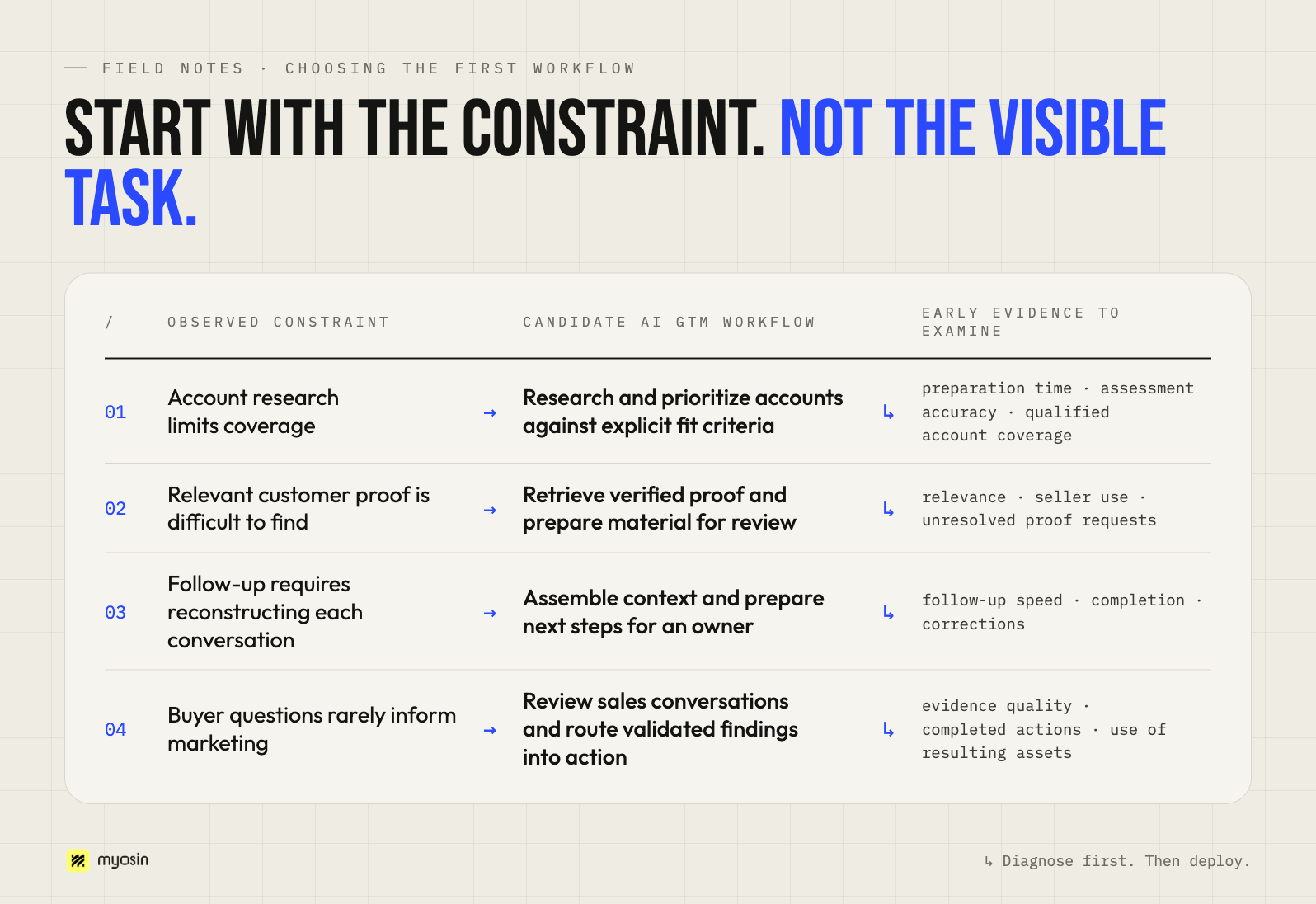
These are hypotheses to test. A missing customer result cannot be solved by a proof-generation workflow. An undefined sales process needs decisions before it needs automation.
Evaluate candidates by their proximity to the commercial constraint, how often the work occurs, the quality of available inputs, who will own the result, and the consequences of an error. A frequent task with accessible evidence and a committed operator is often a stronger first investment than a technically impressive build requiring several unresolved dependencies.
Write down the expected change before building: if preparation becomes faster while remaining useful, the team should be able to give more qualified accounts informed attention. That expectation gives the pilot something concrete to test.
What must the workflow know, and who decides what happens next?
A useful AI GTM workflow needs company-specific context, reliable sources, a defined output, and a person responsible for the next decision.
Consider account preparation. A generic brief can describe a company without helping a seller decide how to approach it. A useful brief needs to connect account evidence to the company’s actual sales thesis.
That may require ICP criteria, product-fit requirements, previous conversations, dated market signals, approved customer results, and examples of briefs sellers have found useful. The system should distinguish a verified fact from an inference and make missing information visible.
The seller then evaluates whether the account deserves attention, which proof is relevant, and what approach fits the relationship.
Define how that work enters the team’s day. What triggers the brief? Where does it appear? Who reviews it? What gets recorded in the CRM? What happens when sources conflict or no suitable proof exists?
Those choices turn a plausible output into an operating workflow. Seller corrections should also return to the system. If a signal repeatedly produces poor-fit accounts, the criteria need to change. If a brief misses a buying role, future research should account for it.
This is where AI for B2B sales and marketing becomes shared work. Sales supplies the context of the conversation. Marketing develops explanations and evidence that other sellers can use. The workflow connects both to a commercial decision.
Where should AI fit in your existing GTM stack?
Put AI where the selected workflow can reach the information it needs and deliver its result into the tools the team uses.
Start by examining existing capabilities. Better CRM configuration, cleaner data, or a defined handoff may resolve part of the problem. A focused integration or custom tool becomes useful when the current stack cannot support a distinctive part of the motion.
Choosing whether to improve your CRM, build beside it, or replace it means looking beyond the initial build. Each option brings ongoing demands: managing access, keeping integrations working, maintaining the software, and helping the team use it.
Sequence the work around its dependencies. Reliable customer facts should exist before a system generates proof assets. Account-fit criteria should be explicit before scoring becomes automated. The team should agree on what follows a meaningful signal before routing it into a seller’s queue.
A broad AI roadmap can obscure those dependencies. The first useful implementation should reveal them through real work and produce evidence for the next investment.
What this looks like at Slip Robotics
Slip Robotics already had market knowledge, customer results, relationships, and a product with a measurable economic case. Selling automated trailer-loading technology into enterprise accounts required helping buyers understand a new category and build confidence across a buying committee.
Myosin worked with Slip to make those existing strengths more usable across its revenue operation.
Account intelligence connects market signals to company fit, product fit, and buying roles. A source-tracked customer fact base supports proof assets. A network map is designed to help the team find potential introductions while leaving outreach with the person who owns the relationship.
The shared data layer sits beside Slip’s CRM, in Slip’s own stack. The system of record remains connected to the work of understanding which accounts deserve attention and what might help them move forward.
At Slip, the work has added more than 4,000 enriched contacts across 129 target companies to the CRM, ranked trade-show leads, and put leadership content in market. The first customer asset set and initial network-map uploads are still moving through review and rollout.
Those are concrete implementation results. Commercial measures, including cost per meeting, speed-to-lead, AE preparation time, and ICP coverage, are being tracked against a baseline established before the work began.
The strategic lesson is in how the system was chosen. Slip’s customer knowledge, buying process, and existing infrastructure shaped what Myosin built. The team’s judgment remains part of how it operates.
How do you measure whether an AI GTM strategy is working?
Measure whether the workflow performs reliably, whether the team uses it, and whether the commercial outcome that justified the investment improves.
Establish a baseline before implementation. For account preparation, that might include time spent, qualified accounts covered, and the quality of the information sellers receive. For proof retrieval, examine whether sellers find and use relevant evidence when buyers ask for it.
Then follow the work into the sales motion. Are qualified conversations increasing? Do opportunities advance? Are fewer promising accounts left unattended? Does the team have more capacity for the conversations that require its attention?
Time saved can be an early indicator. Revenue effects take longer to observe and have other influences. Record the period, the opportunities involved, and changes elsewhere in the business so the team can assess the evidence honestly.
Adoption matters too. A fast workflow whose outputs require extensive repair may consume attention elsewhere. Ask sellers what they trust, what they correct, and what they ignore. Use that feedback alongside performance data to decide whether to improve, expand, or stop the implementation.
Build a capability the team can own
An AI GTM strategy becomes useful through the decisions a team can implement, evaluate, and revise.
Someone must own the workflow, understand its inputs, recognize poor outputs, and know how to recover when it fails. The organization should be able to keep improving it after the original builder leaves.
That is the purpose of Forward Deployed Marketing: work alongside the revenue team to diagnose the constraint, build and test the intervention, install it into the operating environment, and transfer ownership.
Myosin’s certified experts in the Claude Partner Network bring that expertise into client work. At Slip, the team built workflows with Claude Code around the company’s sales process, customer knowledge, and commercial priorities.
For a growth leader, the first move is to name one part of the motion that cannot absorb more demand, define the change that would help, and establish how the team will judge it.
Talk with Myosin about where your sales motion loses capacity and what to build first.


