
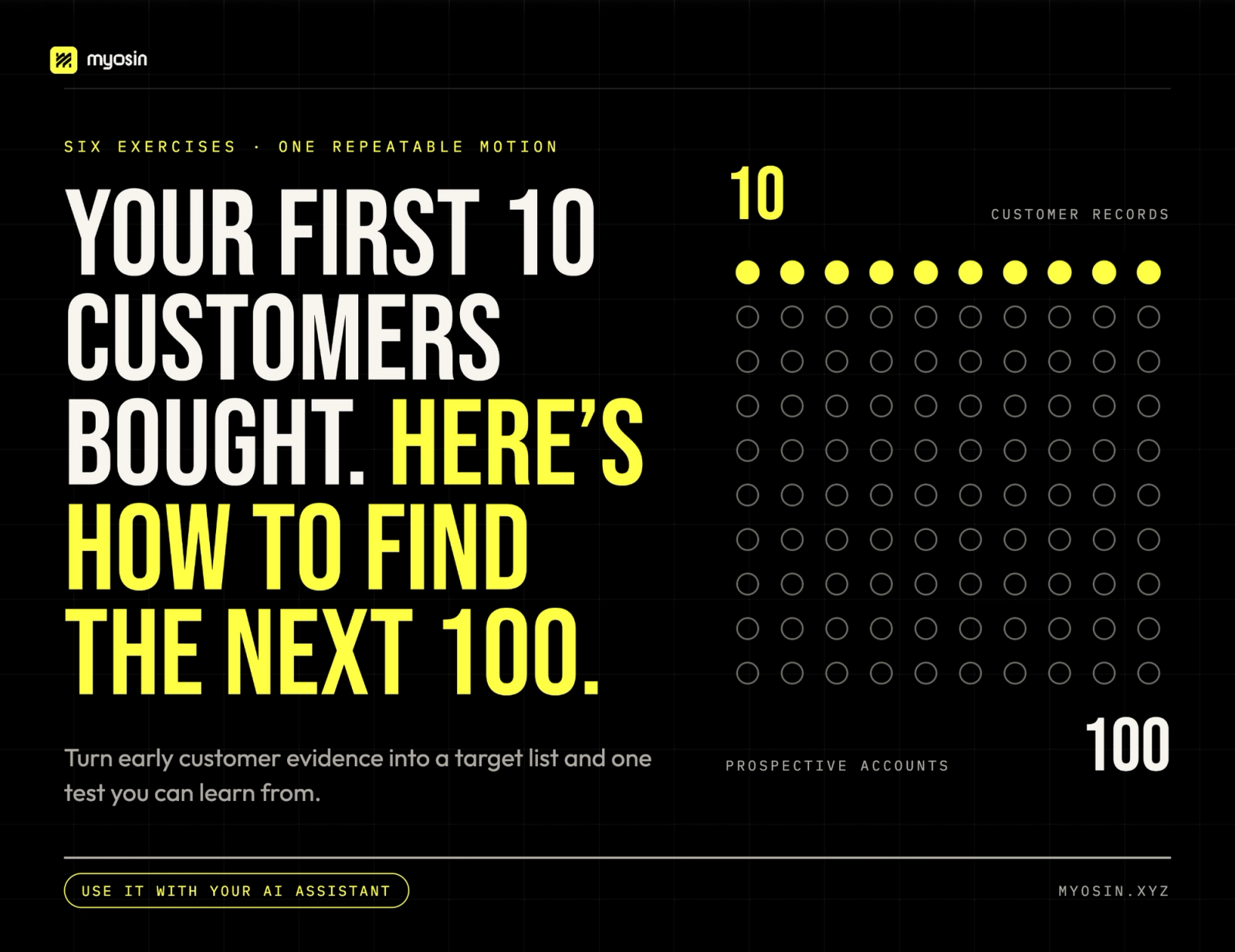
Your First 10 Customers Bought. Here’s How to Find the Next 100.
Turn your early customer wins into a practical plan for finding similar accounts and building a repeatable sales process.

You've built a product and got customers paying for it. You've learned enough about the market to know that people have a problem worth solving, and your product is part of the answer.
Now you want to grow.
Your first ten customers may have come through founder relationships, referrals, a conference, or a handful of sales conversations that turned into deals. Each win helped move the company forward, but finding the next hundred customers presents a different challenge.
You need to understand what made those first customers buy, which companies are likely to face similar problems, and how to reach them without relying on the founder to make every introduction.
The good news is that you already have a place to start.
Your first customers have given you evidence about your market. The opportunity is to turn what you've learned into a repeatable way to find and win more customers.
We created the Myosin Next 100 Customer Toolkit to help you do exactly that. It includes six practical exercises and AI prompts you can use with your own company data to build a target account list and test a customer acquisition strategy.
DOWNLOAD THE FREE MYOSIN NEXT 100 CUSTOMER TOOLKIT
Start with what you know about your first 10 customers
When founders want to accelerate growth, the instinct is often to generate more pipeline. Find more leads, run more campaigns, hire another salesperson, or invest in outbound.
But before you invest in reaching more people, it's worth understanding what made your existing customers buy.
Start with your first ten paying customers. For each one, look beyond the company profile and reconstruct the circumstances surrounding the purchase.
What problem were they trying to solve? Look for the business challenge behind their interest in your product.
What triggered the purchase? Was there a new initiative, operational bottleneck, expansion, or change in priorities?
Who drove the decision? Identify the person who championed the solution and who approved the purchase.
What convinced them to buy? Consider demonstrations, customer evidence, product capabilities, and existing relationships.
You can find much of this information in your CRM, sales notes, meeting transcripts, and conversations with the people who closed those deals.
You may discover that several customers bought because they were expanding into new markets. Others may have needed to replace manual processes as their operations grew. Perhaps a particular product demonstration consistently helped buyers understand the value.
These are useful clues. They also need to be tested.
Ten customers are a small sample, and some early wins may depend on unusual circumstances, including founder relationships, discounts, or custom implementations. Comparing wins against lost or stalled deals can help you distinguish patterns worth pursuing from coincidences.
The objective is to identify three credible hypotheses about who buys your product, what causes them to look for a solution, and what helps them decide.
Find the customers who have a reason to buy now
Once you understand the patterns behind your first customers, you can start defining who to pursue next.
Most companies have some version of an ideal customer profile. It might describe an industry, company size, revenue range, or job title.
These characteristics help narrow the market, but they don't necessarily tell you when someone is ready to buy.
Two companies can look nearly identical on paper while having very different priorities.
Imagine you're selling AI workflow software to growing B2B service companies.
One company recently expanded its team across several locations. Its existing processes are becoming difficult to manage, and operational leaders are looking for ways to improve coordination.
Another company has a similar number of employees and operates in the same industry, but its processes are working well and it has no immediate plans to change them.
Both companies might fit your ideal customer profile. The first has a more visible reason to evaluate your product.
That's why the Myosin guide uses three criteria to identify your next best customer:
Fit. Does the company have the characteristics and problems your product is designed to address?
Trigger. Is there an observable change that makes solving the problem more relevant or urgent?
Access. Can you identify and reach someone who influences or owns the buying decision?
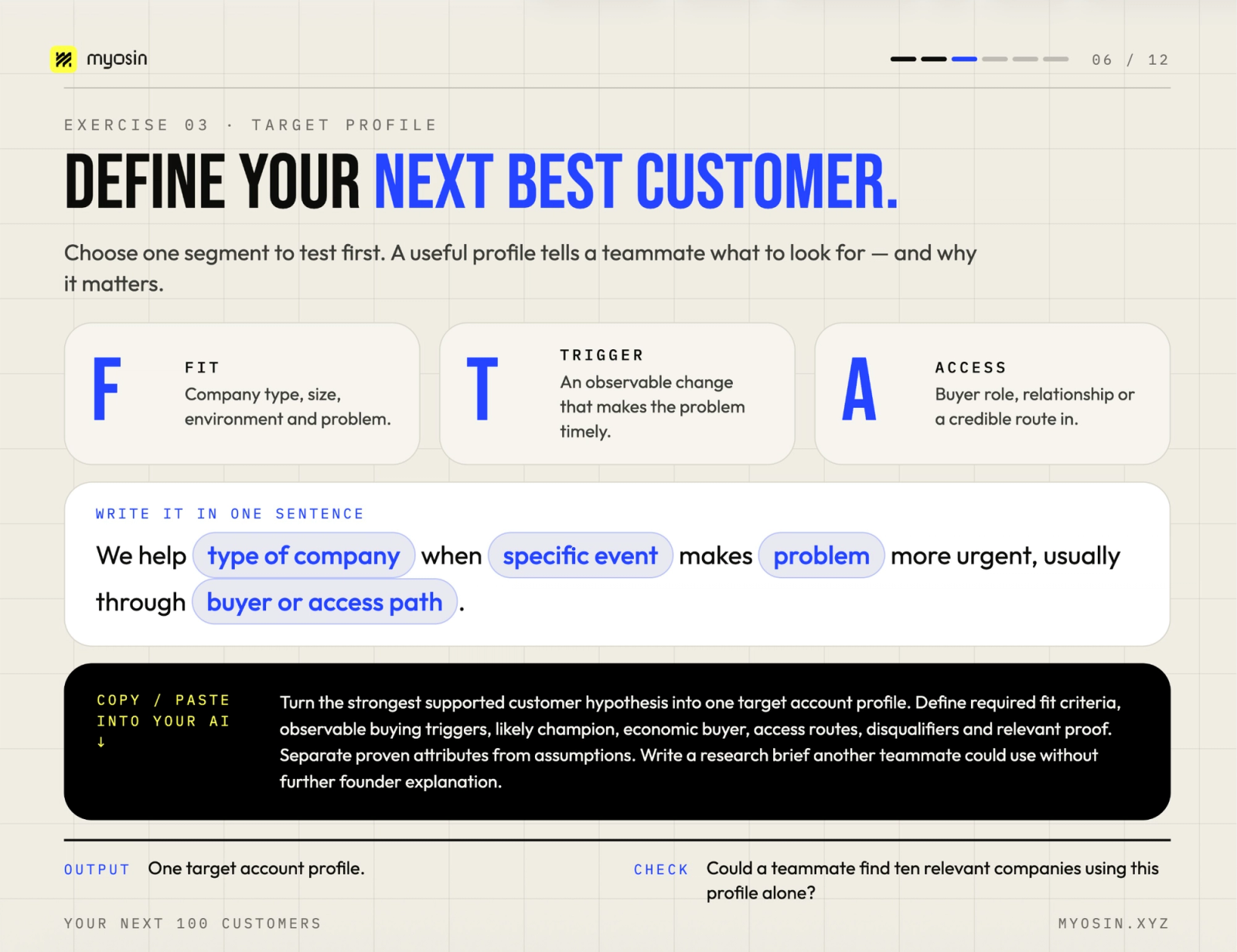
Together, these criteria help you focus on companies that may have a reason to engage, rather than everyone who could theoretically benefit from your product.
Your next step is to define one target customer profile your team can use to research prospective accounts.
Start with one segment. You can always expand later.
Find 100 prospective customers worth pursuing
With a target profile in place, you're ready to build an account list.
The important distinction is that 100 names in a spreadsheet aren't the same as 100 potential sales opportunities.
A useful account list tells you why each company belongs there, what evidence supports that assessment, and who your team should try to reach.
You can begin with company websites, industry directories, hiring announcements, funding news, conference lists, partner ecosystems, and existing relationships.
Look for the signals you identified in your first customer analysis. If customers typically buy when they expand their operations, for example, announcements about new facilities, growing teams, or changing business requirements may be useful research signals.
Then prioritize accounts using Fit, Trigger, and Access.
The goal is to give your sales team a reason to pursue each company and enough context to prepare a relevant conversation.
What this looks like in practice: Slip Robotics
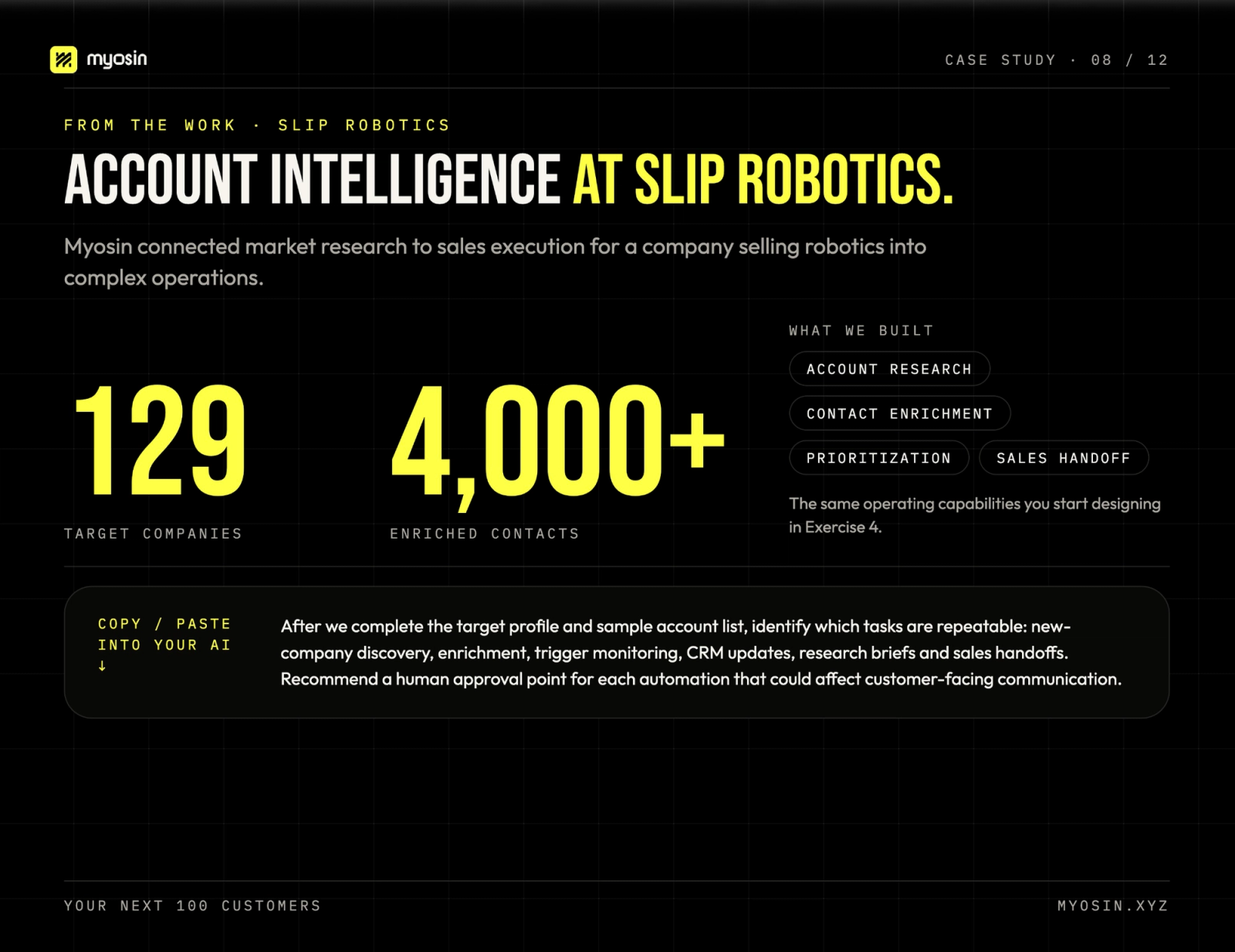
At Myosin, we've worked on this challenge with Slip Robotics, a company bringing robotics into complex logistics operations.
To support its go-to-market efforts, Myosin built account research and sales intelligence capabilities that connected company research, contact enrichment, and prioritization for sales follow-up.
The work included research across 129 target companies and more than 4,000 enriched contacts.
The value of this approach is the system behind the research. Account information becomes more useful when it helps sales teams understand where to focus, identify relevant people, and prepare informed follow-up.
These figures demonstrate the scale of the research and enrichment work, rather than a claim about how many customers were acquired.
You don't need to build the entire system on day one.
Start by identifying 100 accounts using your customer profile, record the evidence behind each recommendation, and prioritize the companies with the strongest signals.
This is also an opportunity to use AI. With the right research criteria and access to relevant sources, an AI assistant can help identify companies, organize account information, and prepare research briefs for review.
The important part is retaining the evidence behind each recommendation. A confidently generated company description isn't a substitute for verified information.
Test one way to reach your next 25 prospects
Now you have a list of prospective customers. How do you find out whether they're interested?
Start small.
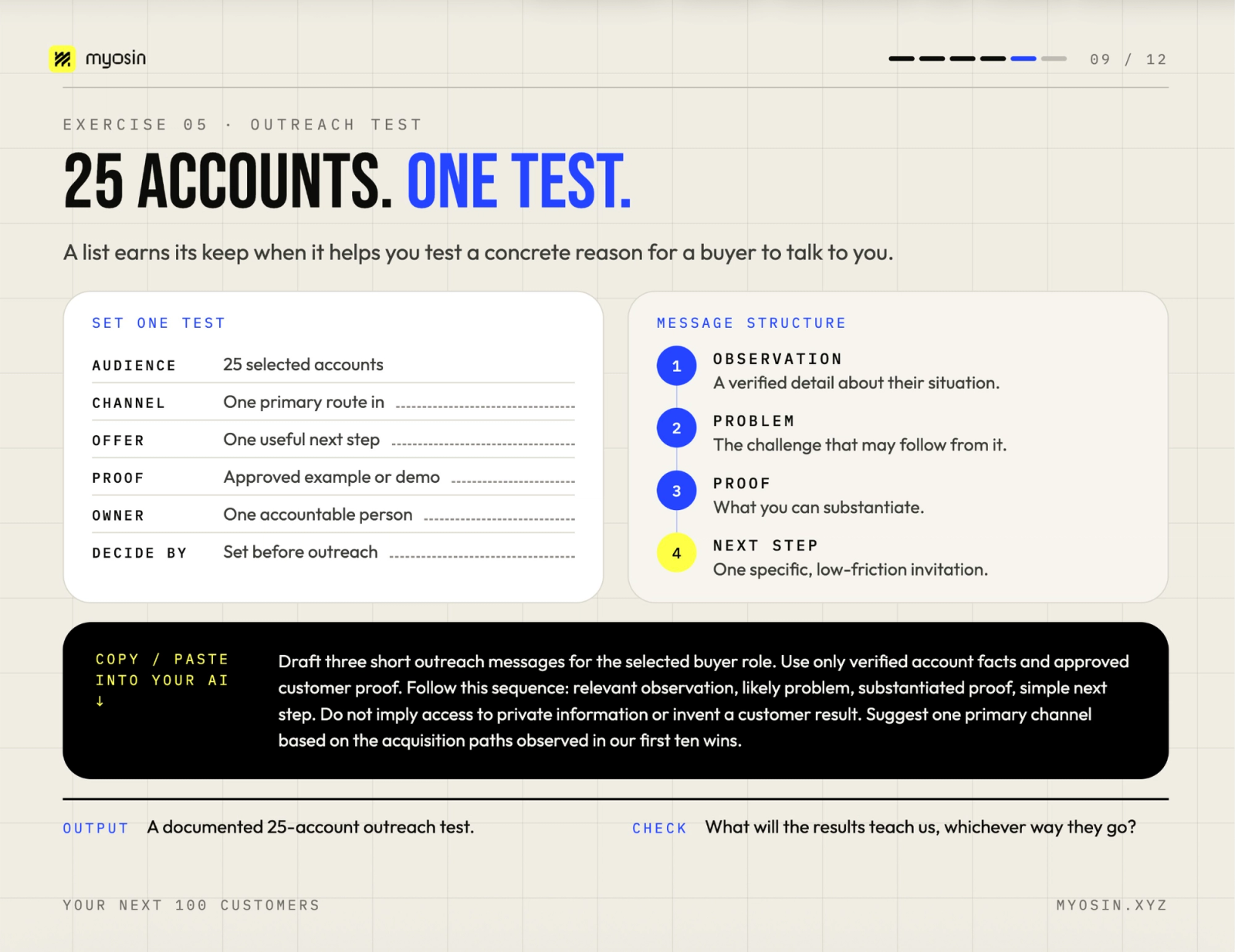
Select 25 accounts from your prioritized list and choose one primary way to reach them.
Your first customer analysis can help with that decision. If early sales came through industry relationships, start by testing warm introductions. If targeted outreach produced qualified conversations, consider building on that approach.
The message should reflect what you've learned about the buyer's situation.
A useful outreach message connects four things:
Observation: Something specific and verifiable about the company.
Problem: A challenge that might follow from that situation.
Proof: A relevant customer example, demonstration, or result you can substantiate.
Next step: A simple invitation that makes sense for the buyer.
For an AI software company, that might mean approaching a growing services business with a specific observation about its expansion, a relevant example of how the product helps manage operational handoffs, and an offer to demonstrate the workflow.
The message should feel informed, not automated.
AI can help research accounts and prepare messages, but someone on your team should verify the facts, evaluate the relevance, and approve what goes out.
Set your success criteria before sending the first message. You want to know what the test is designed to teach you, even if the response is weaker than expected.
Turn what you learn into a repeatable sales process
After the first outreach test, review what happened.
How many accounts responded positively? How many conversations were qualified? Did any become opportunities? What objections or questions came up repeatedly?
The answers help you decide whether to continue, refine your target profile, revise the message, or test a different channel.
A small test won't tell you everything about your market. It can, however, help you make the next decision with more evidence.
Over time, these decisions become the foundation of a more repeatable sales process.
Your team learns which accounts to prioritize, what information to collect before outreach, which proof matters to buyers, and how to improve the approach based on real conversations.
This is where customer acquisition begins to move beyond the founder's personal knowledge.
The company develops a shared understanding of who to pursue, why they might buy, and what to do next.
Download the Myosin Next 100 Customer Toolkit
We've turned this process into a practical guide your team can use.
Your First 10 Customers Bought. Here's How to Find the Next 100 walks you through six exercises:
Analyze your first ten paying customers.
Identify three buying hypotheses.
Define your next best customer.
Research and prioritize 100 prospective accounts.
Run a 25-account outreach test.
Build a 30-day plan based on what you learn.
Each exercise includes an AI prompt and a specific output.
You can work through the exercises with your team, or upload the guide to your preferred AI assistant alongside your company knowledge base, CRM exports, sales notes, and approved customer materials.
Ask the assistant to complete the guide using your company's information, cite the supporting evidence, and identify what still needs verification.
You'll finish with a clearer view of your best prospective customers and a practical plan to begin reaching them.
DOWNLOAD THE FREE MYOSIN NEXT 100 CUSTOMER TOOLKIT
Build the system to reach them
The exercises give you a starting point. The next challenge is making the process repeatable.
As your company grows, account research, buying signals, prospect intelligence, outreach preparation, and sales follow-up need to work together.
That's the kind of system Myosin builds through Forward Deployed Marketing.
We work with technical founders and growth teams to turn customer evidence into practical GTM capabilities, building alongside your team so the process can continue running after the initial project.
Know who your next customers are? Let's build the system to reach them.
Talk to Myosin about building a repeatable customer acquisition process.


