
How to Turn Sales Conversations Into a GTM Learning Loop
Turn sales conversations into a GTM learning loop that improves messaging, sales enablement, and future decisions through customer feedback.

Your sales team learns something about your market every day.
They hear what buyers are trying to accomplish, which questions come up before a purchase, what creates confidence, and where decisions get stuck. Marketing learns from campaigns, content performance, and customer response. Each interaction adds to what the team knows about reaching and winning customers.
But how much of that learning changes what your company does next?
A salesperson may know exactly which explanation helps a hesitant buyer move forward. A marketer may discover that certain messages consistently attract better-fit prospects. That knowledge is valuable, but its impact remains limited when it stays with the person who discovered it.
A GTM learning loop gives teams a repeatable way to turn customer evidence into action, evaluate what happens, and use the results to improve future decisions.
Why acting on customer feedback isn't enough
Consider a B2B company whose sales team keeps hearing the same objection: buyers need stronger evidence of return on investment before they can justify a purchase.
The team shares that feedback with marketing. Marketing develops an ROI-focused asset with customer outcomes, implementation costs, and projected financial returns. Sales receives the material and begins using it in conversations.
The request is complete. The company has listened to its customers and responded with something useful.
But has it solved the problem?
That depends on what happens next.
Are salespeople using the new material? Do buyers find the financial evidence credible? Does it help opportunities move forward? Are the same questions still coming up?
Without those answers, the company knows it produced an asset. It knows much less about whether the asset addressed the underlying buying friction.
This is an important distinction. Customer feedback can lead to plenty of useful activity without producing much organizational learning.
We've previously talked about how sales conversations help growth teams identify what to fix next. Identifying the signal and deciding how to respond are important steps. But the work continues after that first response.
The next question is what the response taught the company.
A learning loop changes what happens next
Let’s think about the company whose buyers are asking for ROI proof.
Over the next several weeks, the team reviews relevant conversations and looks at how buyers respond.
The financial evidence appears to help. Buyers understand the projected return and can see how the investment might be justified. Yet some opportunities continue to stall.
Looking more closely at those conversations, the team notices something it missed in the original feedback.
Buyers aren't necessarily questioning the financial return. They're concerned about how much effort implementation will require, how quickly the product can be deployed, and whether their teams have the capacity to manage the change.
The original diagnosis was reasonable, but incomplete.
That new understanding changes the response.
Instead of producing another ROI asset, marketing and sales work together to explain the implementation process. They develop a clearer deployment timeline, provide evidence from existing customers, and prepare salespeople to address the operational concerns behind the objection.
The team then watches what happens in subsequent conversations.
Do buyers respond differently when implementation expectations are clearer? Are they more willing to involve additional stakeholders? Do opportunities progress, or does another concern emerge?
The results help the team refine its approach again.
This is how a GTM learning loop works. Customer evidence informs a hypothesis. The team takes action, observes the response, and uses what it learns to update its understanding.
Customer evidence → Hypothesis → Action → Buyer response → Evaluation → Updated understanding
The updated understanding informs the next cycle.
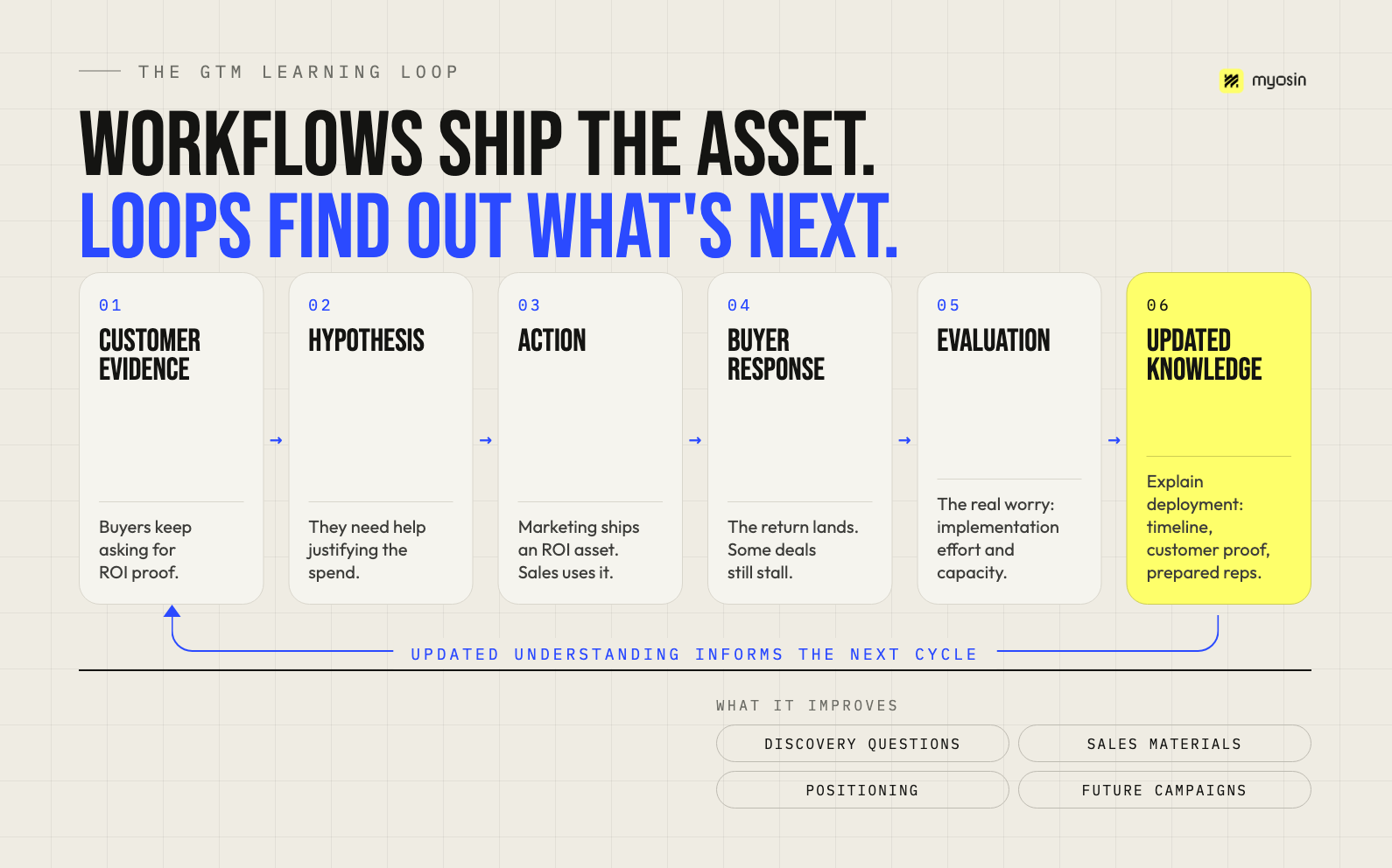
The value comes from what accumulates over time. The team begins with a broad assumption about financial justification. Through successive conversations and responses, it develops a more specific understanding of what buyers need to make a decision.
That knowledge can improve discovery questions, sales materials, positioning, and future campaigns.
A completed workflow gets the new asset into the hands of salespeople. A learning loop helps the organization understand whether it worked, why it worked, and what should happen next.
Make customer learning part of how your GTM team operates
Most growth teams already have the information needed to begin learning this way.
Sales calls, CRM notes, customer interviews, campaign results, and feedback from the field all provide evidence about what buyers want and how they make decisions.
The challenge is connecting that evidence to a consistent process for making and evaluating decisions.
Start with what the team is hearing. Individual comments can be useful, but a recurring concern across similar buyers may reveal a larger problem. Understanding the context matters: who raised the objection, where they were in the buying process, and what they were trying to accomplish.
Next, make the team's interpretation explicit.
In our example, the initial hypothesis was that buyers lacked sufficient financial evidence. The team responded by developing an ROI asset. Making that assumption visible gave everyone something specific to evaluate.
Once the asset was in use, the team needed to look at the results. That meant paying attention to how salespeople used it, how buyers responded, and what happened to relevant opportunities.
Not every change in deal progression can be attributed to a single asset or message. The goal is to gather enough evidence to make a better decision, rather than claim certainty from a handful of conversations.
Finally, the learning needs somewhere to go.
If the team discovers that implementation concerns are more important than expected, that knowledge should inform more than one salesperson's next call. It may change sales guidance, marketing messages, customer proof, or the questions asked during discovery.
This requires clear ownership. Sales provides the conversational context. Marketing helps interpret patterns and develop responses. Someone must also be responsible for reviewing what happened and deciding whether the approach needs to change.
When that responsibility is informal, learning often depends on a few experienced people remembering what they've seen. Growth becomes harder when important knowledge and decisions remain concentrated in individuals.
A learning loop helps move that knowledge into a shared process the organization can continue to use and improve.
How AI helps the learning compound
As a company grows, the volume of customer information grows with it.
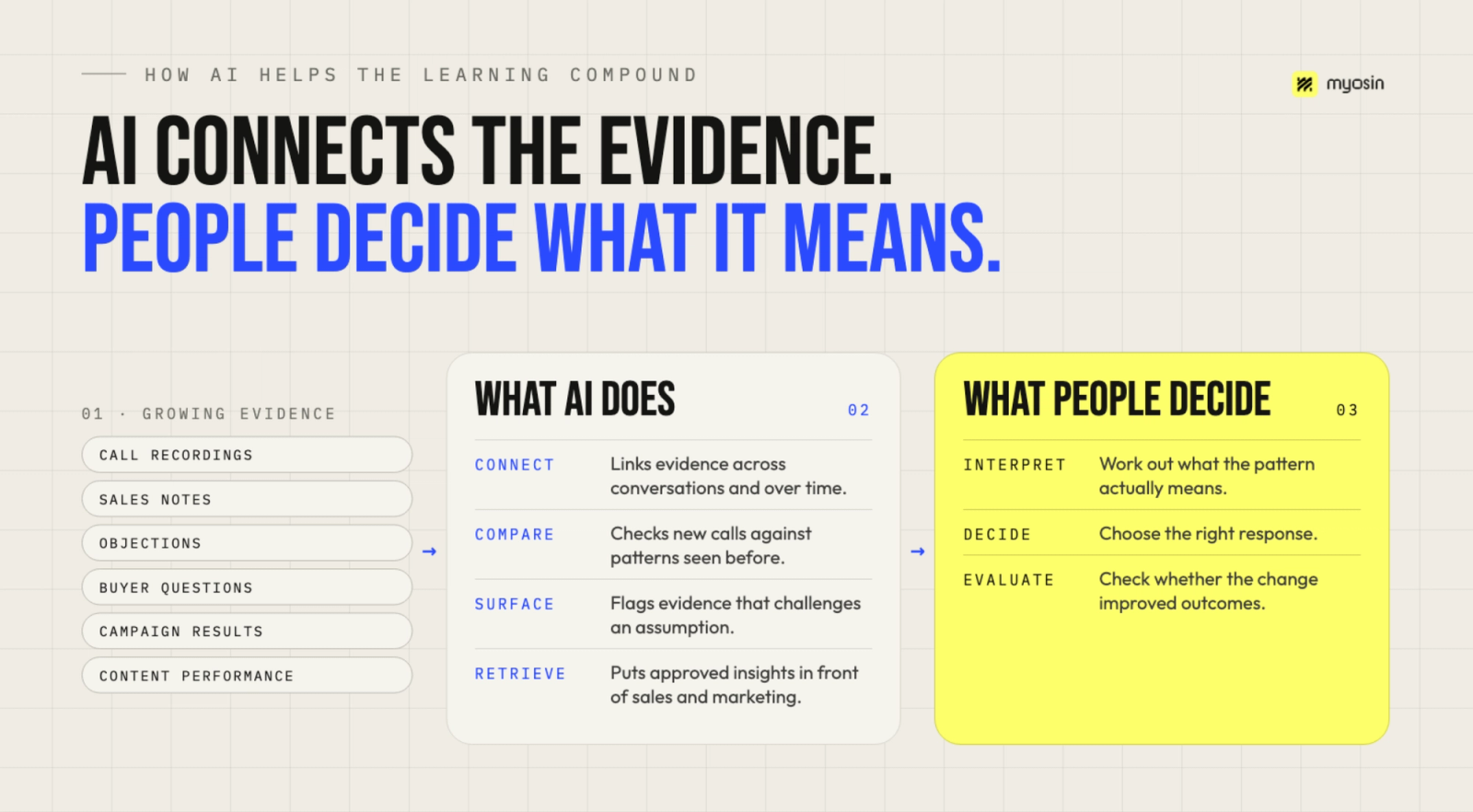
More sales conversations produce more recordings, notes, objections, questions, and feedback. Marketing adds campaign results, content performance, and other evidence about how the market responds.
AI can help connect that information across conversations and over time.
For example, a system could identify recurring objections in sales transcripts, compare recent conversations with previously observed patterns, and surface new evidence that challenges an existing assumption.
It could also make approved customer insights easier to find when a salesperson prepares for an account conversation or when marketing develops a new campaign.
In our ROI example, the system could help identify a shift from questions about financial justification toward concerns about implementation. It could retrieve earlier conversations, show where similar issues appeared, and help the team examine whether its revised materials addressed those concerns.
That reduces the effort required to revisit what the company has already learned.
But interpretation still matters.
An increase in implementation-related questions might reflect a change in the types of customers entering the pipeline. It might follow a product update, a change in pricing, or a different competitive environment.
AI can help surface those patterns and make the supporting evidence accessible. People still need to assess what the evidence means, decide which response is appropriate, and evaluate whether the change improves outcomes.
This is part of the broader shift we’re moving toward with Forward Deployed Marketing: building GTM systems that connect business context, execution, and feedback so teams can operate more effectively over time.
The opportunity is larger than automating the analysis of sales calls.
It's to help the organization retain what it learns, make that knowledge available across the business, and use it to improve future execution.
What did your last GTM decision teach you?
Think about a recent change your growth team made in response to customer feedback.
Maybe you updated a sales pitch, created a new case study, revised your positioning, or changed how you qualify opportunities.
What prompted that decision? What did you expect to improve? What happened after the change was introduced?
And where does that learning live today?
Your team probably already has much of the information needed to answer these questions. The opportunity is to connect the evidence, decisions, and results so the next round of work begins with a better understanding of your customers.
You don't need to build a complex system to start. Choose one recurring buyer concern, make the team's hypothesis explicit, decide what evidence would help evaluate the response, and review what happens.
Then use the findings to improve the next decision.
Over time, those cycles create something more valuable than a growing collection of transcripts, reports, and sales materials. They create an organization that becomes better at understanding its market and responding to what customers actually need.
Build a GTM system that learns
Myosin works with growth and revenue teams to identify where their GTM processes are breaking down and build systems that connect customer intelligence to better execution.
Through Forward Deployed Marketing, we help teams turn fragmented information and manual workflows into repeatable operating capabilities they can maintain and improve.


