
Is Forward Deployed Marketing Right for Your Growth Team?
Is Forward Deployed Marketing right for your growth team? Learn when FDM can help address a growth constraint and build lasting GTM capabilities.

Your team knows how to win customers. You have sellers who understand the market, relationships that lead to opportunities, and customer stories that help buyers see what is possible.
As the company grows, more people need access to what your best operators already know. New sellers need to recognize the right accounts. Customer evidence needs to reach the people having buying conversations. Follow-up needs to happen consistently across more opportunities.
Those demands can expose gaps in a working sales motion. The team is doing more, but it is harder to carry the same judgment and coordination across the business.
Forward Deployed Marketing may be a fit when your company has a growth motion worth building on and needs help identifying what is limiting it. Myosin works alongside your team to diagnose the constraint, build and test a response, and make the resulting capability part of how your team operates.
Where the strain starts to show
Growth leaders often see the symptoms before they can identify the cause.
Account research takes too long. Sellers pursue opportunities that looked promising but were never a strong fit. The people closest to the market know which signals matter, but that knowledge has not made its way into the tools and processes the rest of the team uses.
Customer proof presents a similar challenge. Your company may have strong results and useful stories, but the details live across presentations, account notes, and individual relationships. A seller preparing for a conversation may need to ask a colleague which example applies, whether the customer has approved its use, and where to find the latest version.
Each issue can slow the team down. Each can also point to a different underlying constraint.
Slow account research might be a capacity problem. It might also reflect an unclear definition of the ideal customer or inconsistent information about target accounts. Customer proof may be difficult to find because it has never been organized, or because the team has not yet agreed on which stories are ready to use.
Those distinctions matter. Before improving a workflow, you need to understand what the work is meant to accomplish and what is preventing it from happening reliably.
How Forward Deployed Marketing helps
Forward Deployed Marketing is an embedded approach to improving growth. Myosin works alongside your team to understand the commercial problem and build a response within the environment where the work already happens.
The engagement moves through four stages: diagnose and prioritize, build and test, install, and transfer. The stages give the work direction, while each build produces information that can refine the diagnosis.
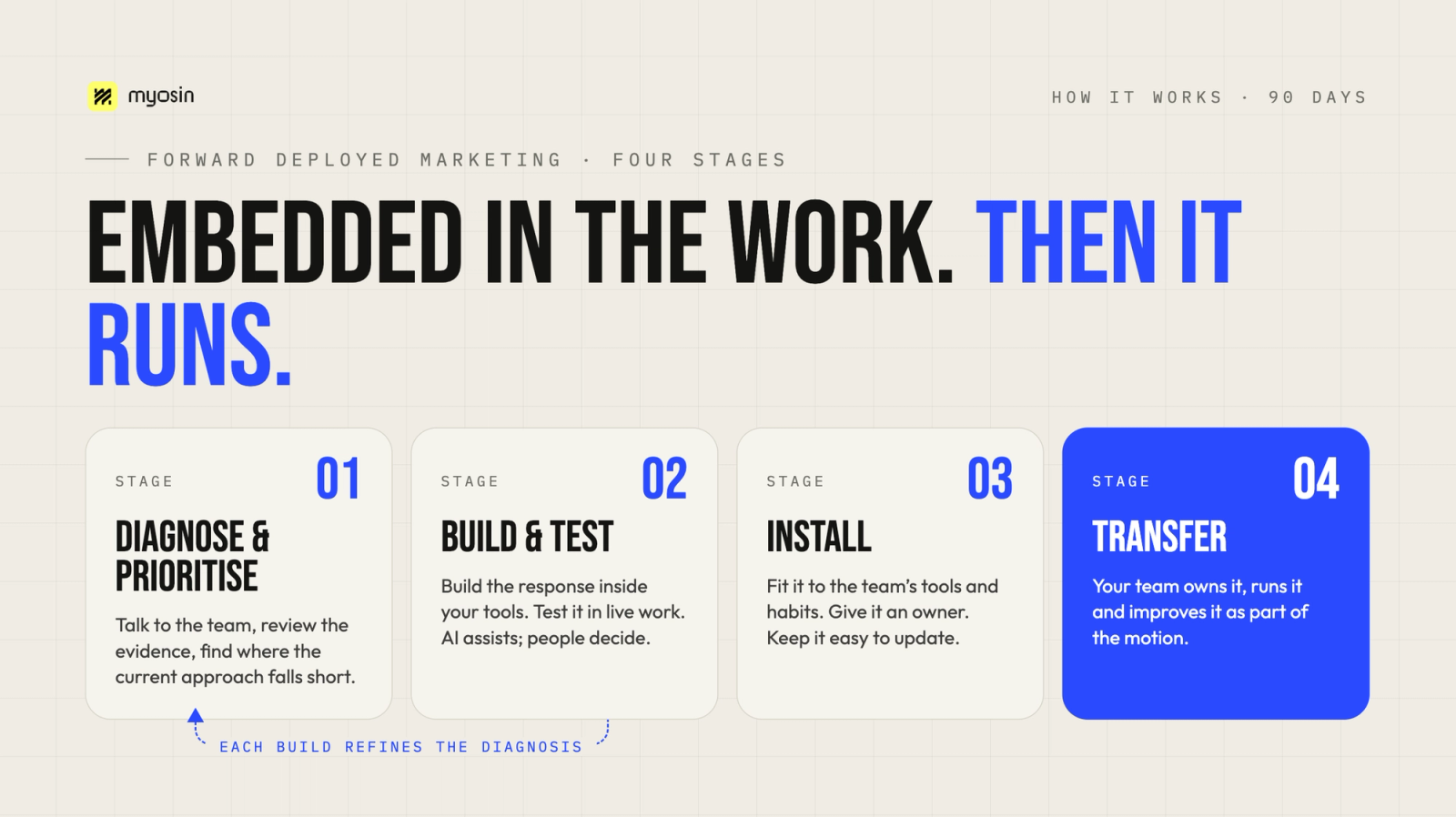
Consider the customer-proof problem. Myosin might begin by talking with sellers and account owners, reviewing the evidence already available, and identifying where proof is needed in the sales process. The team may find that the issue is not a shortage of customer stories. It is that sellers cannot easily connect the available evidence to a buyer’s situation.
From there, the work could involve organizing approved stories by use case, customer challenge, and buying concern, then testing whether sellers can find and use the right material during live opportunities. AI might help organize or retrieve the information. People still decide whether claims are accurate, which stories are approved, and how to use them in a conversation.
The work is installed when the process fits the team’s tools and habits, someone owns it, and new evidence can be added as customers and products change. The team can then continue using and improving it as part of its sales motion.
That is one possible response to one constraint. Another team may need to improve account research, turn sales-call insights into better messaging, or make opportunity follow-up more reliable. The starting point is the outcome the company needs and the reason its current approach is falling short.
Is it the right fit for your team?
FDM is often most useful when a company has a sales motion that works but is becoming harder to repeat or scale. There is enough evidence to understand how the business wins, and enough friction to make a better operating approach valuable.
You may not know exactly what needs to be built. You should be able to identify an area that matters to growth and deserves closer attention: accounts are not being prioritized consistently, customer knowledge is difficult to share, or important next steps depend on manual coordination.
The people closest to the work also need to participate. A revenue leader helps set the priority and make decisions. Sellers, marketers, or operations leads share how the work happens, test what is built, and say where it falls short. Their knowledge shapes the response.
Finally, consider what you want your team to own afterward. If you want an outside partner to help build a capability that your people can use and improve, FDM may be a good fit.
When a different engagement may be the better starting point
If you already know what needs to be executed and want ongoing support for a campaign or channel, an agency engagement may be more appropriate. Myosin can also work with teams in that capacity, managing campaigns and ongoing marketing execution.
If your primary need is senior leadership capacity, a fractional leader or permanent hire may be the right starting point. If your company is still learning who buys and why, customer research and focused experiments may need to come before building a system to scale the motion.
These approaches can work together. The right place to begin depends on what your business needs to accomplish next.

What should your team be able to do afterward?
A successful engagement should leave your team able to do something more reliably than it could before.
That includes knowing where the capability lives, who owns it, how to evaluate its results, and what to do when it needs attention. Depending on the work, the team may receive documented processes, access to tools, review criteria, and guidance for operating and improving the system.
The business result matters too. Before building, Myosin and the team should agree on what the work is meant to change and how they will assess progress. That might include a commercial measure, such as qualified pipeline or conversion, alongside measures of whether the process is being used and completing the work it was designed to support.
Your team does not need to solve every GTM problem at once. Start with the part of your growth motion that matters to the business and still depends too heavily on individual effort. Understanding that constraint gives you a clearer place to begin.


