
Turn Conference Conversations Into Pipeline: Keep It Personal as Your Network Grows
Build AI-powered systems around your network to keep conference follow-up personal, deliver relevant proof, and move conversations toward sales.

Your next meeting starts in ten minutes. You’ve just finished a conversation with someone whose company could be a good fit. They described a problem your team has helped solve before, and you promised to send a customer example.
You connect on LinkedIn and head to the next session. By dinner, you’ve made two more introductions, agreed to a call the following week, and heard a question you wish your marketing team could have listened to.
These are the conversations you came for. Carrying them forward takes work: remembering the details, finding the right material, bringing colleagues up to speed, and making time to reach out.
AI-powered marketing systems can help with that work. Built around how you develop relationships, they give you more capacity to stay prepared, attentive, and personally involved as your network grows.
The opportunity is to build a warm system around your network—one that helps your team respond to the conversations you’re actually having.
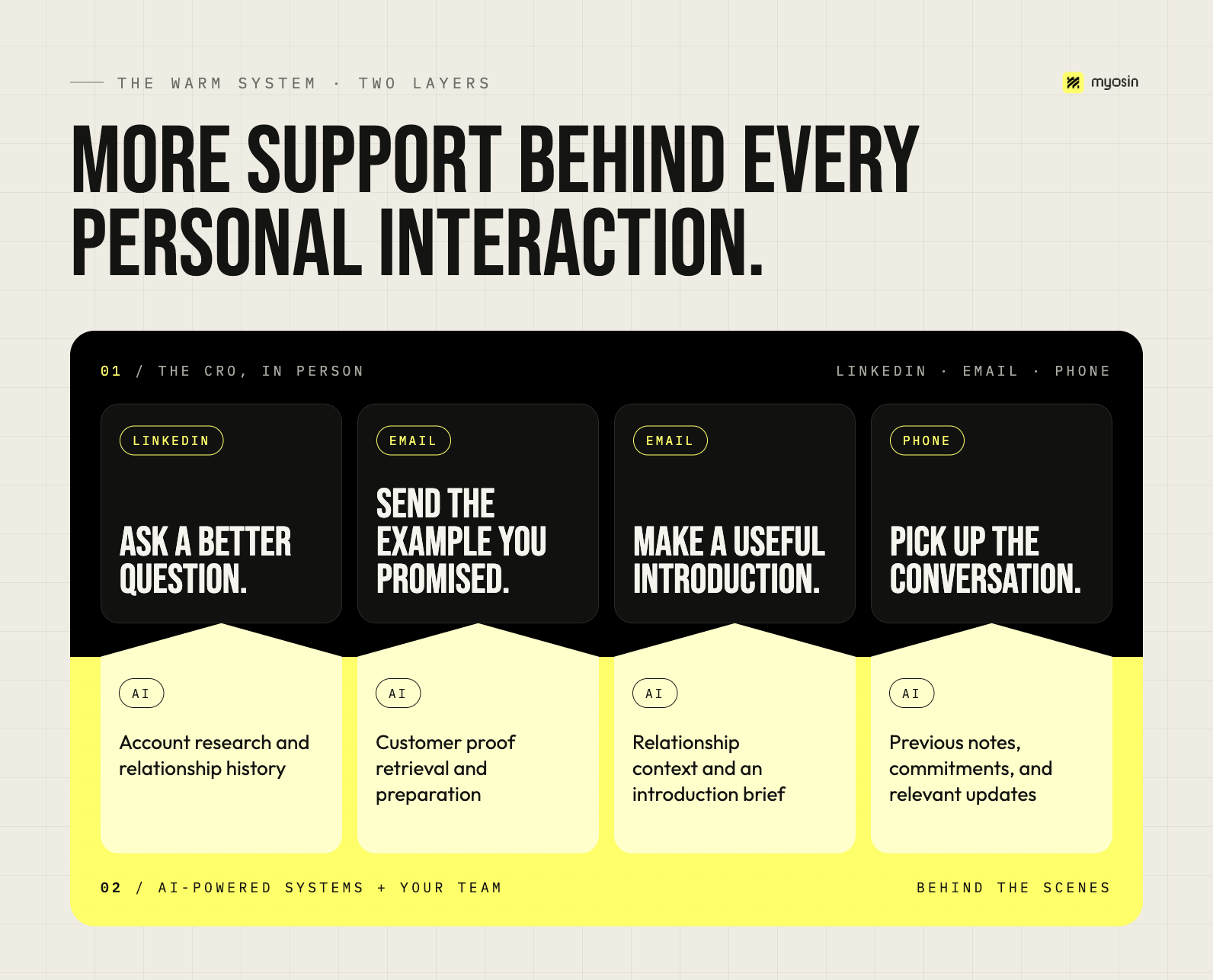
Before the meeting: arrive with context you can use
Imagine opening a short brief before your next meeting. It tells you what the company does, why the account matters, and whether anyone on your team already has a relationship there. It also surfaces a relevant detail from your last conversation.
Perhaps a colleague spoke with the company six months ago. Perhaps there’s an open opportunity, or the person you’re meeting previously asked about an implementation concern. Knowing that changes where you begin.
A preparation workflow can bring together account research, internal notes, relationship history, and approved customer evidence. AI can help assemble that information into something you can read between meetings, with sources available when you need to check a detail.
The useful output is a brief that helps you ask a better question. You still decide what to explore and allow the person in front of you to change your understanding.
Preparation becomes personal when it helps you pick up a conversation rather than start it again.
Making that context available takes work across research, customer evidence, and relationships—the same components Myosin brought together when building a GTM system for Slip Robotics.
At the event: preserve what made the conversation matter
A name and a company tell your team very little about the conversation you just had.
What was the person trying to solve? What made them interested? Did they ask for help, offer an introduction, or simply enjoy the discussion? What did you agree to do?
Consider a hypothetical conversation with a sales leader over dinner. Their company has traction, but the founder still gets pulled into nearly every important deal. They’re trying to understand how to help the wider team sell with the same confidence. You offer to send an example of how another business made customer evidence easier for reps to use.
Afterward, a short voice note could preserve the essentials. A supporting workflow could structure the note, match it to an existing account, and prepare a task for your team: find the relevant example and return it for review.
You confirm the important details. Your colleagues now have enough context to help without asking you to reconstruct the conversation days later.
This is where the system begins to support the relationship. The other person shared something specific. Your team can respond to it specifically.
Between conversations: make it easier to keep your word
Following through on a promise should be straightforward. In practice, the customer example may live in an old presentation, the useful result may need verification, and the colleague who knows the story may be traveling too.
Marketing can build a system around that recurring work.
A searchable collection of approved customer evidence gives the team a foundation. A retrieval workflow can help find the right example, identify what it supports, and prepare material suited to the question. Where evidence is missing, it should flag the gap so someone can investigate.
Returning to the dinner conversation, your team might prepare a short customer story and a few lines explaining its relevance. You review it and send a LinkedIn message yourself:
“Enjoyed our conversation last night. Here’s the example I mentioned about getting customer proof into reps’ hands. Happy to talk through what might apply to your team.”
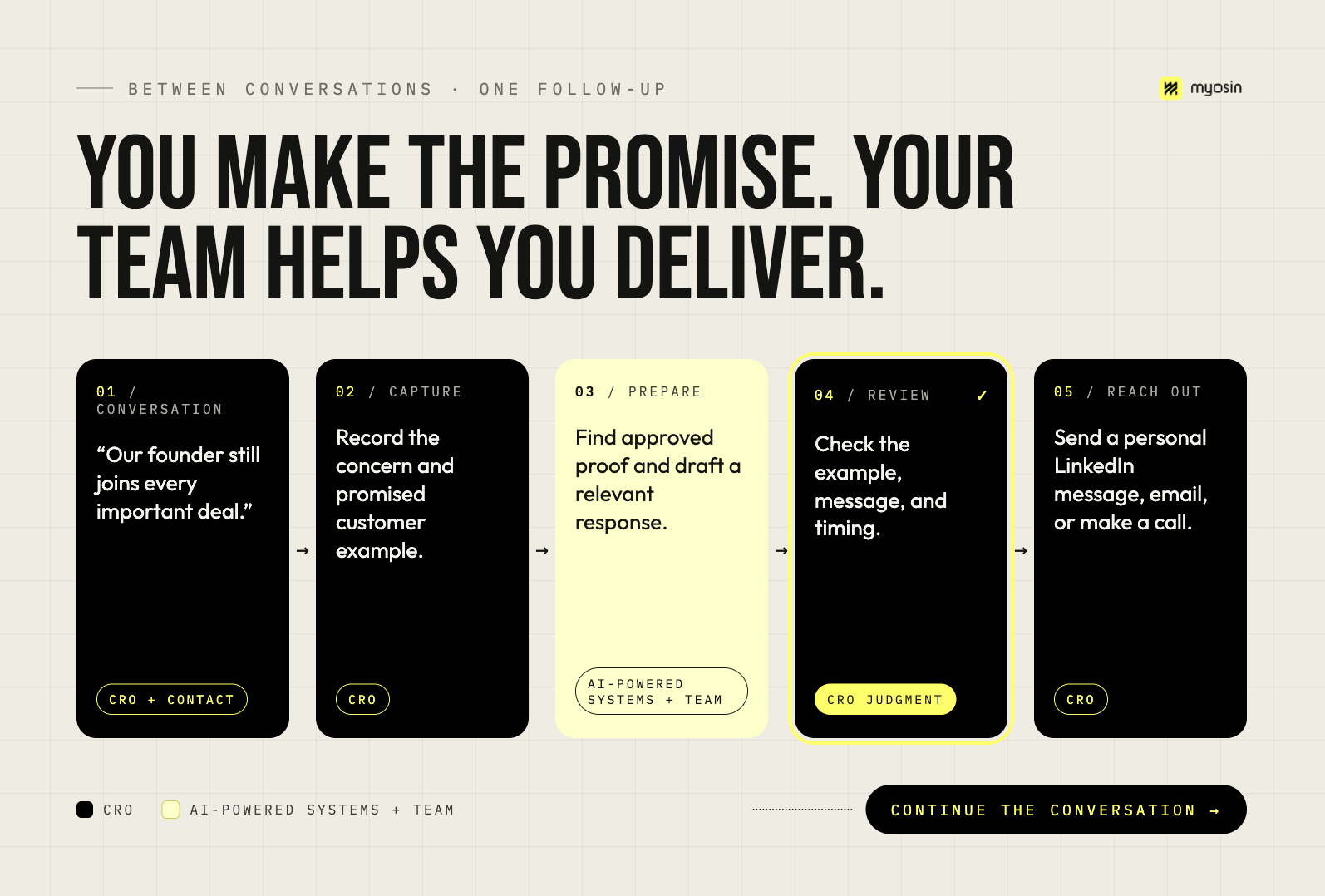
That message feels personal because it follows a real exchange and delivers what you offered. The work behind it makes reaching out easier.
The channel should fit the relationship. A LinkedIn message may be enough. An email may be easier to forward internally. An established contact may appreciate a phone call. Your judgment determines how to continue; the system helps you arrive ready.
After the event: give each relationship a useful next step
Back at work, your calendar fills quickly. The conference has produced several kinds of conversations, each with a different implication.
A potential buyer with a current problem may be ready for a deeper discussion. An existing opportunity may need an answer to a concern raised at the event. A partner may be waiting for a short description they can use to make an introduction. Someone else may have no immediate need but would welcome an invitation to a relevant peer discussion.
Your team needs to understand those differences.
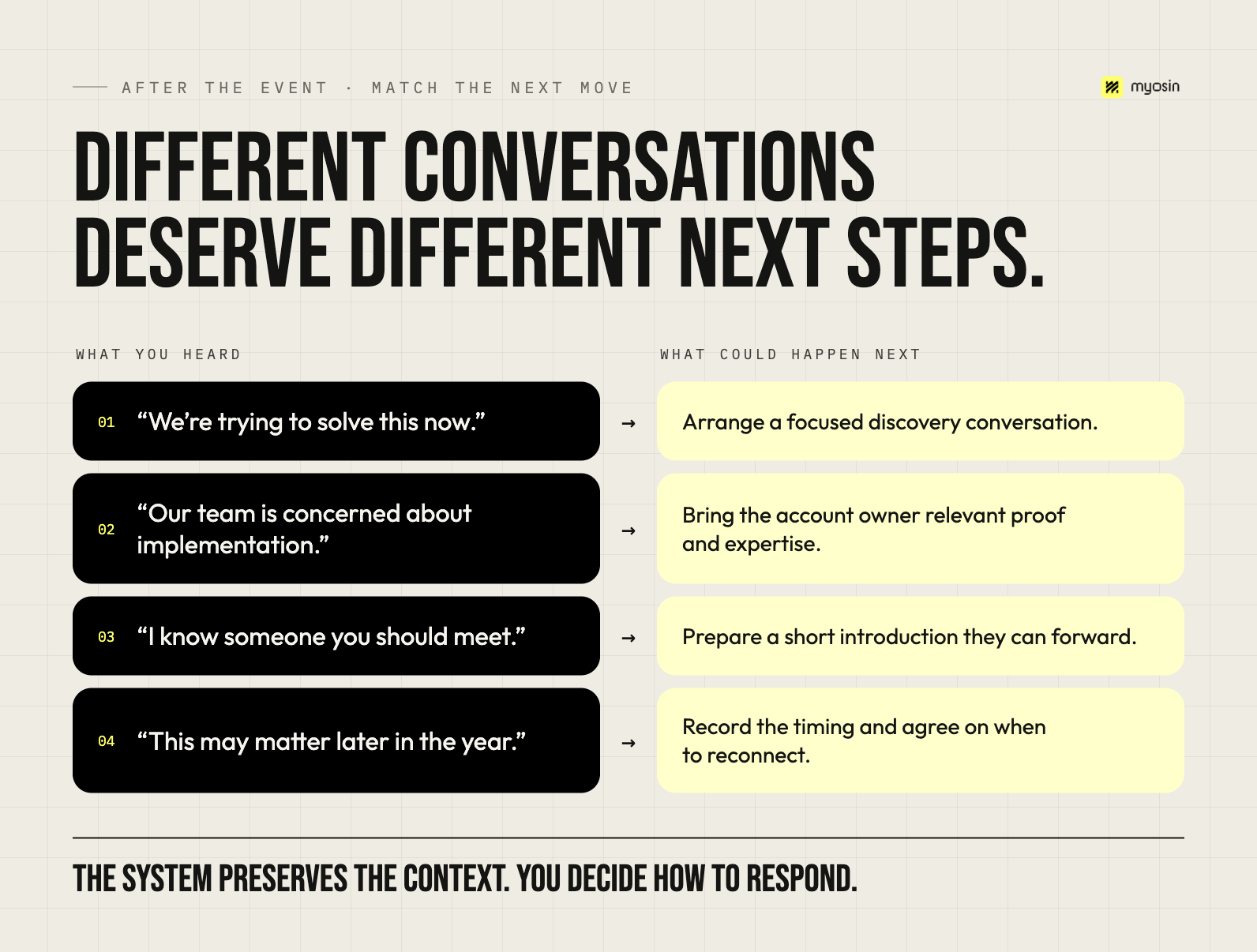
AI can help organize the notes, connect them with account history, and prepare recommended actions. Each action needs an owner and enough context to make a sound decision. You and the account team decide which conversations deserve attention, who should reach out, and what would make that contact useful.
These workflows can sit alongside your existing CRM, connecting the information your team already holds to the decisions and actions that follow a conversation.
A shared view of unfinished commitments also reduces how much depends on your memory. If you promised an introduction, someone can prepare the context. If a colleague should join the next call, they can receive a brief before you make the handoff.
Staying personal also means recognizing when to give someone room. A conversation without a current buying need may deserve an occasional useful exchange. The system should preserve that distinction rather than turn every contact into an urgent sales task.
As an opportunity develops: keep the context moving
The next challenge arrives when more people enter the conversation.
Your contact brings in a colleague. An account executive takes responsibility for the opportunity. A technical specialist joins to answer implementation questions. Each person needs to understand what the buyer is trying to accomplish and what has already been discussed.
The same systems can support that progression. Meeting preparation draws on the latest conversation. Customer evidence responds to new questions. Commitments remain visible. The team updates its understanding as the buyer’s situation becomes clearer. The questions buyers ask can also reveal what your growth team should fix next, from missing customer evidence to an explanation that repeatedly needs clarification.
This gives you more options for remaining involved. You can make a well-timed call, help a colleague prepare, or reconnect with the original contact when your relationship would help move the discussion forward.
Commercial progress should guide how the team evaluates the work. Are relevant conversations becoming qualified opportunities? Are buyers agreeing to meaningful next steps? Does the team resolve questions that previously held deals up? Over time, which opportunities reach a sale?
Messages sent and contacts uploaded can show activity. Evaluating the system also requires looking at what happens in the buying process.
Build around the work that keeps getting stuck
This is a practical starting point for Forward Deployed Marketing.
Myosin works alongside revenue and marketing teams to diagnose where growth gets constrained and build, test, and install systems around the work. A conference makes those constraints easier to see because so many relationships, commitments, and handoffs arrive at once.
If valuable context stays in the CRO’s notes, begin with capture and handoff. If follow-up waits for customer evidence, improve how the team organizes, retrieves, and prepares proof. If every next step waits for the CRO, clarify what colleagues can own and where their judgment is still needed.
Each workflow needs usable inputs, clear responsibilities, review points, and someone who can operate it when information or priorities change. AI handles parts of the work; the team remains responsible for the promises made and the relationships involved.
Start with a recurring point of friction, test the workflow in real use, and assess whether it helps the team carry conversations forward. What you learn can guide the next build.
Your network has value because people know you, trust your judgment, and choose to speak openly with you. Building around that activity gives your team more capacity to honor those relationships.
Before your next conference, look back at the last one. Choose a promising conversation that stalled. Identify the work that would have helped you follow through—and who could have carried it with the right context.
That gives you a concrete place to start.
Where does follow-through get stuck in your team? Bring Myosin a real example. We can help diagnose the constraint and build the workflow around it.


