
What Is Revenue Engineering? How to Build Systems That Scale Growth
Learn what revenue engineering is, how it differs from RevOps, and how AI, data, and connected workflows help companies build repeatable growth.

Revenue engineering is the practice of designing, building, and improving the systems that generate and grow revenue. It connects sales, marketing, customer data, technology, and operational workflows to make growth more consistent, measurable, and scalable.
For companies using AI, revenue engineering can include account intelligence, automated research, sales workflows, lead qualification, and systems that help teams identify opportunities and move deals forward.
The need for revenue engineering often emerges when a company has already figured out how to sell its product.
The founder has won customers. The team knows there's demand. The product is working, and the company is ready to grow.
But making that success repeatable is proving harder than expected.
Salespeople spend hours researching accounts. Customer knowledge is scattered across tools and conversations. Marketing generates leads without enough context for sales to act on them. Promising opportunities stall because the next step isn't clear, or the information needed to move forward is difficult to find.
The company responds by hiring more people, adding tools, or launching more campaigns. Activity increases, but the underlying problems remain.
Revenue engineering approaches growth from a different direction. It examines how information, decisions, and work move through the company, then builds better systems around the sales motion that already works.
Why Revenue Engineering Matters
Early sales success often depends on knowledge concentrated in a few people.
A technical founder understands the product, knows which customers benefit most, and can connect a buyer's problem to a relevant capability. They remember why previous customers bought, which objections came up, and what evidence helped close the deal.
That knowledge makes the founder an effective salesperson. It also creates a constraint when the company starts to grow.
A new salesperson may have access to the CRM, product documentation, and marketing materials, but that doesn't mean they can reproduce the founder's judgment. They still need to understand which accounts are worth pursuing, how to prepare for conversations, what information matters to different buyers, and how to move an opportunity forward.
As the team expands, these gaps become more expensive.
Salespeople repeat research that someone else has already completed. Customer evidence gets buried in documents. Marketing and sales operate from different assumptions about the ideal customer. Managers spend time reconstructing what happened instead of deciding what should happen next.
These problems can look like a lack of pipeline or sales capacity. Sometimes they are. But adding more opportunities to an inconsistent process can make the problem larger.
Before investing in more acquisition, it's worth examining where existing deals are getting stuck.
If the company can already attract buyers, the next improvement may come from making its existing sales motion easier to execute.
That is where revenue engineering becomes useful.
How Does Revenue Engineering Work?
Revenue engineering connects the information a company already has with the decisions and activities required to generate revenue.
Think about what happens before a salesperson reaches out to a prospective customer.
They need to identify a relevant company, understand its business, determine whether it has a problem the product can solve, find the right person, and prepare a conversation that is worth having.
Much of the information required for this work already exists. Some is in the CRM, some in customer conversations, some in product documentation, and some in external data sources.
The challenge is bringing that information together in a way people can reliably use.
Revenue engineering addresses this through four connected parts of the growth system.
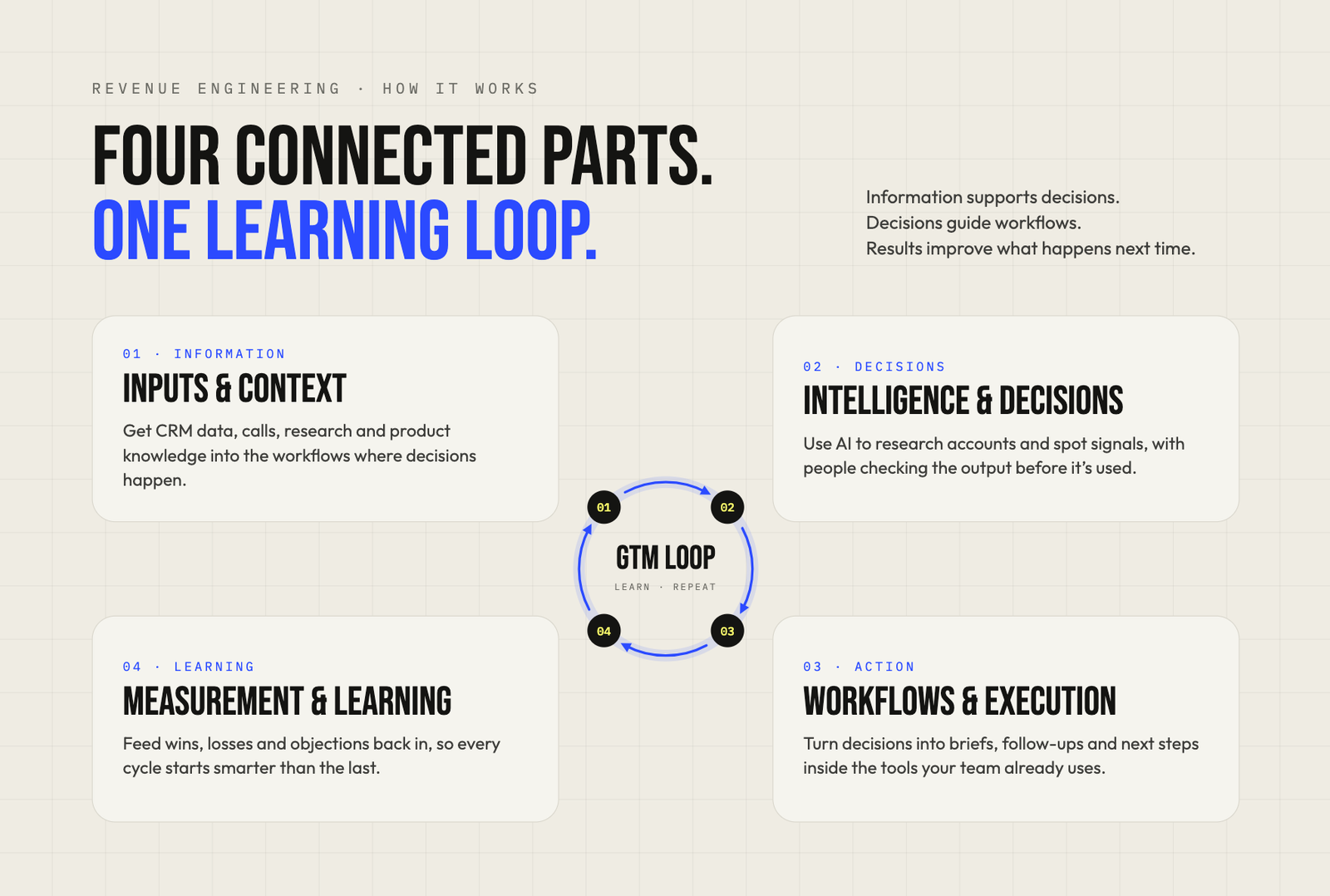
1. Inputs and Context
Every revenue system depends on the quality of the information available to it.
That includes CRM records, account data, customer research, sales conversations, product knowledge, case studies, and the company's understanding of its ideal customer.
In many organizations, this information exists but isn't readily accessible when someone needs it.
A salesperson may know that a similar customer purchased the product six months ago without knowing why the deal closed. A marketer may have detailed buyer research that never reaches the team preparing outbound conversations.
Revenue engineering begins by making useful information available within the workflows where decisions happen.
2. Intelligence and Decisions
Once information is accessible, teams need ways to turn it into better decisions.
Which accounts are most relevant? What buying signals deserve attention? Which customer examples fit a particular prospect? What should a salesperson know before a meeting?
AI can help research accounts, identify patterns, enrich customer records, and prepare recommendations.
But the value depends on the quality of the inputs and the judgment built into the process. An AI agent can produce a convincing account brief from incomplete or outdated information. Without appropriate checks, that can make a salesperson less effective rather than more prepared.
Revenue engineering defines what information matters, how it should be evaluated, and where people need to review or approve the result.
3. Workflows and Execution
Good information matters when it changes what people do.
A revenue engineering system might prepare an account brief before a meeting, surface a relevant case study, identify a missing stakeholder, or create a follow-up task after a sales conversation.
These workflows can connect existing tools such as the CRM, email, knowledge base, and research systems.
The objective is to reduce the manual coordination required to move opportunities forward.
A salesperson should be able to spend more time understanding customers and developing relationships, with less time reconstructing information or managing repetitive tasks.
Myosin's revenue engineering systems focus on bringing these capabilities into the tools and sales workflows companies already use.
4. Measurement and Learning
A working system should improve as the company learns more about its customers.
Sales conversations reveal which problems buyers care about. Won and lost deals provide evidence about positioning, qualification, and the sales process. Repeated objections may indicate gaps in product education or customer proof.
That information can improve account selection, sales materials, messaging, and future recommendations.
The difficulty is that much of this knowledge remains inside individual conversations or CRM notes.
Revenue engineering can make those insights easier to capture and apply, creating a GTM learning loop that connects what the company learns from customers to how it markets and sells.
Together, these four parts create a connected system: information supports decisions, decisions guide workflows, and results improve the information and processes used next time.
AI makes some of these capabilities easier to build, but the discipline is broader than automation. Revenue engineering also requires sound data practices, clear ownership, and people who understand how the system should operate.
Revenue Engineering vs. RevOps vs. Growth Marketing
Revenue engineering overlaps with several established functions, particularly revenue operations, growth marketing, and sales engineering.
The difference is primarily one of emphasis.
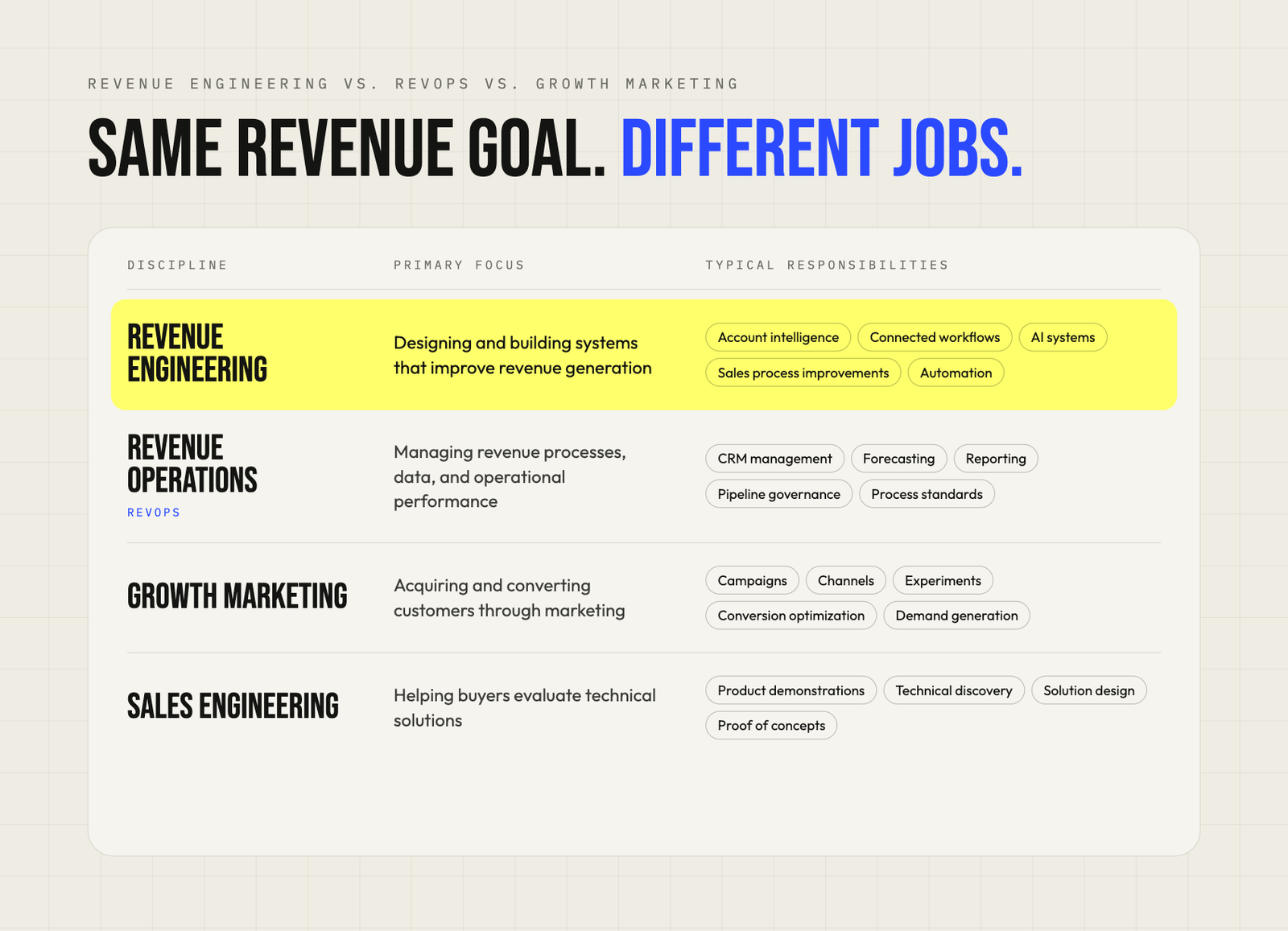
These boundaries aren't fixed. A RevOps team may build sophisticated automation. A growth marketer may design systems that connect campaigns to revenue. A sales engineer may help improve processes throughout the customer journey.
Revenue engineering brings an engineering approach to the work of generating revenue.
Rather than treating individual activities as separate projects, it asks how the processes connecting them can be designed, tested, measured, and improved.
Consider a company whose salespeople regularly prepare account research before outbound conversations.
RevOps might maintain CRM data quality and reporting. Growth marketing might develop the messaging and campaigns that reach target accounts.
Revenue engineering could connect account data, customer evidence, research tools, and sales workflows so that each salesperson receives relevant information and a useful starting point for the conversation.
The functions complement one another.
The important distinction is that revenue engineering focuses on building the capabilities that help the company execute its growth strategy more effectively.
What Does a Revenue Engineer Do?
A revenue engineer works across business processes, data, and technology to improve how a company generates revenue.
Depending on the organization, that might involve connecting CRM systems, building AI-powered research workflows, developing account qualification processes, automating repetitive tasks, or creating tools that help salespeople prepare for customer conversations.
The role requires technical capability and an understanding of how the company wins customers.
A workflow can be technically impressive and still provide little commercial value. Revenue engineers need to understand the sales motion well enough to identify which systems are worth building and how their impact should be measured.
Revenue Engineering Examples in Practice
The easiest way to understand revenue engineering is to look at the problems it solves.
Building an AI-Powered GTM System for Slip Robotics
Slip Robotics develops automated truck-loading and unloading technology for manufacturers and logistics operations.
Its product addresses a specific operational problem, but identifying the companies most likely to benefit requires research.
The sales team needs to understand a prospective customer's facilities, logistics environment, potential operational constraints, and relevant decision-makers.
This is a substantial amount of work, particularly when the company is developing a market for a new category of technology.
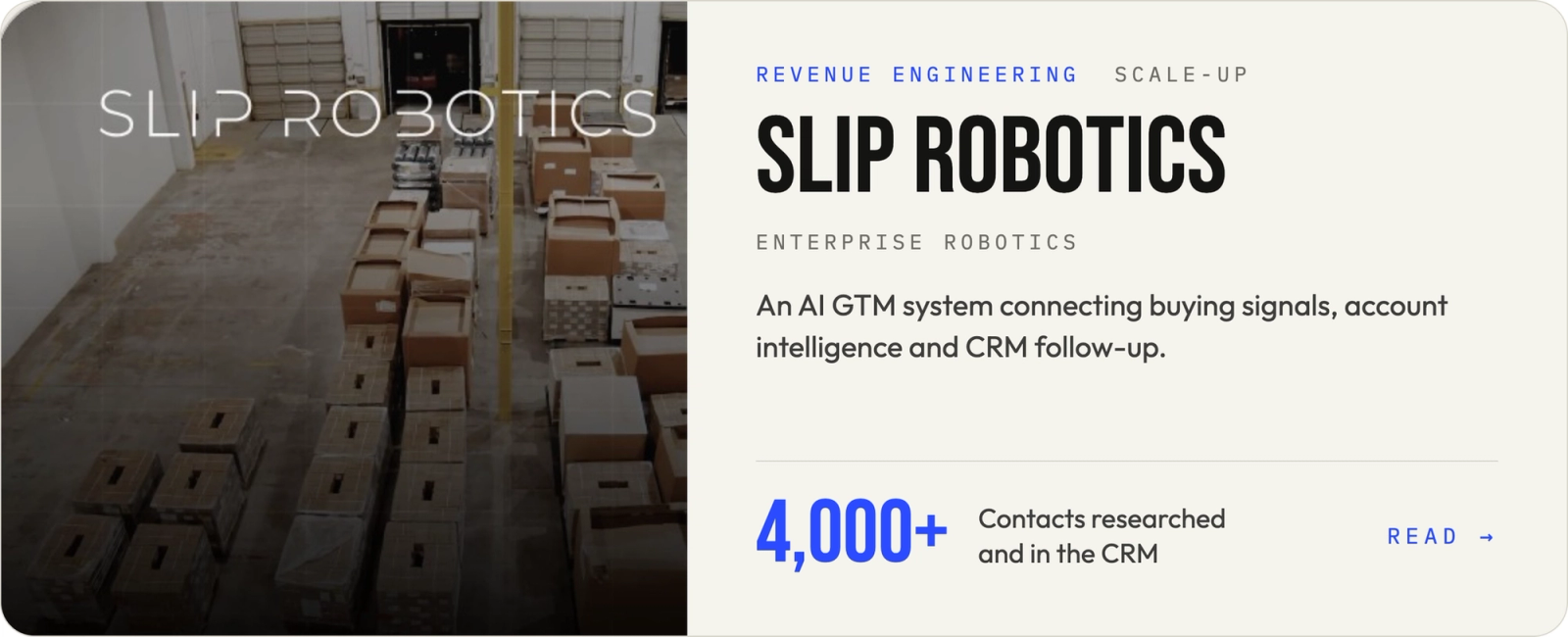
Myosin worked with Slip Robotics to build an AI-enabled go-to-market system supporting account intelligence and sales preparation.
The engagement included researching and enriching more than 4,000 contacts across 129 target companies, mapping relevant buying roles, and developing workflows to help prioritize opportunities.
The work created a more structured foundation for account research and sales preparation.
Instead of treating every prospect as a blank page, the system could bring together relevant information to help salespeople understand an account and prepare for a more informed conversation.
This illustrates an important principle of revenue engineering.
The goal is not to generate the largest possible list of leads. It is to help the team identify promising opportunities, understand why they matter, and make better use of its time.
The documented results demonstrate the account intelligence and GTM infrastructure Myosin built. Measuring the longer-term commercial impact requires tracking how those capabilities affect pipeline development, conversions, and revenue.
Read the Slip Robotics case study for more on the engagement.
Launching a New AI Feature
Consider a B2B software company introducing a significant new AI capability.
The company already has customers and a sales team, but its existing messaging, sales materials, and account segmentation were developed around the original product.
The new feature creates opportunities, but the team needs to understand which customers are most likely to benefit and how to explain its value.
Revenue engineering could connect product information, customer data, existing use cases, and account research to support that work.
The system might help identify relevant customer segments, prepare account-specific talking points, surface supporting evidence, and track how buyers respond.
The product launch becomes a source of information that improves future selling, rather than a campaign that ends when the announcement is published.
Improving Conference Follow-Up
A revenue leader attends an industry conference and has a dozen promising conversations.
During those meetings, they learn about customer challenges, discuss possible solutions, and promise to send relevant examples or make introductions.
Back at the office, they face the administrative work of turning those conversations into next steps.
A connected revenue system could prepare meeting briefs before the event, help organize conversation notes, retrieve relevant customer evidence, and create a follow-up queue with clear ownership.
The leader still decides what to say and how to develop the relationship. The system makes it easier to follow through on the commitments already made.
This is a useful example of how automation can make customer interactions more personal.
When the supporting work is easier to manage, people have more time and better context for the conversations that matter.
How to Build a Revenue Engineering System
One of the most common mistakes in AI adoption is starting with a tool and looking for a problem to solve.
Revenue engineering works better when the process begins with the company's existing sales motion.
The question is where better information, connected workflows, or automation could make that motion more effective.
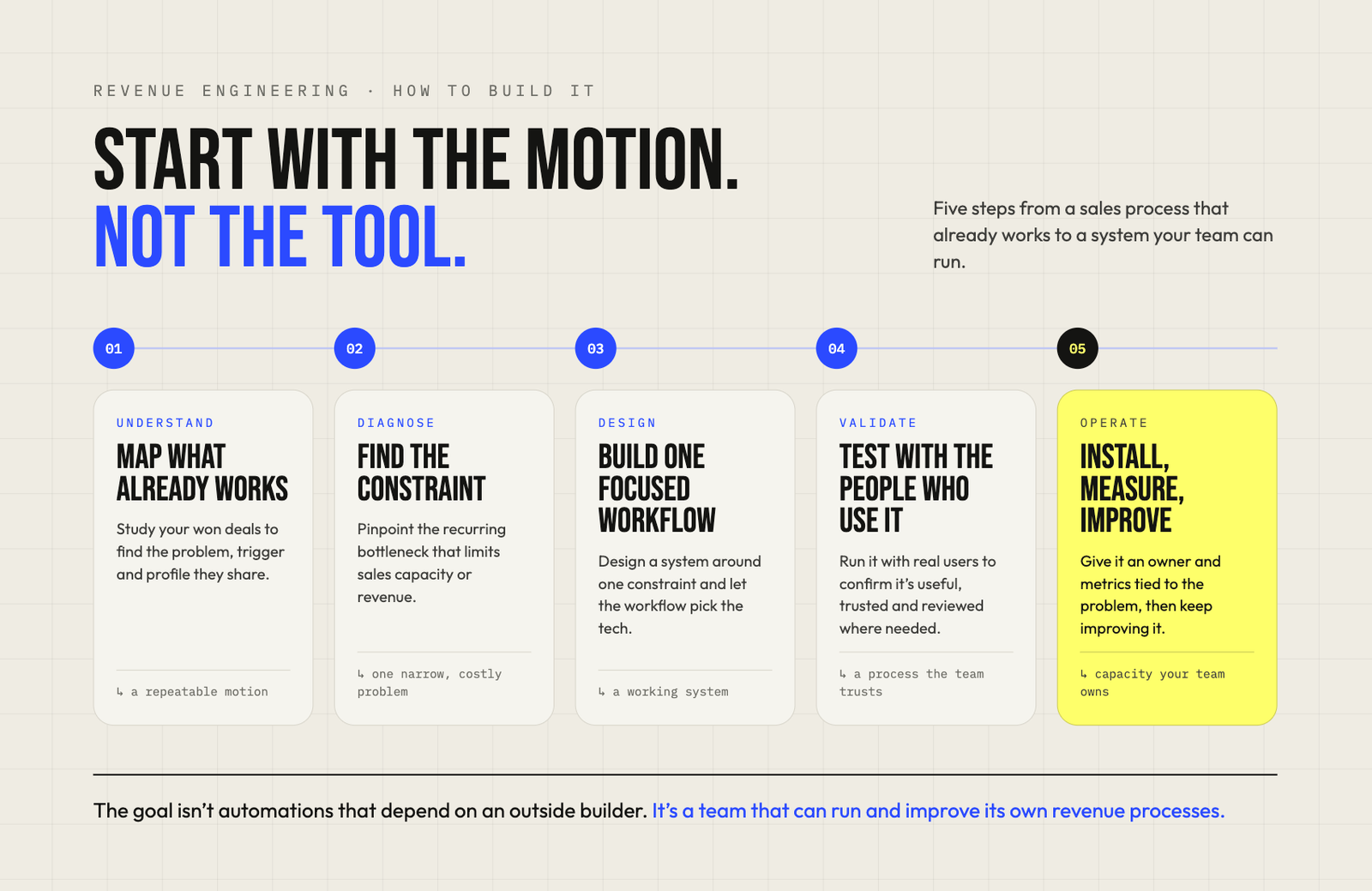
1. Map the Sales Motion That Already Works
Start with the customers the company has already won.
How did those opportunities begin? What made the buyers interested? Which conversations moved the deals forward? What evidence helped customers make a decision?
Look for patterns across several successful sales.
A technical founder may discover that the strongest opportunities share a particular operational problem, buying trigger, or customer profile.
That knowledge provides a foundation for building systems that support a repeatable process.
The goal is to understand what works before trying to scale it.
For a deeper approach, see our guide to building an AI GTM strategy around a sales motion that already works.
2. Find the Constraint
Once the sales motion is understood, identify where execution becomes difficult.
Perhaps account research takes too long. Maybe salespeople cannot easily find relevant customer examples. Opportunities stall because a next step has no clear owner. Or the company struggles to translate founder knowledge into materials and processes the rest of the team can use.
These constraints will differ by company.
The most valuable starting point is usually a problem that occurs repeatedly and has a meaningful effect on sales capacity, customer experience, or revenue.
A narrow, well-understood problem provides a better foundation than an ambitious effort to automate the entire GTM organization.
3. Build a Focused Workflow
Choose one constraint and design a system around it.
If account preparation is slowing the team down, start by defining what a salesperson needs before a customer conversation.
That might include company information, relevant buying signals, CRM history, customer examples, and suggested discovery questions.
Identify where each piece of information comes from, how it should be evaluated, and how the final output reaches the salesperson.
Then build a workflow that supports that process.
AI may help gather, interpret, and organize information. Existing software may handle storage, routing, and task management.
The technology should serve the workflow, not determine it.
4. Test It With the People Who Use It
A successful technical demonstration doesn't establish that a system will work in daily operations.
Salespeople need to trust the information. Managers need to understand how recommendations are produced. Someone needs to know what happens when the workflow makes a mistake or encounters missing data.
Testing should involve the people who will operate the system.
Does the account brief contain information worth using? Does it reduce preparation time? Are the recommendations relevant? Does the workflow fit naturally into the sales process?
Some decisions can be automated. Others require human review, particularly when they involve customer relationships, uncertain information, or commercially sensitive actions.
The purpose of testing is to establish whether the system makes the work better, not simply whether the technology functions.
5. Install, Measure, and Improve
A workflow becomes valuable when the team can reliably use it.
That requires ownership, documentation, appropriate review processes, and a way to understand performance.
The metrics should reflect the problem the system was built to solve.
For an account research workflow, that might include research time, qualified meetings, account coverage, or the quality of sales conversations.
For a follow-up workflow, it could include the time between meetings and next actions, completion rates, and opportunity progression.
Over time, the team should be able to use the results to improve the system.
The strongest outcome is not a collection of automations that depend on an outside builder. It is a company with greater capacity to operate and improve its own revenue processes.
When Does a Company Need Revenue Engineering?
Revenue engineering becomes particularly useful when a company has a product customers want, but struggles to make its sales motion repeatable.
Several patterns suggest it may be time to invest:
Founder-dependent sales. The founder remains essential to too many opportunities because important product and customer knowledge hasn't been transferred to the team.
Repetitive manual work. Salespeople spend significant time researching accounts, preparing materials, updating systems, or coordinating follow-up.
Disconnected customer information. The CRM, sales conversations, customer evidence, and product knowledge are difficult to use together.
Inconsistent execution. Different team members approach similar opportunities in different ways, making it difficult to understand what produces results.
Stalled opportunities. Promising deals lose momentum because information, follow-up, or ownership is missing.
Difficulty scaling the team. Adding people increases activity but doesn't create a corresponding improvement in sales effectiveness.
Not every company needs a substantial revenue engineering investment.
An early-stage business still searching for product-market fit may benefit more from direct customer conversations and learning why people buy.
Revenue engineering becomes increasingly useful when the company has enough evidence to identify a working sales motion and enough repetition to justify building better systems around it.
Even then, the first investment should be proportional to the problem.
One effective workflow that the team uses every day can be more valuable than an elaborate system that nobody trusts or maintains.
How Myosin Approaches Revenue Engineering
Knowing which part of a revenue process needs improvement is one challenge. Building a system that works inside the company is another.
Many teams have access to capable AI models, automation tools, and customer data. What they lack is the time or technical capacity to connect those resources into workflows that people can reliably use.
Myosin approaches this problem through Forward Deployed Marketing.
Our team works alongside founders and revenue leaders to understand how their business generates customers, identify the constraints limiting growth, and build systems around the work that matters most.
The approach has three phases.
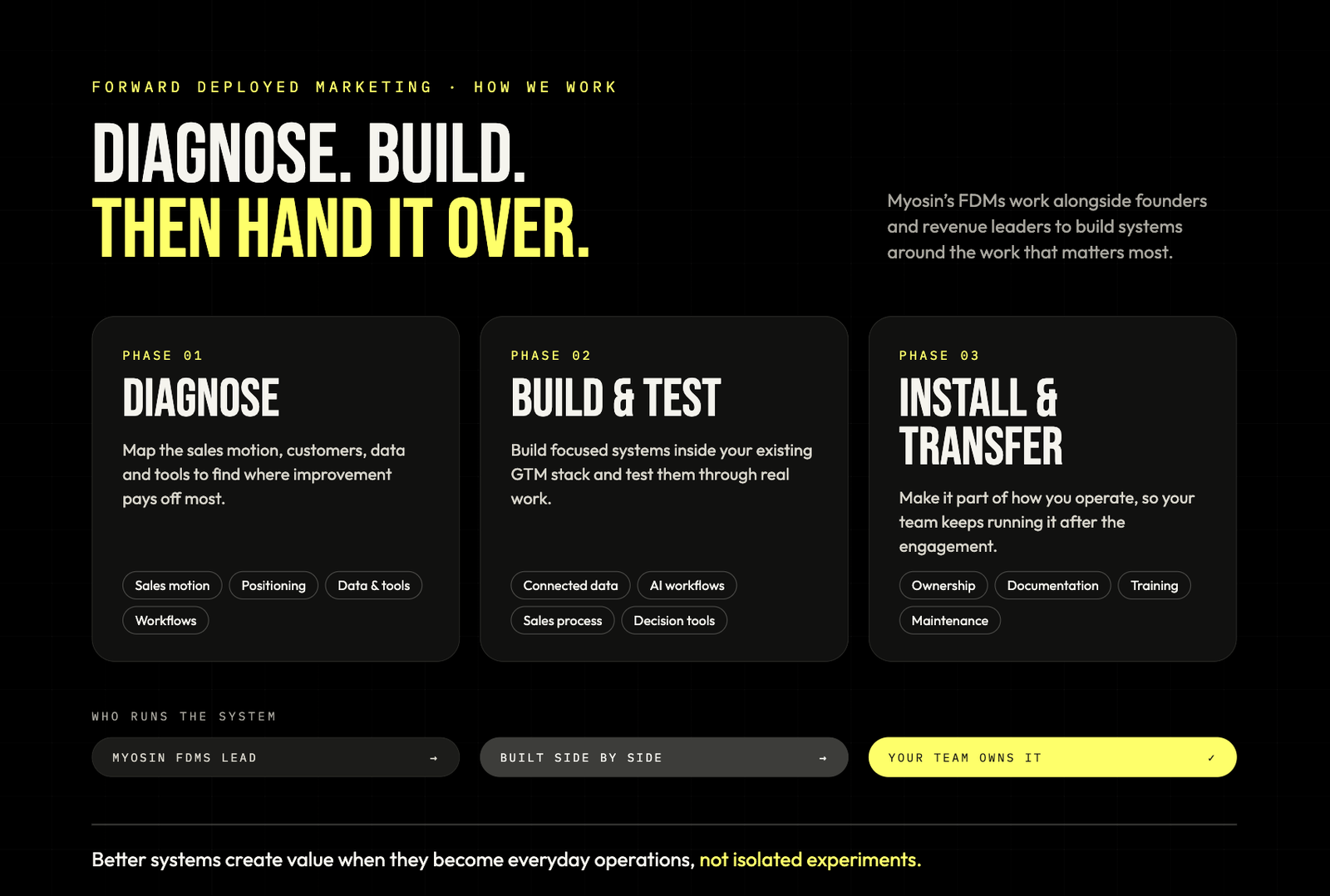
Diagnose
We start by understanding the company's existing sales motion, customers, positioning, data, tools, and workflows.
The purpose is to identify where improvements could have the greatest commercial impact.
That might be better account intelligence, more effective sales preparation, stronger customer evidence, or a more reliable process for developing opportunities.
Build and Test
We develop focused systems within the company's existing GTM environment.
That can include connecting data sources, building AI-powered workflows, improving sales processes, and creating tools that help the team make better decisions.
These systems are tested through actual work, with feedback from the people who will use them.
Install and Transfer
The final step is making the system part of how the company operates.
That means establishing ownership, documenting workflows, training the team, and creating the processes needed to maintain and improve what has been built.
The goal is for the company to develop capabilities it can continue using after the engagement.
Revenue engineering creates the most value when better systems become part of everyday operations rather than remaining isolated experiments.
Getting Started With Revenue Engineering
If your company has customers and a working sales motion, you already have useful evidence about how revenue is generated.
Start there.
Look at a handful of recent opportunities. Examine how they began, what helped them move forward, and where work became difficult.
Pay particular attention to the things your best salespeople know or do that the rest of the team struggles to reproduce.
You may find that the next improvement doesn't require another campaign, a larger prospect list, or a new sales platform.
It may require a better way to connect the information and workflows you already have.
Revenue engineering gives companies a way to build those capabilities deliberately, test whether they improve performance, and make them part of a more repeatable growth system.
The result should be a team that can do more of what works, with better information, clearer processes, and less dependence on any one person.
Build a Better Revenue System
Myosin works with technical founders and revenue teams to diagnose growth constraints and build AI-powered systems around their existing sales motion.
Explore Myosin's Revenue Engineering Services or Start with a Growth Systems Audit to identify opportunities for improvement.


